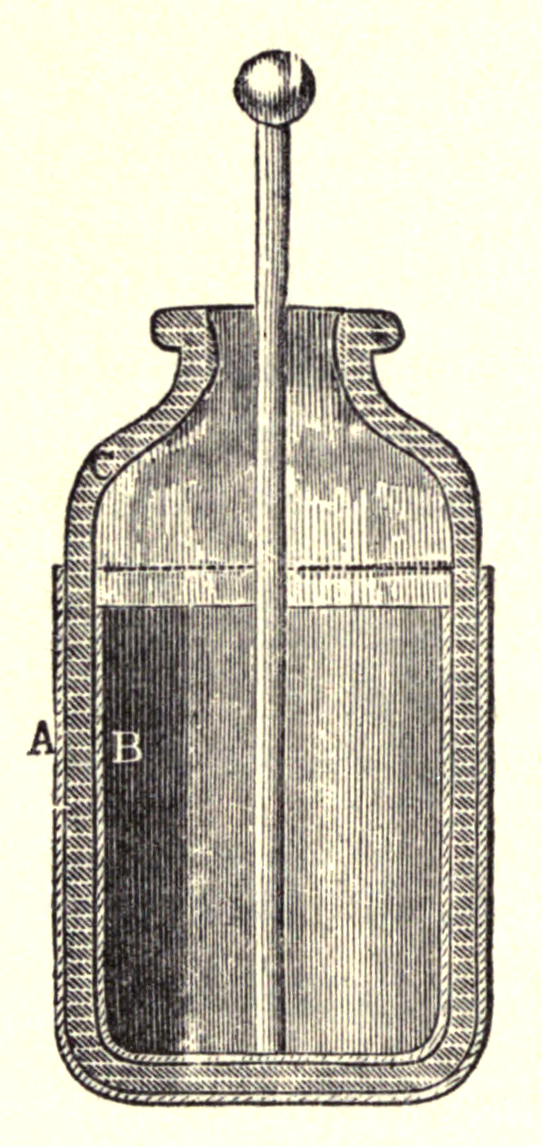


Leyden Jar
Before 1745 electricity could be made but not kept. A rubbed glass globe produced a charge that vanished the moment you stopped turning it. The Leyden jar changed that: a glass wall with a conductor on each side stores charge, and gives it back all at once.
That is a capacitor, and this is the first one. Two conducting surfaces separated by an insulator — foil inside, foil outside, glass between. The glass is not packaging; it is the component, and its thickness and area set how much charge the jar holds.
Scale this to a hand-rubbed charge and nothing else. A small jar charged by friction gives an unpleasant jolt. The same jar charged from a mains-powered supply, a camera flash circuit or a large electrostatic machine is genuinely dangerous, and a bank of them can kill. Build the jar, charge it by rubbing, and never connect it to a powered source.
निर्देशनहरू
Read the safety rule first
Read the safety rule first
This jar is charged by friction only — a rubbed rod or a hand-cranked machine. Never charge it from mains, a power supply, or a camera flash capacitor circuit. A charged capacitor holds its energy after the source is removed and gives it up in one pulse through whatever touches both plates.
Choose a small glass jar
Choose a small glass jar
Take a clean, dry glass jar of about 250 ml with straight sides and a plastic lid. Small is deliberate: capacitance scales with plate area, so a small jar stores a small charge.
यस चरणका सामग्री:
 सिसाको भाँडो1 टुक्रा
Dry everything thoroughly
Dry everything thoroughly
Dry the jar inside and out and work on a dry day if you can. A film of moisture on the glass is a conductor and quietly drains the charge as fast as you put it in.
Line the inside with foil
Line the inside with foil
Press aluminium foil against the inside wall up to about two thirds of the height, smoothing out creases. This is the inner plate.
यस चरणका सामग्री:
 एल्युमिनियम पत्र1 पाना
Wrap the outside to the same height
Wrap the outside to the same height
Wrap foil round the outside to the same level and tape it down. Leave a clear band of bare glass at the top on both sides — that gap is what stops the charge simply arcing over the rim.
Fit a conductor through the lid
Fit a conductor through the lid
Push a metal rod or a stiff wire through a hole in the lid so it reaches the inner foil. Bend the bottom end to press firmly against the foil.
यस चरणका सामग्री:
 पित्तलको डण्डी1 टुक्रा
Put a ball on the top end
Put a ball on the top end
Fix a metal ball or a smooth knob to the top of the rod. Sharp points leak charge into the air continuously; a rounded terminal holds it.
Make a discharging tool
Make a discharging tool
Bend a wire into a U with an insulating handle — a dry wooden dowel or plastic rod — taped along its middle. Every discharge is made with this tool, never with a finger.
यस चरणका सामग्री:
 काठको चुकुल1 टुक्रा
Charge it by friction
Charge it by friction
Rub a plastic rod hard with wool or fur and touch it repeatedly to the top terminal while your other hand rests on the outer foil. Your hand is the ground return — this is exactly the detail Musschenbroek worked out and von Kleist had missed.
Test with a scrap of foil
Test with a scrap of foil
Hang a light strip of foil near the terminal and watch it lift as charge accumulates. It is a crude electroscope and it tells you the jar is filling without touching anything.
Discharge with the tool and observe the spark
Discharge with the tool and observe the spark
Hold the insulated handle, touch one end of the U to the outer foil, then bring the other toward the terminal. A snap and a spark means the charge went round your wire and not through anything else.
Vary the plate area and compare
Vary the plate area and compare
Build a second jar with foil covering only a third of the height and charge it with the same number of rod strokes. The smaller plates hold less charge and give a weaker spark — capacitance rises with area.
Vary the glass thickness
Vary the glass thickness
Repeat with a thick-walled jar. A thicker dielectric means less capacitance for the same area, and the spark shortens again. Two variables, two clean results.
Time how long it holds charge
Time how long it holds charge
Charge the jar, wait a measured interval, then discharge and judge the spark. Repeat on a humid day. Charge leaks away across damp glass, which is why early experimenters got wildly inconsistent results and blamed the weather — correctly.
चाहिने औजार:
 रोकघडी
Discharge it before putting it away
Discharge it before putting it away
Short the jar with the discharging tool, then leave the tool bridging both plates while it is stored. A jar left charged is a trap for whoever picks it up next — and glass can hold a residual charge that reappears after an apparent discharge.
History & Context
History & Context
Two inventors, months apart. Ewald Georg von Kleist, a German cleric, produced the effect on 11 October 1745 using a small medicine bottle of alcohol with a nail through the cork. Independently, at Leiden in 1745–46, Pieter van Musschenbroek and Andreas Cunaeus arrived at the same thing — and, crucially, worked out why it only worked when the bottle was held in the hand: the outside needs a path to ground. Musschenbroek wrote to Réaumur in January 1746, and it was the Abbé Nollet, translating the letter from Latin, who named it the Leyden jar.
From liquid to foil. The first jars held water or alcohol as the inner conductor. Replacing the liquid with metal foil cemented to the inside and outside of the glass is the improvement that made the device practical, and it is the form still built today. The terminal rod through the lid touching the inner foil completes it.
Why it mattered so much. Storage turned electricity from a demonstration into a tool. You could now deliver a known quantity of charge on demand, repeatedly — which made quantitative experiment possible. Franklin used Leyden jars in his work on charge and coined much of the vocabulary; the jar sits directly behind the discovery that charge is conserved and comes in two kinds.
The showmanship, and the danger. Nollet famously discharged a jar through a line of monks holding hands to show the speed of the effect. Large jars and banks of jars were used for public spectacle in the eighteenth century, and the shocks were sometimes severe. That history is the reason this blueprint is scaled to friction charging: the physics is identical at every scale, and only the energy changes.
What it became. Every capacitor in every circuit is this object — two conductors, one insulator between them. The jar shape disappeared, the principle did not.
सामग्री
4- 1 टुक्राप्लेसहोल्डर
- 1 पानाप्लेसहोल्डर
- 1 टुक्राप्लेसहोल्डर
- 1 टुक्राप्लेसहोल्डर
CC0 सार्वजनिक डोमेन
यो ब्लुप्रिन्ट CC0 अन्तर्गत जारी गरिएको छ। तपाईं अनुमति नसोधी प्रतिलिपि, परिमार्जन, वितरण र प्रयोग गर्न सक्नुहुन्छ।
ब्लुप्रिन्ट मार्फत उत्पादनहरू किनेर सिर्जनाकर्तालाई सहयोग गर्नुहोस् सिर्जनाकर्ता कमिसन विक्रेताले तोकेको, वा यो ब्लुप्रिन्टको नयाँ संस्करण बनाउनुहोस् र आम्दानी बाँड्न आफ्नो ब्लुप्रिन्टमा जडानको रूपमा समावेश गर्नुहोस्।