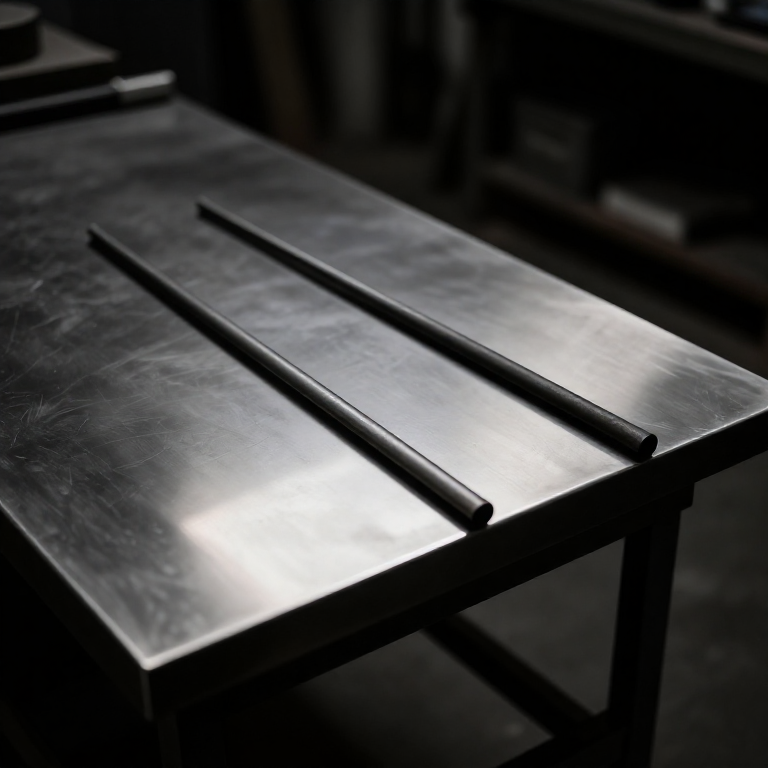


Marver and Bench
Hot glass has no shape of its own. Left alone on the end of a pipe it sags, runs and goes lopsided within seconds. Everything a glassblower does is a race against gravity, and the two pieces of furniture that win it are a flat plate and a bench with two rails.
The marver is a flat slab the gather is rolled on. It does three things at once: it makes the blob concentric, it chills the skin so the outside stiffens while the core stays soft, and it drives the shape toward a cylinder. Nothing else does all three.
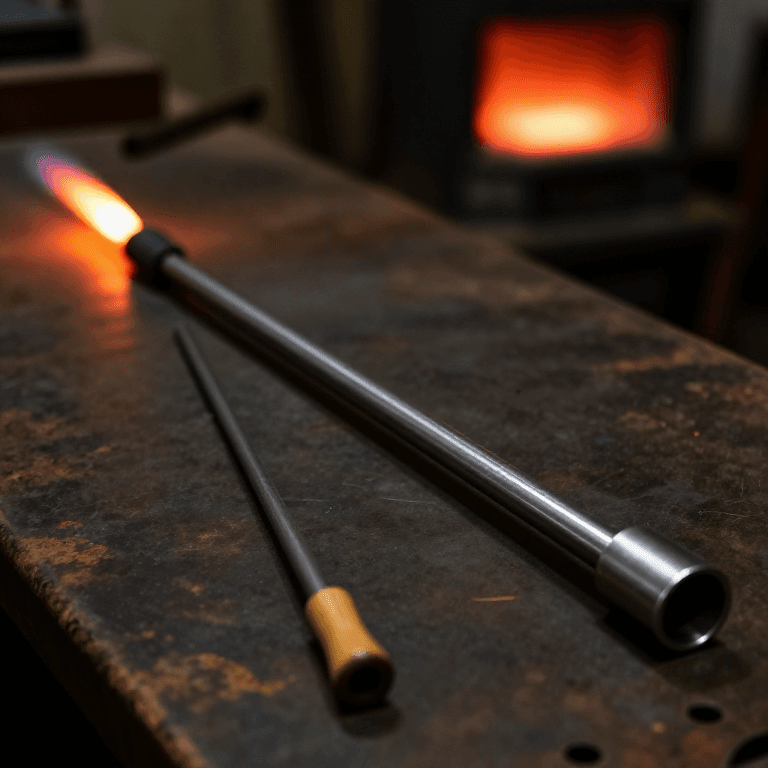
The bench is a seat with two parallel rails sticking out in front. The pipe lies across them and is rolled continuously with the left hand while the right works the glass. That constant rotation is what stops gravity ever finding a low side.
निर्देशनहरू
Get a steel plate for the marver
Get a steel plate for the marver
Take a mild steel plate at least 500 x 400 mm and 10 mm thick. Thickness is what gives it the thermal mass to stay cool through repeated contact with hot glass.
यस चरणका सामग्री:
 नरम फलामको डन्डी1 टुक्रा
Flatten and clean the surface
Flatten and clean the surface
Grind the plate flat and take the surface down to clean bare steel. Every pit, scale flake and paint speck prints into the glass, and the mark is permanent.
चाहिने औजार:
 गिट्टी कागज
Mount it dead level at hip height
Mount it dead level at hip height
Fix the plate on a heavy stand so the surface is level and at about hip height. Out of level and the gather rolls off; wrong height and the pipe cannot be kept horizontal while you roll.
Leave clear space on both sides
Leave clear space on both sides
Keep at least 1.5 m clear either side of the marver. A blowing iron is long and you will swing it — clearance is a safety dimension, not a convenience.
Never let the marver get wet
Never let the marver get wet
Keep water away from the plate and dry it fully if it does get wet. Hot glass on a wet steel surface flashes the water to steam and throws glass off the plate.
Build the bench frame
Build the bench frame
Build a low seat from steel or hardwood, seat height around 450 mm, wide enough to sit square with tools to one side.
यस चरणका सामग्री:
 कडा काठको फल्याक2 टुक्रा
Fit two parallel rails
Fit two parallel rails
Fit two rails projecting about 700 mm in front of the seat, 250 mm apart and level with each other. The pipe rests across these and is rolled along them.
Check the rails are level with each other
Check the rails are level with each other
Put a straightedge and a spirit level across both rails. If one rail is high, the pipe drifts to one side as it rolls and the piece goes off centre without you seeing why.
चाहिने औजार:
 रुलर
रुलरRound and smooth the rail tops
Round and smooth the rail tops
Round the top edge of each rail and polish it. The pipe has to roll under a fingertip's pressure — any drag makes continuous rotation impossible, and rotation is the whole point.
Slope the rails very slightly down
Slope the rails very slightly down
Set the rails a few degrees below horizontal, falling away from the seat. It keeps the working end from creeping back toward you as you roll.
Test-roll a cold pipe
Test-roll a cold pipe
Lay a cold blowing iron across the rails and roll it for a full minute. It should turn smoothly at a steady speed with no wobble and no wandering.
Fit a tool rest and a yoke
Fit a tool rest and a yoke
Add a rest on the right for jacks and shears, and a notched yoke at the far end of the rails to park the pipe. Anything you have to look for while glass is cooling is a design fault.
Marver a gather to centre it
Marver a gather to centre it
Take a gather and roll it on the marver with the pipe kept horizontal, moving the whole length of the plate. The gather comes back concentric and evenly skinned — this is the first move of nearly every glass object.
Feel the skin form
Feel the skin form
Notice the resistance change as you roll: the outside chills and stiffens while the interior stays fluid. That temperature difference is what lets a blown bubble expand evenly instead of blowing out at the thinnest point.
Work at the bench with continuous rotation
Work at the bench with continuous rotation
Sit, lay the pipe across the rails, and roll it steadily with the left hand while shaping with the right. Rotation never stops while the glass is soft — pause for two seconds and gravity puts a low side on the piece that cannot be taken out again.
History & Context
History & Context
Older than the blowpipe's fame. Glassblowing appears in the Roman world around the first century BC and spreads across the empire fast, because a blown vessel takes minutes where a core-formed one takes days. The bench, the pipe, the marver, the jacks and the shears are the toolkit that made that speed possible, and the set has barely changed since.
Why the name. Marver comes from the French marbre, marble — the plates were originally polished stone. Steel replaced it because steel is flatter, tougher, cheaper in large sizes and conducts heat better, which is precisely the property being used.
What marvering actually does. Three things at once. It centres the gather on the pipe. It chills a skin on the outside, creating a stiff shell around a hot core. And it shapes toward a cylinder. The chilled skin is the subtle one: a bubble blown into a uniformly soft gather expands fastest wherever it is thinnest and blows out, while a skinned gather inflates evenly.
The bench is a lathe made of a person. Two rails and a seated worker rolling continuously is a rotation system with a human as the motor. It is the reason glassblowers work seated and the reason the trade is organised around a team — the person on the bench cannot stop rotating, so somebody else fetches, opens the furnace door and brings the next gather.
Cheap, and therefore everywhere. A marver is a flat plate; a bench is a seat with two rails. Neither needs precision engineering, both can be made from scrap, and together they do more for the quality of a piece than any expensive tool in the shop. That is why the same two objects sit in every glasshouse from Roman Cologne to a modern studio.
सामग्री
2- 1 टुक्राप्लेसहोल्डर
- 2 टुक्राप्लेसहोल्डर
जोडिएका खाकाका सामग्री
CC0 सार्वजनिक डोमेन
यो ब्लुप्रिन्ट CC0 अन्तर्गत जारी गरिएको छ। तपाईं अनुमति नसोधी प्रतिलिपि, परिमार्जन, वितरण र प्रयोग गर्न सक्नुहुन्छ।
ब्लुप्रिन्ट मार्फत उत्पादनहरू किनेर सिर्जनाकर्तालाई सहयोग गर्नुहोस् सिर्जनाकर्ता कमिसन विक्रेताले तोकेको, वा यो ब्लुप्रिन्टको नयाँ संस्करण बनाउनुहोस् र आम्दानी बाँड्न आफ्नो ब्लुप्रिन्टमा जडानको रूपमा समावेश गर्नुहोस्।