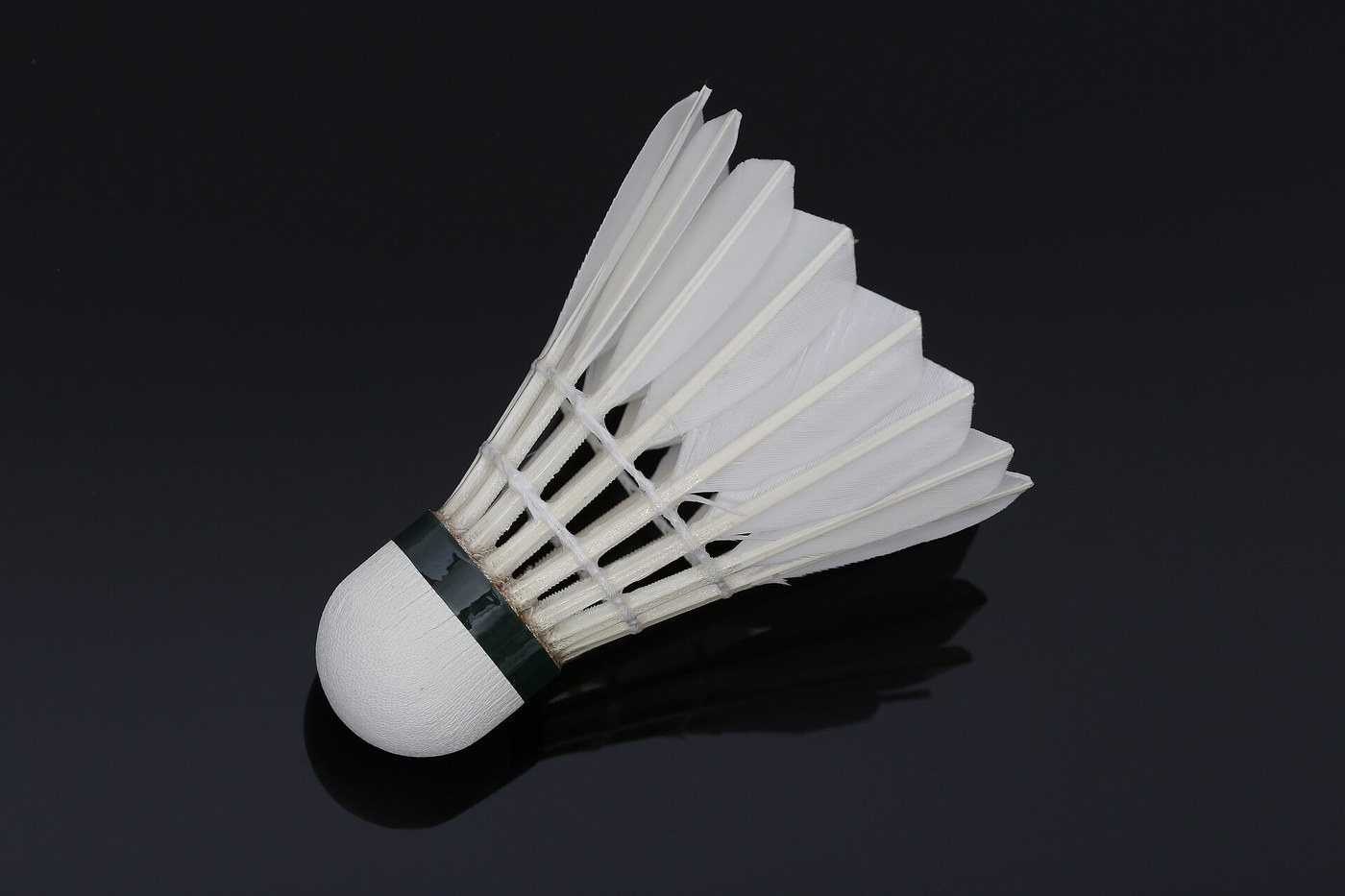

The Shuttlecock
A badminton shuttle leaves a smash faster than any other object struck in sport — well over 300 km/h — and lands a few metres later. Nothing else decelerates like that. The shuttle is the only projectile in sport designed primarily to lose its energy.
It does it with a skirt of feathers that produces enormous drag, and drag rises with the square of speed, so the faster it goes the harder it is braked. A shuttle hit at 300 km/h has shed most of that within the first few metres, which is precisely why a game of extraordinary racket speed fits on a small court.
The other property is that it always turns nose-first. Hit it backwards, sideways, anyhow, and within a fraction of a second the cork is leading. That is because nearly all the mass is in the cork base and nearly all the drag is on the skirt behind it: the centre of mass sits far ahead of the centre of pressure, which makes the shuttle powerfully self-righting, exactly like a badminton-shaped dart.
The regulated version is precise. Sixteen feathers, fixed in a cork base 25-28 mm across, feather length 62-70 mm, total mass 4.74-5.50 g. Feathers come from one wing only — usually the left — because left and right feathers curve opposite ways and cannot be mixed.
Build one, and measure the drag for yourself.
निर्देशनहरू
Prepare the base
Prepare the base
Cut or turn a cork base 25-28 mm in diameter with a domed bottom, and cover the dome with a thin leather or fabric skin.
Weigh it.
Almost all the shuttle's mass must be here. The base is not a fixing point that happens to be heavy — the mass concentration at the nose is what makes the whole thing self-righting.
यस चरणका सामग्री:
 कर्कको पाता1 पाना
 छालाको फित्ता1 टुक्रा
चाहिने औजार:
 डिजिटल तराजु
Sort feathers by curvature, and use one hand only
Sort feathers by curvature, and use one hand only
Lay out your feathers and sort them into two piles by which way the vane curves. Discard one pile.
From the remaining pile, select sixteen of closely matched length, 62-70 mm, and matched stiffness.
Mixing curvatures gives a shuttle that will not spin consistently and flies erratically — which is why manufacturers use one wing and why a single shuttle needs feathers from more than one bird.
यस चरणका सामग्री:
 प्वाँख16 टुक्रा
चाहिने औजार:
 डिजिटल क्यालिपर ६ इन्च
Set the feathers in a circle, all leaning the same way
Set the feathers in a circle, all leaning the same way
Mark sixteen equally spaced holes around the cork. Set each quill in, angled outward to form the skirt and each rotated the same way so the skirt is slightly asymmetric.
Glue and let cure fully.
That consistent lean is what makes the shuttle spin in flight. Spin stabilises it, exactly as rifling does a bullet, and a shuttle with feathers set randomly wobbles.
यस चरणका सामग्री:
 ५ मिनेटको इपोक्सी1 टुक्रा
Bind the skirt and weigh the result
Bind the skirt and weigh the result
Bind the feathers to each other with two rings of thread at the height real shuttles use, and glue the bindings.
Weigh the finished shuttle.
Aim for 4.74-5.50 g.
The binding is structural: it makes sixteen independent feathers behave as one conical skirt. Without it the skirt splays under load and the shuttle both slows differently and dies after a few hits.
यस चरणका सामग्री:
 सिलाइको धागो1 टुक्रा
Measure terminal velocity
Measure terminal velocity
Drop the shuttle from a measured height — a stairwell — and time the fall over a marked lower section where it has already stopped accelerating. Repeat five times.
Compute the speed. Do the same for a plastic shuttle and for a ball of similar mass.
Expect the feathered shuttle to be much slower than the ball and to reach a steady speed within a short drop.
You have measured the drag directly: at terminal velocity, drag exactly equals weight.
चाहिने औजार:
 रोकघडी
 नाप्ने फित्ता
Test the turnover, and test it to destruction
Test the turnover, and test it to destruction
Throw the shuttle base-first, tail-first and sideways, and film it. Measure how far it travels before the cork leads.
Then hit it repeatedly and record how many hits before flight changes.
Expect turnover within a fraction of a second every time, and expect feathers to break early.
Feathered shuttles are consumables — a professional match gets through many tubes, and that is the real reason plastic exists.
Compendium — why the rules are so specific
Compendium — why the rules are so specific
The specification is tight because flight is a system, not a component. BWF rules fix sixteen feathers, a base of 25-28 mm, feather length 62-70 mm from base top to tip, and a mass of 4.74-5.50 g. On top of that, shuttles are speed-tested: hit with a full underhand stroke from one back boundary, a correct shuttle must land within a defined band near the other back line. Manufacturers adjust for temperature, altitude and humidity by selling several "speeds", because thinner or drier air changes the drag and therefore the length of every shot in the game.
Three birds per shuttle, and that is arithmetic, not extravagance. Only about six feathers per wing are suitable, left and right feathers curve oppositely and cannot be mixed, and sixteen matched feathers are needed — so a single tournament shuttle draws on three birds. Goose is the premium material and duck the common alternative. This is also the entire economic argument for synthetic shuttles, which are one moulded piece, last far longer and cost a fraction.
Synthetics still do not fly the same, and the reason is instructive. A moulded plastic skirt is a solid cone; a feather skirt is porous and slightly flexible. Air passes through a feather skirt, and the skirt deforms under load, so drag changes with speed differently from a rigid cone. The practical consequence is that plastic shuttles feel fast at the start of a rally and slow at the end relative to feather, and top-level play remains on feather for that reason alone.
The self-righting is worth stating properly. Stability comes from the centre of mass sitting well ahead of the centre of pressure. If a shuttle is disturbed, the aerodynamic force acts behind the mass and produces a restoring moment — the same arrangement as the flights on a dart or the feathers on an arrow, and the exact opposite of an unstable rocket. It is one of the clearest demonstrations of static stability available at bench scale.
Older and wider than badminton. Shuttlecock games are ancient and widespread — ti jian zi in China, kicked rather than struck, is over two thousand years old, and battledore and shuttlecock was a European pastime for centuries. Modern badminton took its name from Badminton House in Gloucestershire in the 1860s, but the projectile long predates the sport built around it. Practical care: feathers are brittle when dry, so shuttles are traditionally humidified before play, and a tube kept in a cold car will break on the first smash.
सामग्री
5- 1 पानाप्लेसहोल्डर
- 1 टुक्राप्लेसहोल्डर
- 16 टुक्राप्लेसहोल्डर
- 1 टुक्राप्लेसहोल्डर
- 1 टुक्राप्लेसहोल्डर
आवश्यक उपकरणहरू
4- प्लेसहोल्डर
- प्लेसहोल्डर
- प्लेसहोल्डर
- 1 vendor sell this, none ship to you yetप्लेसहोल्डर
जोडिएका खाकाका सामग्री

सम्बन्धित ब्लुप्रिन्ट
यी ब्लुप्रिन्टहरूले ज्ञान साझा गर्छन् — प्रविधि, सामग्री वा सिद्धान्त

CC0 सार्वजनिक डोमेन
यो ब्लुप्रिन्ट CC0 अन्तर्गत जारी गरिएको छ। तपाईं अनुमति नसोधी प्रतिलिपि, परिमार्जन, वितरण र प्रयोग गर्न सक्नुहुन्छ।
ब्लुप्रिन्ट मार्फत उत्पादनहरू किनेर सिर्जनाकर्तालाई सहयोग गर्नुहोस् सिर्जनाकर्ता कमिसन विक्रेताले तोकेको, वा यो ब्लुप्रिन्टको नयाँ संस्करण बनाउनुहोस् र आम्दानी बाँड्न आफ्नो ब्लुप्रिन्टमा जडानको रूपमा समावेश गर्नुहोस्।