कला
सुन्दरता र कल्याण
हस्तकला
संस्कृति र इतिहास
मनोरञ्जन
वातावरण
खाना र पेय
रिभर्स इन्जिनियरिङ
विज्ञान
खेलकुद
प्रविधि
पहिर्न मिल्ने
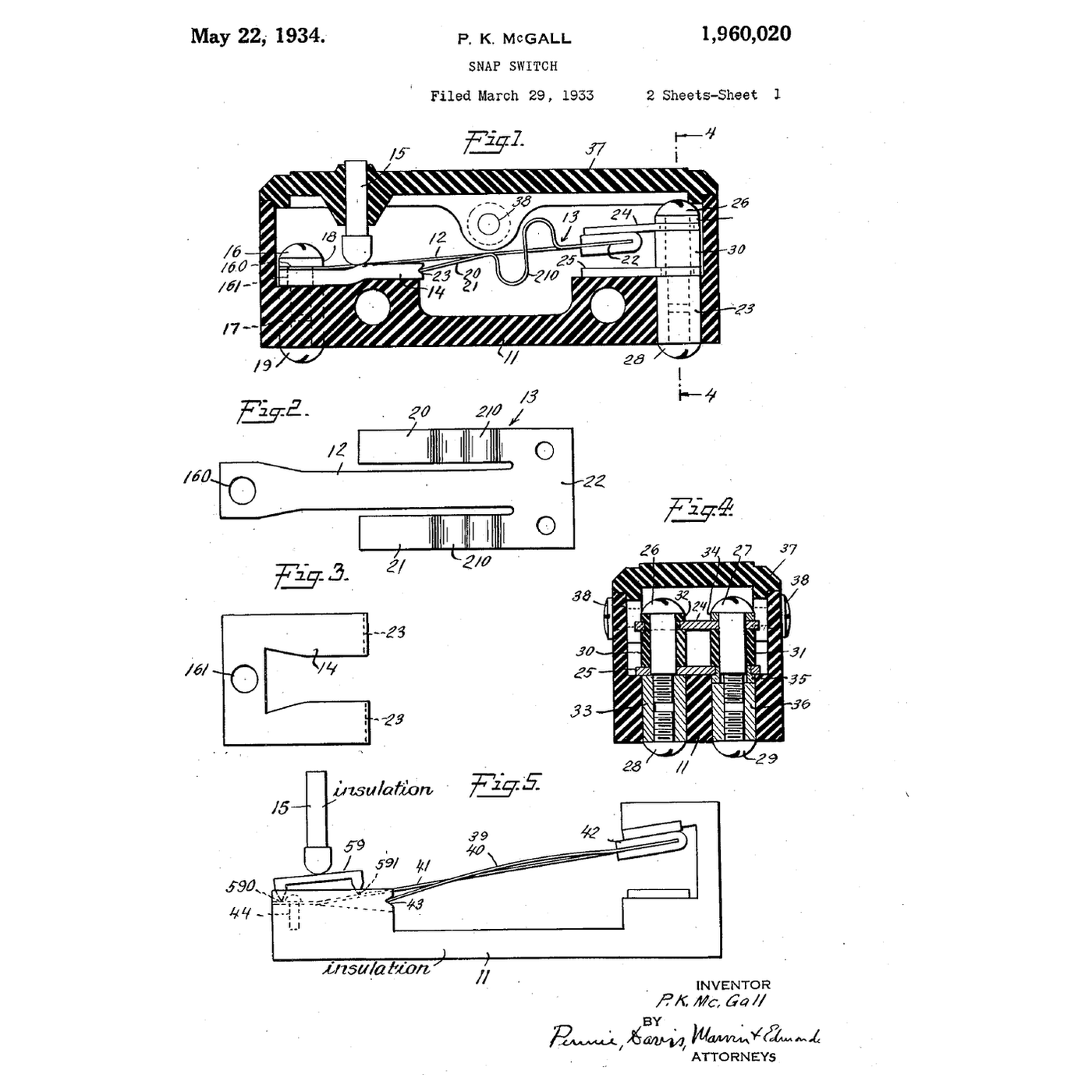


The Snap-Action Switch: A Spring That Jumps Past Its Own Centre
A contact that opens slowly draws an arc that eats it away; one that wavers at the edge chatters. A snap-action switch cannot do either: its contact is held by springs arranged over-centre, so a small, slow push on the plunger builds up to a point and then the contact jumps from one stop to the other in a few milliseconds.
Philip Kenneth McGall of Orange, New Jersey, working for C. F. Burgess Laboratories, filed US 1,960,020, *Snap Switch*, on 29 March 1933; it was granted 22 May 1934. A thin beryllium-copper leaf spring is held in tension by two side strips in compression, pivoted near the middle of the leaf; silver contacts at the free end move between two stops. It became the "micro switch" found in machines, appliances and mice.
This rung models the snap-through force, shows why the lower stop sits above dead centre, and makes a snap switch from spring steel.
मध्यम
About 3 hours
निर्देशनहरू
1
1
The drooping force and the speed of the snap
The drooping force and the speed of the snap
Jupyter नोटबुक लोड हुँदैछ…
2
2
Read McGall's switch
Read McGall's switch
Fig. 1 of US 1,960,020 shows the switch in section: a base 11 of wood, hard rubber or Bakelite; the thin leaf spring 12 bolted at one end over a thick metal shim 14; two parallel spring strips 20 and 21, joined to the leaf's free end by a U-shaped stirrup 22 and pivoted in notches in the shim; and a plunger 15 pressing the leaf near its anchored end.
What the specification specifies: the leaf "preferably is a thin beryllium copper strip" (or phosphor bronze); the strips are in longitudinal compression, putting the leaf in tension; contacts "preferably made of silver … which minimizes the damage resulting from arcing"; "the bottom contact 25 is placed above the neutral or dead-center position" so the arm returns when released; and the leaf is widened ahead of its anchorage so it does not fatigue there.
3
3
Make a snap switch from spring steel
Make a snap switch from spring steel
Cut a strip of thin spring steel 60 mm long and 12 mm wide. Cut a slot 3 mm wide down its middle for 40 mm, leaving the two outer legs and a solid end. Bend the centre tongue slightly so that, when you clamp the solid end and push the tongue's tip back into line with the legs, the legs bow — now they are in compression and the tongue is in tension, as in McGall's switch.
Clamp the solid end to a plywood base with a machine screw. Set two machine-screw stops either side of the free end, the lower one just above the point where the strip flips over, and solder a wire to the strip and to each stop.
Press slowly near the clamped end with a spring scale: the force rises, then the free end jumps to the lower stop with a click. Release it and it jumps back. Wire the lower stop through a buzzer: it sounds cleanly, with no chatter, however slowly you press. Note the operating force and compare with the notebook's curve.
यस चरणका सामग्री:
 स्प्रिङ फलामको पट्टी1 टुक्रा
 प्लाइउडको पाता1 टुक्रा
 मेसिन स्क्रु4 टुक्रा
 पिजो बजर1 टुक्रा
 टिन-सिसाको टाँका1 टुक्रा
 सूक्ष्म स्विच (लिभरले चल्ने)1 टुक्रा
चाहिने औजार:
 टाँका लगाउने डन्डी
 बलमापक (स्प्रिङ तराजु)
 बेन्चको भाइस
 छालाका काम गर्ने पन्जा
 दिष्ट धाराको विद्युत् स्रोत
4
4
A switch that chatters or will not reset
A switch that chatters or will not reset
Snap switch faults.
Flow
Loading...
5
5
History and honest limits
History and honest limits
**Philip Kenneth McGall** filed **US 1,960,020** on 29 March 1933, assigned to C. F. Burgess Laboratories of Madison, Wisconsin; it was granted 22 May 1934. The company Micro Switch was formed later in the 1930s, and the name came to stand for the small snap-action switch itself.
**Honest limits.** The notebook's two-spring model shows the snap-through and the role of the stops; McGall's real geometry, with a leaf in tension and strips pivoted near its middle, has a different force curve with the same character. Spring steel strip has sharp edges: wear gloves when cutting and bending it.
सामग्री
6- 1 टुक्राप्लेसहोल्डर
- 1 टुक्राप्लेसहोल्डर
- 4 टुक्राप्लेसहोल्डर
- 1 टुक्राप्लेसहोल्डर
- 1 टुक्राप्लेसहोल्डर
- 1 टुक्राप्लेसहोल्डर
आवश्यक उपकरणहरू
5- टाँका लगाउने डन्डी10% कमिसनMagento Legacy Storeships internationallyप्लेसहोल्डर
- प्लेसहोल्डर
- प्लेसहोल्डर
- प्लेसहोल्डर
- प्लेसहोल्डर
सम्बन्धित ब्लुप्रिन्ट
यी ब्लुप्रिन्टहरूले ज्ञान साझा गर्छन् — प्रविधि, सामग्री वा सिद्धान्त


CC0 सार्वजनिक डोमेन
यो ब्लुप्रिन्ट CC0 अन्तर्गत जारी गरिएको छ। तपाईं अनुमति नसोधी प्रतिलिपि, परिमार्जन, वितरण र प्रयोग गर्न सक्नुहुन्छ।
ब्लुप्रिन्ट मार्फत उत्पादनहरू किनेर सिर्जनाकर्तालाई सहयोग गर्नुहोस् सिर्जनाकर्ता कमिसन विक्रेताले तोकेको, वा यो ब्लुप्रिन्टको नयाँ संस्करण बनाउनुहोस् र आम्दानी बाँड्न आफ्नो ब्लुप्रिन्टमा जडानको रूपमा समावेश गर्नुहोस्।