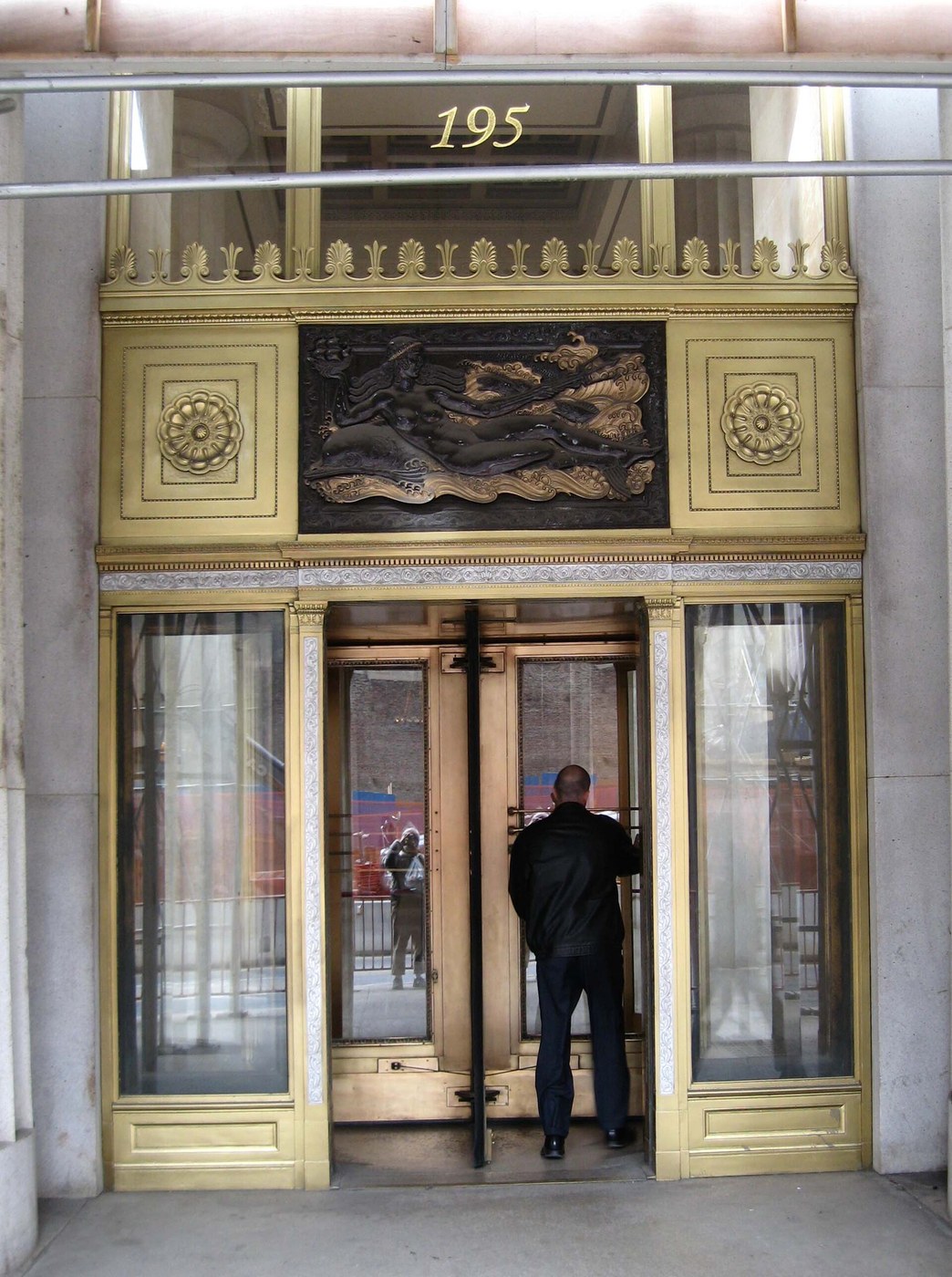


Van Kannel Revolving Door
A tall heated building in winter is a chimney. Warm air rises and escapes upstairs, cold air is drawn in at street level, and every time the front door opens the pressure difference slams it, blasts the lobby with cold, and makes the door genuinely hard to pull against the draught.
A revolving door never opens. At every position at least one wing seals against the drum, so there is no straight path from outside to inside — the building's pressure boundary is unbroken while people walk through it. It is an airlock you can use without stopping.
It also solves a crowd problem: people pass in both directions simultaneously in a compartment each, and nobody has to hold anything. The patent is titled "Storm-door structure" — US Patent 387,571, granted to Theophilus Van Kannel of Philadelphia on 7 August 1888.
निर्देशनहरू
Build a model, and mind the pinch points
Build a model, and mind the pinch points
A revolving door has moving wings closing on fixed jambs — a genuine crushing hazard at full size. Build this at model scale and keep fingers clear of the closing edges.
Read US 387,571 and note the claim about both directions
Read US 387,571 and note the claim about both directions
Van Kannel writes that "persons can pass both in and out at the same time" while weather is excluded. Two problems solved by one geometry.
Demonstrate stack effect with a smoke source
Demonstrate stack effect with a smoke source
Warm a tall box and hold a smoke source at a low opening. Air is pulled IN at the bottom. That inward draught is the force fighting an ordinary door.
Build a cylindrical drum with two openings
Build a cylindrical drum with two openings
Make a circular enclosure open on opposite sides — one facing the street, one the lobby. The curved walls are the sealing surfaces.
यस चरणका सामग्री:
 बाल्टिक भुर्जा प्लाइउड1 पाना
चाहिने औजार:
 हाते आरा
Set the openings at less than 180 degrees apart
Set the openings at less than 180 degrees apart
Keep the two apertures narrower than the gap between wings. If both openings can ever be clear at once, you have built a hole in the wall with extra steps.
चाहिने औजार:
 रुलर
रुलरMake four wings on a central post
Make four wings on a central post
Fit four leaves at right angles to a vertical shaft. Four gives two enclosed compartments at all times; three gives more capacity and a poorer seal.
Fit brush or felt seals to every wing edge
Fit brush or felt seals to every wing edge
Line the vertical and top edges so they wipe the drum. The seal, not the wing, is what excludes the weather — a wing with a 5 mm gap is a 5 mm slot all the way up.
यस चरणका सामग्री:
 ऊनको भरण1 टुक्रा
Verify the seal by rotating slowly through 360 degrees
Verify the seal by rotating slowly through 360 degrees
Turn the assembly a full revolution and look for any angle where you can see straight through. There must be none — check every position, not just the obvious ones.
Mount the shaft on a thrust bearing
Mount the shaft on a thrust bearing
Carry the wings' weight on a bearing at the base with a light guide at the top. It must turn under a child's push while supporting the whole assembly.
यस चरणका सामग्री:
 नरम फलामको गोलो डण्डी1 टुक्रा
Repeat the smoke test through the revolving door
Repeat the smoke test through the revolving door
Run the stack-effect test again with the drum in place, turning. Almost no air crosses — you have kept the pressure boundary while people pass.
Add a speed governor
Add a speed governor
Fit friction or a fluid damper to cap rotation speed. An unrestrained revolving door can be spun fast enough to injure whoever is inside it.
Make the wings collapsible
Make the wings collapsible
Hinge the wings so they can fold flat under pressure from inside. This is the book-fold or breakout position, and it is a legal requirement for escape routes.
Test the breakout with the door jammed
Test the breakout with the door jammed
Block the rotation and push a wing from inside. It must fold and give a clear opening. A door that cannot fail open is not acceptable on an exit.
Measure throughput against a swing door
Measure throughput against a swing door
Time counters passing through both. The revolving door carries people in both directions at once and never has to be held — capacity is continuous, not batched.
Compendium — an airlock you can walk through
Compendium — an airlock you can walk through
The patent. US 387,571, "Storm-door structure", granted 7 August 1888 to Theophilus Van Kannel of Philadelphia. The specification describes a door of pivoted wings turning on a central post, admitting people in both directions while excluding wind, rain, snow, dust and street noise. Van Kannel won the Franklin Institute's John Scott Medal for it in 1889, and the first installation is generally given as Rector's restaurant in Times Square around 1899. A German patent by H. Bockhacker of Berlin predates it by seven years, so "first revolving door" is a claim worth qualifying.
Stack effect is the problem it actually solves. A heated multi-storey building has warm buoyant air inside; it rises and leaks out at the top, drawing cold air in at street level. The resulting pressure difference at the entrance can be large enough to make a hinged door hard to open and to slam it shut behind people, and every opening dumps conditioned air. A revolving door keeps at least one wing sealed at all times, so the pressure boundary is never broken — it is a continuously operating airlock. Modern energy studies still show meaningful heating savings from using the revolving door rather than the side door beside it.
Two problems, one geometry. The pressure seal and the two-way pedestrian flow come from the same arrangement. Each compartment carries its occupants independently, so inbound and outbound traffic never conflict and nobody has to hold a door for anybody. That is a genuinely elegant piece of design — but it comes with a hard constraint, which is that the aperture width must always be less than the angular spacing of the wings. Get that wrong and the seal is lost at some rotation angle, and the whole benefit disappears.
The failure mode had to be added later. A door that always seals is, by construction, a door that can jam shut — which is unacceptable on an escape route. Modern revolving doors have collapsible or breakout wings that fold flat under push from inside, and building codes limit how much of a required exit width a revolving door may provide. This is the same reasoning as the fail-safe air brake and the fusible-link sprinkler: decide in advance which way the device should fail, and build that in rather than hoping.
सामग्री
3- 1 पानाप्लेसहोल्डर
- 1 टुक्राप्लेसहोल्डर
- 1 टुक्राप्लेसहोल्डर
सम्बन्धित ब्लुप्रिन्ट
यी ब्लुप्रिन्टहरूले ज्ञान साझा गर्छन् — प्रविधि, सामग्री वा सिद्धान्त

CC0 सार्वजनिक डोमेन
यो ब्लुप्रिन्ट CC0 अन्तर्गत जारी गरिएको छ। तपाईं अनुमति नसोधी प्रतिलिपि, परिमार्जन, वितरण र प्रयोग गर्न सक्नुहुन्छ।
ब्लुप्रिन्ट मार्फत उत्पादनहरू किनेर सिर्जनाकर्तालाई सहयोग गर्नुहोस् सिर्जनाकर्ता कमिसन विक्रेताले तोकेको, वा यो ब्लुप्रिन्टको नयाँ संस्करण बनाउनुहोस् र आम्दानी बाँड्न आफ्नो ब्लुप्रिन्टमा जडानको रूपमा समावेश गर्नुहोस्।