

Weaving with a Flying Shuttle — Kay's Invention That Launched the Textile Revolution
In 1733, John Kay of Bury, Lancashire, patented the flying shuttle — a mechanism that allowed a single weaver to propel the shuttle across even the widest loom with a flick of the hand. Before Kay's invention, looms wider than a person's arm span required two weavers: one to throw the shuttle from the right, another to catch and return it from the left. The flying shuttle halved the labor required and more than doubled weaving speed.
The mechanism is elegantly simple. A shuttle race (a smooth wooden track) is mounted along the front of the loom's beater. At each end of the race, a picker (a wooden block on a leather strap) sits in a picker box. Both pickers are connected by a single cord that passes through a handle at the center. When the weaver jerks the handle right, the left picker strikes the shuttle and sends it sliding across the race to the right picker box. Jerking left sends it back. The weaver's other hand operates the beater.
Kay's invention was the first domino in the chain reaction that became the Industrial Revolution. Weavers using flying shuttles consumed yarn so quickly that spinners could not keep up — creating the demand that drove the invention of the Spinning Jenny (1764), Water Frame (1769), and Spinning Mule (1779). The textile revolution was born from a piece of string and two wooden blocks.
निर्देशनहरू
Set up a warped floor loom
Set up a warped floor loom
Begin with a floor loom that has been warped (warp threads strung from back beam to front beam, threaded through heddles and reed). A minimum loom width of 60 cm is needed to benefit from a flying shuttle — narrower looms can be managed by hand. The warp should be tensioned evenly with all threads at equal tightness. Plain weave threading (alternating threads through heddle frames 1 and 2) is standard for learning.
यस चरणका सामग्री:
 Warp Yarn200 ग्राम
चाहिने औजार:
 Floor Loom
Install the shuttle race on the beater
Install the shuttle race on the beater
Attach the shuttle race — a smooth, flat wooden or metal track — along the bottom front edge of the beater (the swinging frame that holds the reed). The race must be perfectly straight and level so the shuttle slides freely from end to end. Sand any rough spots — the shuttle needs a friction-free path to travel at speed.
चाहिने औजार:
 Flying Shuttle Kit
Mount picker boxes at each end of the race
Mount picker boxes at each end of the race
Fix a picker box (an open-topped wooden compartment) at each end of the shuttle race. The boxes catch and hold the shuttle when it arrives. Each box contains a picker — a flat wooden block mounted on a leather strap — that swings inward to strike the shuttle. The pickers must swing freely and return to their resting position by gravity or a spring.
Thread the picking cord through the handle
Thread the picking cord through the handle
Connect both pickers with a single cord (strong linen or cotton twine) that passes through a central handle — a short wooden peg or toggle grip that the weaver holds. The cord runs from the right picker, through the handle, to the left picker. When the weaver jerks the handle right, the cord pulls the left picker inward, striking the shuttle. Jerking left activates the right picker.
यस चरणका सामग्री:
 Cordage3 मिटर
Wind the weft bobbin and load the shuttle
Wind the weft bobbin and load the shuttle
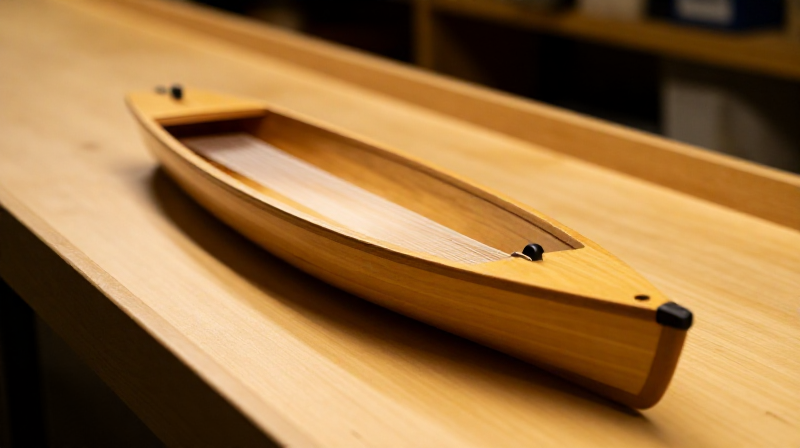
Wind weft yarn onto a bobbin (a small wooden or paper core that fits inside the shuttle). Wind firmly and evenly — a lopsided bobbin causes the shuttle to wobble and veer off the race. Insert the loaded bobbin into the boat shuttle. The weft yarn should feed freely through the shuttle's eye or slot as the shuttle moves.
यस चरणका सामग्री:
 Weft Yarn100 ग्राम
चाहिने औजार:
 Boat Shuttle
Place the shuttle in the right picker box
Place the shuttle in the right picker box
Set the loaded shuttle on the race inside the right picker box, pointed end facing left. Thread the weft yarn through the first few warp threads by hand and attach it to the selvedge (edge) of the fabric. The shuttle is now loaded, positioned, and ready for its first flight across the warp.
Open the shed by pressing a treadle
Open the shed by pressing a treadle
Press the first treadle with your foot. This raises one set of heddles, lifting every other warp thread and creating an opening (the shed) between the raised and lowered threads. The shed must be clean and wide enough for the shuttle to pass through without snagging. Check that no threads are crossed or tangled before throwing the shuttle.
Throw the shuttle with the picking cord
Throw the shuttle with the picking cord
Hold the picking handle in your right hand. With a sharp flick of the wrist to the left, jerk the handle. The cord pulls the right picker inward, striking the shuttle. The shuttle shoots across the race through the open shed, trailing weft yarn, and lands in the left picker box. The entire crossing takes a fraction of a second — far faster than a hand throw.
Beat the weft into place
Beat the weft into place
With your left hand, pull the beater firmly toward you. The reed pushes the newly laid weft thread snugly against the previous row of weaving. Release the beater and let it swing back to its resting position. The beat should be firm and even — too light and the fabric will be loose and sleazy, too hard and it will be stiff and dense.
Change the shed and return the shuttle
Change the shed and return the shuttle
Release the first treadle and press the second treadle. This reverses which warp threads are raised and lowered, creating a new shed that crosses the weft from the opposite direction. Now flick the picking handle to the right — the left picker strikes the shuttle, sending it back across to the right picker box. Beat again. One complete cycle (two throws + two beats) creates two rows of plain weave.
Establish a weaving rhythm
Establish a weaving rhythm
The flying shuttle weaving rhythm is: treadle — throw — beat — treadle — throw — beat. With practice this becomes automatic, and a skilled weaver can sustain 60–80 throws per minute. The weft should lay straight and flat across the warp without pulling the selvedge edges inward. If the edges draw in, you are pulling the weft too tight — leave a slight arc of slack before beating.
Replace the bobbin when the weft runs out
Replace the bobbin when the weft runs out
When the bobbin empties, the shuttle becomes noticeably lighter and may not cross the full width. Stop weaving, remove the empty bobbin, and insert a freshly wound one. Overlap the new weft tail with the old weft end by about 3 cm inside the shed — subsequent beating locks the overlap in place. Trim any protruding ends later.
Advance the warp as cloth accumulates
Advance the warp as cloth accumulates
After every 15–20 cm of woven fabric, release the front beam brake, wind the finished cloth forward onto the cloth beam, and re-tension the warp from the back beam. This keeps the weaving zone at a comfortable working distance and maintains even warp tension. Uneven tension causes the shuttle to snag and produces wavy cloth.
Check selvedge quality regularly
Check selvedge quality regularly
Examine the fabric edges every 10 cm. Clean selvedges should be straight and firm with no loops or pulled-in threads. Flying shuttle selvedges tend to be tighter than hand-thrown selvedges because the shuttle enters the picker box under tension. If one selvedge is tighter than the other, adjust the cord lengths so the shuttle strikes with equal force from both sides.
Weave to the end of the warp
Weave to the end of the warp
Continue weaving until approximately 15 cm of unwoven warp remains (this waste is needed for tying off). The final throws may feel tighter as the remaining warp stretches thin — slow your rhythm and reduce beating force to avoid snapping threads. Weave the last two rows by hand if the shed is too narrow for the shuttle.
Cut the cloth from the loom
Cut the cloth from the loom
Cut the warp threads at the back of the loom behind the last heddle. The cloth, still attached to the cloth beam, can now be unwound. Cut the front lashing to free the cloth completely. The raw fabric has fringed ends where the warp was cut — these can be knotted, hemmed, or turned under depending on the intended use.
चाहिने औजार:
 Sharp Scissors
Inspect and finish the cloth
Inspect and finish the cloth
Lay the cloth flat on a clean surface and inspect for weaving faults: skipped threads, broken warp ends, uneven beating. Minor faults can be repaired with a darning needle. Wash the cloth in warm water to remove sizing and relax the fibers — this is called fulling. The cloth will shrink slightly (5–10%) and the weave will tighten as the fibers felt against each other. Press flat while damp and hang to dry.
सामग्री
3- 200 ग्रामप्लेसहोल्डर
- 3 मिटरप्लेसहोल्डर
- 100 ग्रामप्लेसहोल्डर
आवश्यक उपकरणहरू
4- प्लेसहोल्डर
- प्लेसहोल्डर
- प्लेसहोल्डर
- प्लेसहोल्डर
जोडिएका खाकाका सामग्री
सम्बन्धित ब्लुप्रिन्ट
यी ब्लुप्रिन्टहरूले ज्ञान साझा गर्छन् — प्रविधि, सामग्री वा सिद्धान्त


CC0 सार्वजनिक डोमेन
यो ब्लुप्रिन्ट CC0 अन्तर्गत जारी गरिएको छ। तपाईं अनुमति नसोधी प्रतिलिपि, परिमार्जन, वितरण र प्रयोग गर्न सक्नुहुन्छ।
ब्लुप्रिन्ट मार्फत उत्पादनहरू किनेर सिर्जनाकर्तालाई सहयोग गर्नुहोस् सिर्जनाकर्ता कमिसन विक्रेताले तोकेको, वा यो ब्लुप्रिन्टको नयाँ संस्करण बनाउनुहोस् र आम्दानी बाँड्न आफ्नो ब्लुप्रिन्टमा जडानको रूपमा समावेश गर्नुहोस्।