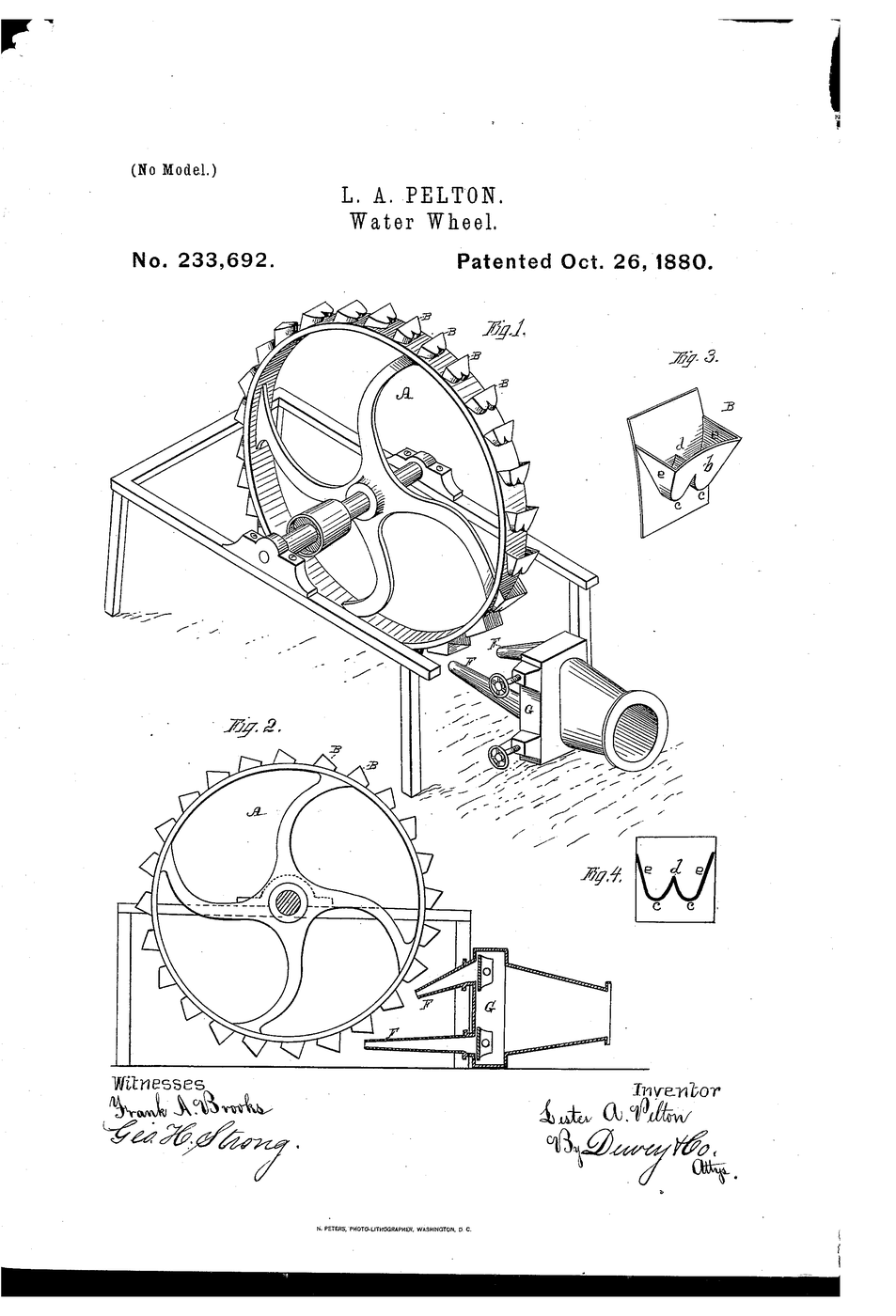


Pelton Wheel
Mining camps in the Sierra Nevada had water at enormous pressure and very little of it — a thin jet coming down a steep pipe from a creek far above. A traditional water wheel wants volume and a gentle fall, so it was the wrong machine. What the camps used instead was the hurdy-gurdy wheel: a disc with flat paddles round the rim, hit by a nozzle jet.
The hurdy-gurdy wasted most of the jet, and the reason is specific. Pelton's specification says it: water hitting flat-bottomed buckets "splashes and reacts against the bottoms of the succeeding buckets, thus retarding the wheel". The wheel was fighting its own discharge.
His fix is one shape. Give each bucket two curved halves meeting at a central apex, so the jet is split down the middle and the two halves are thrown out sideways, clear of the wheel and clear of the next bucket.
US Patent 233,692, simply titled "Water-Wheel", granted 26 October 1880 to Lester A. Pelton of Camptonville, California.
Mga Tagubilin
Read the problem statement in US 233,692
Read the problem statement in US 233,692
Pelton names the fault exactly: water on flat buckets "splashes and reacts against the bottoms of the succeeding buckets, thus retarding the wheel". Write that down — you are going to reproduce it deliberately.
Cut a 150 mm disc with a flat rim face
Cut a 150 mm disc with a flat rim face
Cut a plywood disc 150 mm across. Pelton specifies a wheel "having a flat face" with buckets secured to it, so keep the rim square and true.
Mga materyales para sa hakbang na ito:
 Playwud na Baltic Birch1 pilyego
Mount the disc on a free-running axle
Mount the disc on a free-running axle
Fit a dowel axle through the centre and support it so the wheel spins with almost no friction. Check it coasts for several seconds after a flick.
Mga materyales para sa hakbang na ito:
 Kahoy na Tarugo1 piraso
Fit sixteen FLAT paddles — build the hurdy-gurdy first
Fit sixteen FLAT paddles — build the hurdy-gurdy first
Fix sixteen flat rectangular paddles evenly round the rim. This is the machine Pelton set out to improve, and it is your control.
Set up a fixed jet with a brass nozzle
Set up a fixed jet with a brass nozzle
Clamp a hose with a brass nozzle so a single jet strikes the rim tangentially. Fix the position — every comparison depends on the jet not moving.
Mga kailangang kasangkapan:
 Nozzle na tanso
Run the flat wheel and count its top speed
Run the flat wheel and count its top speed
Open the water and let the wheel reach steady speed. Count revolutions for 30 seconds. Record the figure.
Watch where the water goes, not the wheel
Watch where the water goes, not the wheel
Look at the spray. Water rebounds off each flat paddle straight back into the path of the next one. You are watching the retarding effect the patent describes.
Form split buckets with a central apex
Form split buckets with a central apex
Make sixteen buckets, each with two curved bottoms meeting at a sharp central apex and flaring sides. The apex must sit dead centre in the jet.
Replace the paddles with the split buckets
Replace the paddles with the split buckets
Swap all sixteen, keeping the same wheel, axle, jet and position. Change one variable only.
Run again and count for the same 30 seconds
Run again and count for the same 30 seconds
Same water, same nozzle, same clock. Record revolutions and compare with step 6.
Watch the discharge leave sideways
Watch the discharge leave sideways
The jet now splits at the apex and both halves sweep out of the flaring sides, clear of the wheel and the following bucket. The spray pattern is the proof, not the speed alone.
Offset the jet from the apex and lose the gain
Offset the jet from the apex and lose the gain
Shift the nozzle 10 mm sideways so the jet misses the apex. Count again. Performance falls off — the apex only works when the jet is aimed at it.
Couple a small motor as a generator and measure output
Couple a small motor as a generator and measure output
Belt a hobby gearmotor to the axle and read its terminal voltage on both bucket types at the same jet setting. Electrical output makes the comparison a number.
Mga kailangang kasangkapan:
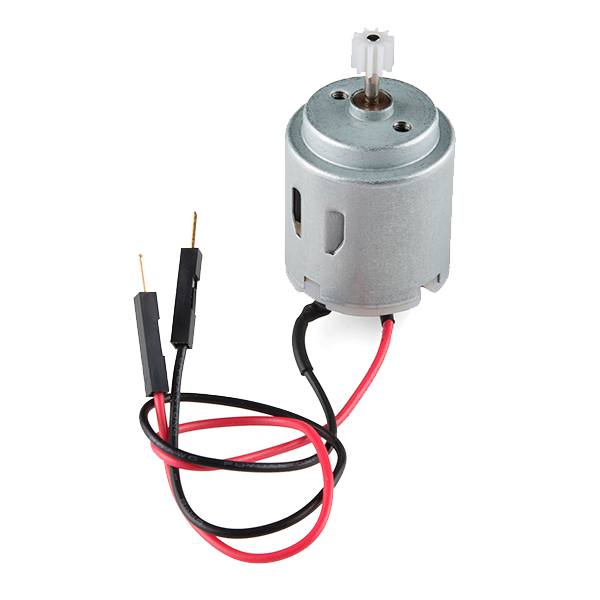 Hobby Motor - Gear
 Digital na Multimetro na Pang-laboratoryo
History & Context — an improvement, not an invention
History & Context — an improvement, not an invention
The patent. US 233,692, "Water-Wheel", granted 26 October 1880 to Lester Allan Pelton of Camptonville, California. The granted title is two words, which understates it, and the popular framing overstates it in the other direction.
🔴 Pelton did not invent the impulse water wheel, and his own specification says so in its first sentence. He writes that his invention "relates to certain improvements in that class of water-wheels known as hurdy-gurdy wheels, which are driven by the momentum of a stream of water delivered into buckets on the periphery of the wheel through a nozzle and under a high pressure". The machine existed and was in daily use in the California gold country. He also acknowledges predecessors on the exact problem he solves: "Buckets having pointed and other shaped bottoms have been used to overcome the difficulty named, and with some success." A patent that names the prior art this plainly is not claiming to have invented the category, and repeating "Pelton invented the water turbine" gets the history backwards.
What he does claim is a shape, and it is a good one. The buckets have "a bottom or bottoms formed in two distinct curves, c c, which meet in an apex at d, so that when the stream of water strikes this apex it will be divided into two parts, each of which is directed into one of the bottoms". The flaring sides then cause the two streams "to react and escape smoothly at each side, so that the whole reactionary force of the water is utilized, and the water is discharged clear of the wheel and the following bucket". Two jobs in one form: extract the momentum by turning the water back on itself, then get the spent water out of the way. Step 7 shows why the second job matters as much as the first.
Why high-head sites made this worth doing. Hydraulic mining and the mountain mines had enormous head — water falling hundreds of metres down a pipe — and modest flow. That is the opposite of a mill stream, and it suits an impulse machine, where all the pressure is converted to velocity in a nozzle and the wheel simply catches a fast jet in open air. Reaction turbines of the Francis type, running full of water under pressure, suit large flows and low heads. The two machine families are not competitors so much as answers to different sites, and Pelton wheels still run in high-head hydro stations today for exactly the reason they were adopted in the 1880s.
On the origin story. A widely repeated tale has Pelton noticing a wheel whose jet had slipped off-centre and finding it ran faster. It is a pleasing story and it matches the physics of step 12 in reverse, but the patent says nothing about it, and it should be told as tradition rather than as documented fact.
Mga Materyales
2- 1 pilyegoPlaceholder
- 1 pirasoPlaceholder
Mga Kinakailangang Kasangkapan
3- Placeholder
- Hobby Motor - Gear10% komisyon$2.54
- Placeholder
Kaugnay na Blueprint
Ang mga blueprint na ito ay nagbabahagi ng kaalaman — mga teknik, materyales, o prinsipyo

CC0 Pampublikong Domain
Ang blueprint na ito ay inilabas sa ilalim ng CC0. Malaya kang kumopya, magbago, mamahagi, at gumamit nang walang pahintulot.
Suportahan ang Maker sa pamamagitan ng pagbili ng mga produkto sa kanilang Blueprint Komisyon ng Maker itinakda ng mga Vendor, o lumikha ng bagong bersyon ng Blueprint na ito at isama bilang koneksyon sa iyong Blueprint upang ibahagi ang kita.