SINING
BEAUTY AT WELLNESS
CRAFTS
KULTURA AT KASAYSAYAN
LIBANGAN
KAPALIGIRAN
PAGKAIN AT INUMIN
REVERSE ENGINEERING
AGHAM
ISPORTS
TEKNOLOHIYA
MGA WEARABLE
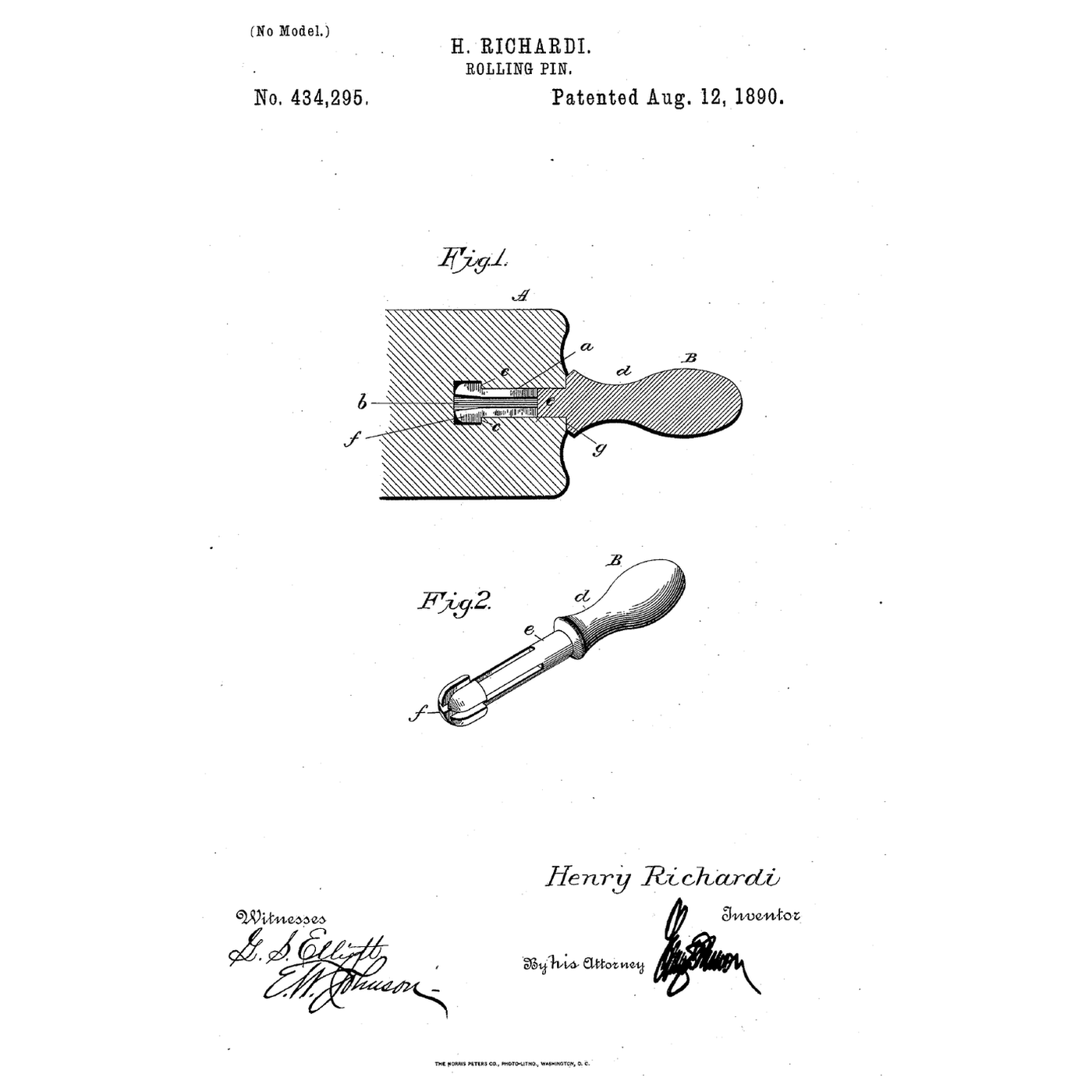


The Revolving Rolling Pin: Handles That Stay Still
A rolling pin spreads dough thinner a little at a time. If the handles turn with the roller, the hands must let them slide; if they stay still, the roller does the turning.
Henry Richardi of Bellaire, Michigan, received US 434,295, dated 12 August 1890 (filed 6 February 1890), for a rolling-pin "that permits the roller proper to revolve relative to the handles and yet consists of but three parts--to wit, the roller and the two handles", all of wood, each handle held in by a split head that springs open inside the roller.
This rung computes how many passes a dough needs and where the rubbing goes, then rolls a dough out and measures it pass by pass.
Baguhan
About 1 hour
Mga Tagubilin
1
1
Passes and rubbing
Passes and rubbing
Naglo-load ng Jupyter notebook…
2
2
Rollers for dough, by machine
Rollers for dough, by machine
The embedded blueprint is an 1884 machine with corrugated then plain rolls; the rolling pin is the hand version.
3
3
Read US 434,295
Read US 434,295
"My invention has reference to rolling-pins for household use; and it consists in the construction hereinafter set forth and claimed, whereby a simple, efficient, and inexpensive rolling-pin is provided that permits the roller proper to revolve relative to the handles and yet consists of but three parts--to wit, the roller and the two handles."
Before, a metal bolt was driven into each end of the roller to carry the handle. Instead, "The head and a portion of the journal are split crosswise" so the head can be squeezed into the roller's recess, where it springs back behind a shoulder, "and thus prevent the accidental withdrawal of the handle."
A shoulder keeps the handle "a slight distance away from the end of the roller, and thereby protect the hand from frictional contact with the revolving roller."
4
4
Rolling out, as a program
Rolling out, as a program
Blockly Workspace
Loading Blockly workspace...
5
5
Measure a dough pass by pass
Measure a dough pass by pass
Mix 300 g of flour with about 150 g of water into a firm dough, knead it smooth and rest it for 20 minutes. Flatten it to about 2 cm.
Roll as in the program, measuring the thickness with the caliper after every pass, until it is 3 mm. Count the passes and work out what fraction each pass took off; compare with the notebook. Roll one half holding the handles and the other half with your palms on the roller, and note which is easier to keep even.
Mga materyales para sa hakbang na ito:
 Harina300 g
 Tubig1 piraso
Mga kailangang kasangkapan:
 Rolyong panggiling ng masa
 Digital na Kalibrador 6 Pulgada
 Digital na Timbangang Pangkusina
 Ruler
Ruler6
6
Dough that springs back, tears or rolls uneven
Dough that springs back, tears or rolls uneven
Rolling-pin troubleshooting.
Flow
Loading...
7
7
History and honest limits
History and honest limits
**Henry Richardi** of Bellaire, Antrim County, Michigan, filed US 434,295 on 6 February 1890; it is dated 12 August 1890. He says he does not claim a revolving handle as such, only his three-part all-wood construction.
**Honest limits.** The pass count assumes the same fraction off every pass; real dough changes as it is worked. The rubbing figures are simple sliding-friction estimates with example values. Your caliper readings are the measurement.
Mga Kinakailangang Kasangkapan
4- Placeholder
- Placeholder
- Placeholder
- Placeholder
Kaugnay na Blueprint
Ang mga blueprint na ito ay nagbabahagi ng kaalaman — mga teknik, materyales, o prinsipyo


CC0 Pampublikong Domain
Ang blueprint na ito ay inilabas sa ilalim ng CC0. Malaya kang kumopya, magbago, mamahagi, at gumamit nang walang pahintulot.
Suportahan ang Maker sa pamamagitan ng pagbili ng mga produkto sa kanilang Blueprint Komisyon ng Maker itinakda ng mga Vendor, o lumikha ng bagong bersyon ng Blueprint na ito at isama bilang koneksyon sa iyong Blueprint upang ibahagi ang kita.