فن
خوبصورتی اور تندرستی
دستکاری
ثقافت اور تاریخ
تفریح
ماحول
خوراک اور مشروبات
ریورس انجینئرنگ
سائنسز
کھیل
ٹیکنالوجی
پہننے والے آلات
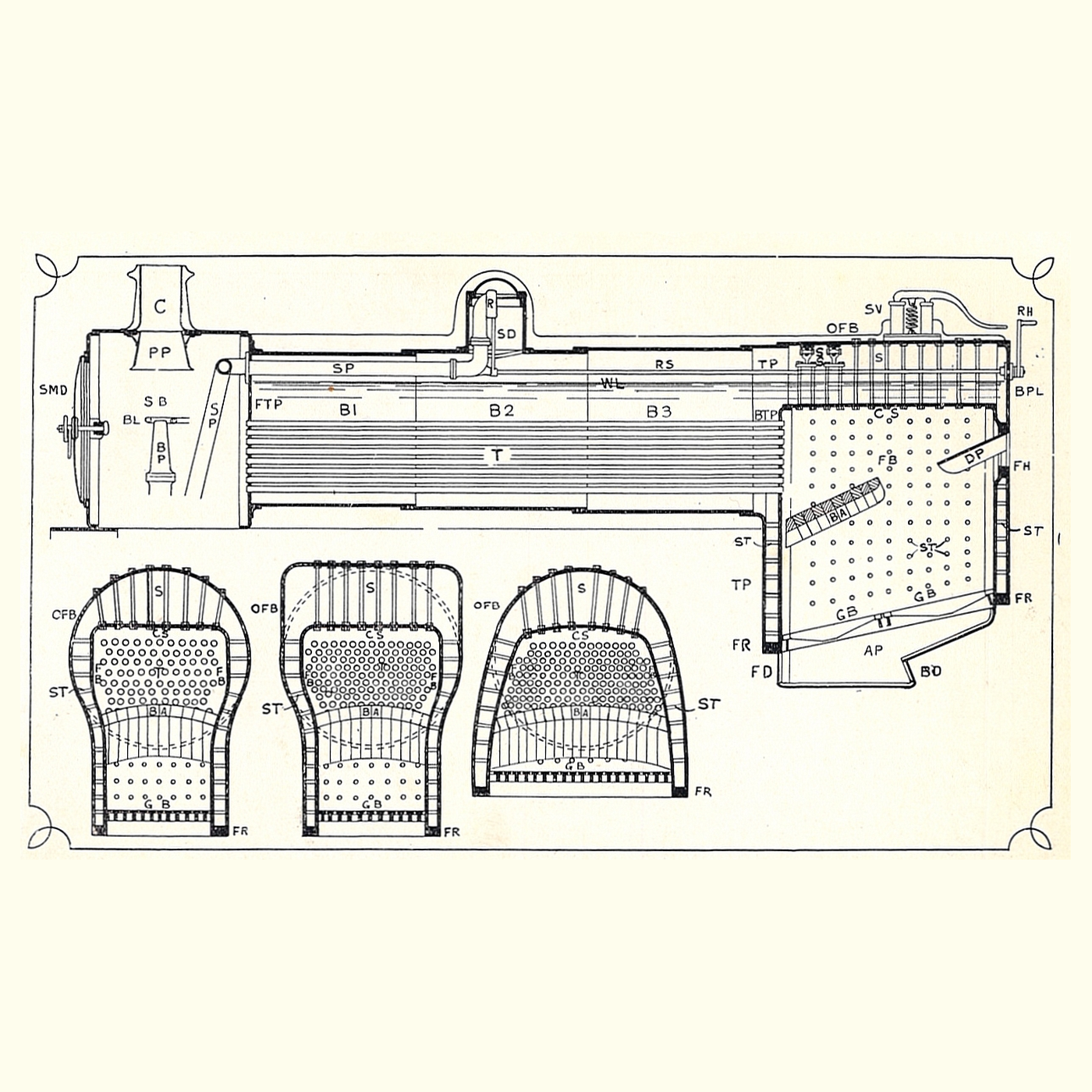

The Fire-Tube Boiler: Surface, Not Fire, Makes Steam
Early boilers were big vessels of water with a fire under them, or a single flue through them. They wasted most of their fuel up the chimney, because hot gas gives up its heat to a wall reluctantly and a single flue offers very little wall.
The multi-tubular boiler split the hot gas among many small tubes running through the water. With the same flow area, the heating surface multiplies — and the gas leaves cool instead of red hot. Marc Seguin in France and Henry Booth, for Stephenson's Rocket of 1829, put it to work, and it became the boiler of every steam locomotive.
This rung never builds a pressure vessel. It measures the principle on the bench with hot air and an open pot of water, and works out why many small tubes beat one big one.
درمیانہ
About 4 hours
ہدایات
1
1
Why one big flue wastes the fire
Why one big flue wastes the fire
Jupyter نوٹ بک لوڈ ہو رہی ہے…
2
2
Build two heat exchangers with the same flow area
Build two heat exchangers with the same flow area
Cut two test sections, each 400 mm long, to sit across an insulated box of water:
- **A:** one copper tube of 22 mm bore.
- **B:** a bundle of small copper tubes whose bores add up to the same area — four tubes of about 11 mm bore, or nine of about 7 mm — soldered through two end plates of copper sheet, so the hot air must go through the small tubes.
Pass each section through holes in opposite walls of the insulated box, sealed with silicone, so the tubes run underwater and both ends stay dry and open. The box is open at the top. **Nothing here is ever closed or pressurised.**
اس مرحلے کے لیے مواد:
 تانبے کی نلکی3 میٹر
 تانبے کی چادر1 شیٹ
 ٹن-سیسے کا ٹانکہ50 گرام
 سلیکون سیلنٹ1 ٹکڑا
درکار اوزار:
 نلی کاٹنے کا اوزار
 پروپین مشعل
 بے تار مشق
 مشقوں کا سیٹ
 ڈیجیٹل ورنیئر کیلیپر ۶ انچ
 چمڑے کے کام کے دستانے
 شفاف حفاظتی عینک
 پلمبنگ کا فلکس
 حرارت روکنے والا صندوق
3
3
Blow the same hot air through each and time the water
Blow the same hot air through each and time the water
Fill the box with 5 litres of cold water and put a thermometer in it. Clamp the heat gun at a fixed distance from the inlet of section A, on its fixed high setting, and run it for ten minutes, stirring and reading the water every minute. Hold the thermometer in the air stream at the tube's outlet and note its temperature too.
Refill with water at the same starting temperature and repeat with section B.
Section B heats the water faster and its outlet air comes out cooler: the same air, the same flow area, more wall. Work out the heat each delivered: 5 kg × 4.19 kJ/kg·K × the temperature rise, divided by 600 seconds, in kilowatts.
اس مرحلے کے لیے مواد:
 پانی10 لیٹر
درکار اوزار:
 گرم ہوا کی بندوق
 باورچی خانے کا تھرمامیٹر
 اسٹاپ واچ
 ڈیجیٹل ترازوچمڑے کے کام کے دستانے
4
4
Read a locomotive boiler
Read a locomotive boiler
A locomotive fire-tube boiler has four parts, and each exists for surface or for safety:
- the **firebox**, a box of water-backed plates around the fire, taking radiant heat;
- the **tubes**, carrying the hot gas the length of the barrel through the water — the surface this rung is about;
- the **smokebox**, where the gas collects and the exhaust steam blast draws it up the chimney;
- the **stays**, hundreds of rods tying the flat firebox plates to the outer shell, because a flat plate under pressure bulges and a round shell does not.
The weakness is scale: every mineral in the water is left behind on the tubes as it boils, and scale is an insulator. Tubes are cleaned and replaced as a routine.
5
5
History and context
History and context
The multi-tubular boiler is usually credited to **Marc Seguin**, who patented a boiler with many small tubes in France in the late 1820s, and to **Henry Booth**, who proposed the same arrangement for Robert Stephenson's *Rocket*, winner of the Rainhill trials of 1829; the *Rocket*'s boiler had 25 copper tubes. No patent number is asserted here — the principle is the payload, and it is fully documented.
It followed the single-flue Cornish boiler and the twin-flue Lancashire boiler, and it was followed by the water-tube boiler (rung 3 of this batch), which turned the idea inside out.
**Honest limits.** A fire-tube boiler holds a large mass of water in a big shell, so the stored energy if the shell fails is enormous, and the shell's size limits the pressure it can hold. It is slow to raise steam. It scales. **Boilers are pressure vessels and are built, tested and inspected under regulation; do not build one.**
مواد
5- 3 میٹرپلیس ہولڈر
- 1 شیٹپلیس ہولڈر
- 50 گرامپلیس ہولڈر
- 1 ٹکڑاپلیس ہولڈر
- 10 لیٹرپلیس ہولڈر
درکار اوزار
13- پلیس ہولڈر
- پلیس ہولڈر
- 1 vendor sell this, none ship to you yetپلیس ہولڈر
- پلیس ہولڈر
- پلیس ہولڈر
- پلیس ہولڈر
- پلیس ہولڈر
- پلیس ہولڈر
- پلیس ہولڈر
- 1 vendor sell this, none ship to you yetپلیس ہولڈر
- پلیس ہولڈر
- پلیس ہولڈر
- پلیس ہولڈر
متعلقہ بلیو پرنٹ
یہ بلیو پرنٹ علم بانٹتے ہیں — تکنیک، مواد یا اصول

Building a Newcomen Atmospheric Engine — The First Engine to Do Real Work
Dwalin کی طرف سے
میکانکس
65
0
0
0
0
0
Rotative Beam Engine
Martin کی طرف سے
ٹیکنالوجی
42
0
0
0
1
0
Safety Relief Valve
Penny کی طرف سے
ٹیکنالوجی
43
0
0
0
0
0
The Steam Injector: Feeding a Boiler With Its Own Steam
Martin کی طرف سے
میکانکس
48
0
0
0
0
0
Cooling Is a Process Too: Still Air, Insulated, or Quenched
Penny کی طرف سے
سیرامکس اور مٹی
42
0
0
0
0
0
CC0 پبلک ڈومین
یہ بلیو پرنٹ CC0 کے تحت جاری کیا گیا ہے۔ آپ اجازت لیے بغیر اس کام کو نقل، ترمیم، تقسیم اور کسی بھی مقصد کے لیے استعمال کرنے کے لیے آزاد ہیں۔
میکر کی حمایت کریں ان کے بلیو پرنٹ کے ذریعے پروڈکٹس خرید کر جہاں وہ میکر کمیشن وینڈرز کی طرف سے مقرر، کماتے ہیں، یا اس بلیو پرنٹ کی نئی تکرار بنائیں اور آمدنی شیئر کرنے کے لیے اسے اپنے بلیو پرنٹ میں کنکشن کے طور پر شامل کریں۔