SZTUKA
Piękno i dobre samopoczucie
RZEMIOSŁO
KULTURA I HISTORIA
ROZRYWKA
ŚRODOWISKO
JEDZENIE I NAPOJE
INŻYNIERIA ODWROTNA
NAUKI
LEKKOATLETYKA
TECHNOLOGIA
URZĄDZENIA DO NOSZENIA
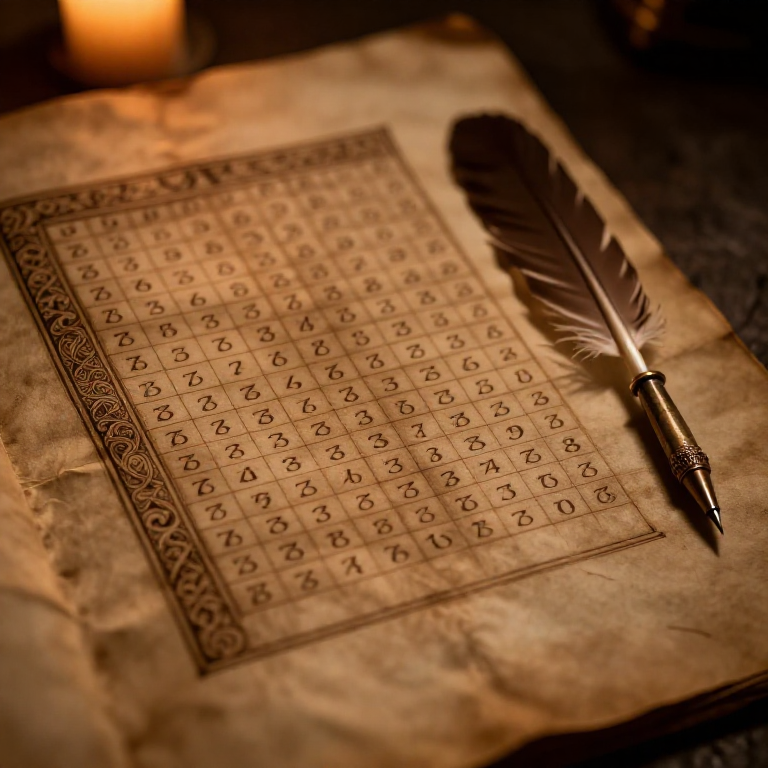


Magic Squares — Arrange Numbers So Every Line Adds the Same
A hands-on maths puzzle: cut number tiles 1 to 9 and arrange them in a 3 by 3 square so every row, column and diagonal adds to 15. A Python cell checks any square you make, and a compendium reveals the maths (and the artist Durer) hidden inside these ancient number patterns.
Początkujący
30 minutes
Instrukcje
1
1
Numbers that balance
Numbers that balance
A magic square is a grid where every row, every column and both diagonals add up to the same total. The oldest, the Chinese Lo Shu, is thousands of years old. You will build one with your hands.
2
2
Make your number tiles
Make your number tiles
Cut nine small squares of card and write the numbers 1 to 9, one on each tile. Draw an empty 3 by 3 grid to place them in.
Materiały do tego kroku:
 Zestaw kolorowych brystoli1 sztuka
Potrzebne narzędzia:
 Nożyczki
 Zestaw ołówków grafitowych
3
3
Solve the puzzle
Solve the puzzle
Arrange the nine tiles in the grid so that every row, every column and both diagonals add up to 15. Hint: the numbers 1 to 9 add to 45, and 45 divided by 3 rows is 15, so 15 is the target. Another hint: 5 belongs in the middle. Keep swapping tiles until every line makes 15.
4
4
Check your square
Check your square
Wczytywanie notatnika Jupyter…
Potrzebne narzędzia:
 Komputer stacjonarny
5
5
Compendium: the maths inside
Compendium: the maths inside
What you discovered. (1) For a square of side n using 1 to n-squared, the magic total is always n times (n-squared plus 1) over 2 -- 15 for a 3x3, 34 for a 4x4. (2) There is really only ONE 3x3 magic square; every solution you find is just that one rotated or flipped. (3) Bigger squares have their own tricks -- odd sizes can be filled by the 'always step up and to the right' Siamese method. (4) In 1514 the artist Albrecht Durer hid a 4x4 magic square in his engraving Melencolia I, with the year 1514 tucked into its bottom row -- proof that mathematicians and artists have loved these balanced numbers for centuries.
Materiały
2- 1 sztukaZastępnik
- 1 arkuszZastępnik
Wymagane narzędzia
3- Zastępnik
- Zastępnik
- Zastępnik
Powiązane blueprinty
Te blueprinty dzielą się wiedzą — technikami, materiałami lub zasadami
CC0 Domena publiczna
Ten plan jest udostępniany na licencji CC0. Możesz go swobodnie kopiować, modyfikować, rozpowszechniać i wykorzystywać do dowolnych celów, bez konieczności uzyskiwania zgody.
Wesprzyj Makera kupując produkty przez jego plan, za co zarabia Prowizja Makera ustalony przez sprzedawców, lub stwórz nową iterację tego planu i dołącz go jako połączenie w swoim własnym planie, aby dzielić się przychodami.