

Baudot Code and the Teleprinter
Morse code is beautifully efficient for a human ear and nearly useless to a machine. Its symbols have different lengths — E is one short mark, Y is four mixed ones — so a receiver cannot know where one letter ends until it recognises the letter. Recognition has to come before segmentation, and that is a job for a trained brain.
Baudot's code inverts the priority. Every character is exactly five units long. Nothing is shorter, nothing is longer.
Now a machine needs no intelligence at all: count five, that is a character, look it up; count five more. Segmentation is arithmetic, and a stepping mechanism can do arithmetic.
The price is paid honestly. Fixed length is less efficient than Morse for a human — five units for E as well as for Q — and five bits gives only 2⁵ = 32 combinations, which will not hold letters, digits and punctuation. The fix is a shift: two special codes that switch the whole table between letters and figures, so 32 codes address roughly 60 characters, at the cost of a receiver that must remember which mode it is in.
That is the first appearance of a bargain the whole industry keeps making: give up some efficiency, gain the ability to be handled by a machine that understands nothing.
Instrukcje
Try to segment Morse without understanding it
Try to segment Morse without understanding it
Write out a short message in Morse as a bare string of dots and dashes with the gaps removed, and hand it to someone with a code table.
Ask them to find the letter boundaries.
Expect it to be ambiguous — many strings split several ways into valid letters — and expect them to resolve it by guessing which reading makes a word.
Write down what that proves: Morse relies on the GAPS, and the gaps are timing that a listener judges. A code whose boundaries are carried by silence of the right duration is a code for a nervous system, not for a ratchet.
Materiały do tego kroku:
 Papier1 sztuka
Build the five-unit table and count what it holds
Build the five-unit table and count what it holds
Write out all combinations of five binary units. Count them: 32.
Now list what a telegram actually needs — 26 letters, ten digits, full stop, comma, space, carriage return, line feed — and find that it does not fit.
Resist the temptation to add a sixth unit and note what it would cost: every character in every message becomes 20 % longer, forever, to accommodate symbols that are rare.
Sizing a code is an argument about the common case, not the complete case.
Materiały do tego kroku:
Papier1 sztukaIntroduce a shift, and then break it on purpose
Introduce a shift, and then break it on purpose
Assign two of your 32 codes to LETTERS and FIGURES, and make a second table for figures and punctuation. Exchange messages with a partner using both.
Now corrupt a single shift character in transit and hand the message on.
Expect everything after that point to decode as nonsense, and to stay nonsense until the next shift arrives.
This is the cost of state. A code where each symbol means the same thing always is robust; a code with modes is compact and fails catastrophically rather than locally. Real teleprinter practice sent shift characters far more often than strictly needed, precisely to limit the blast radius.
Materiały do tego kroku:
Papier1 sztukaAdd start and stop, and find why they are worth the waste
Add start and stop, and find why they are worth the waste
Send a continuous stream of five-unit characters to a partner who begins reading at a moment of their choosing.
Expect them to be reliably wrong, splitting every character across a boundary, with no way to notice.
Now wrap each character with a start unit and a stop unit and repeat.
Expect them to find the framing within one character.
Then compute the overhead: seven or more units carrying five units of content, roughly 30 % thrown away. That is the price of being able to join a conversation already in progress, and every asynchronous serial link since has paid it.
Interleave two messages on one line
Interleave two messages on one line
With two senders and two receivers, agree that characters alternate strictly: sender A, sender B, A, B. Run both conversations at once down a single line.
Expect it to work perfectly while the rhythm holds and to interleave into gibberish the moment one party is late.
This is time-division multiplexing, and Baudot's machine did it with a rotating distributor sweeping contacts. Fixed-length characters are what make it possible: you cannot allocate equal time slots to symbols of unequal length.
Note the connection to the Quadruplex blueprint — the same goal, more traffic per wire, reached by dividing time rather than by stacking independent electrical properties.
History & Context
History & Context
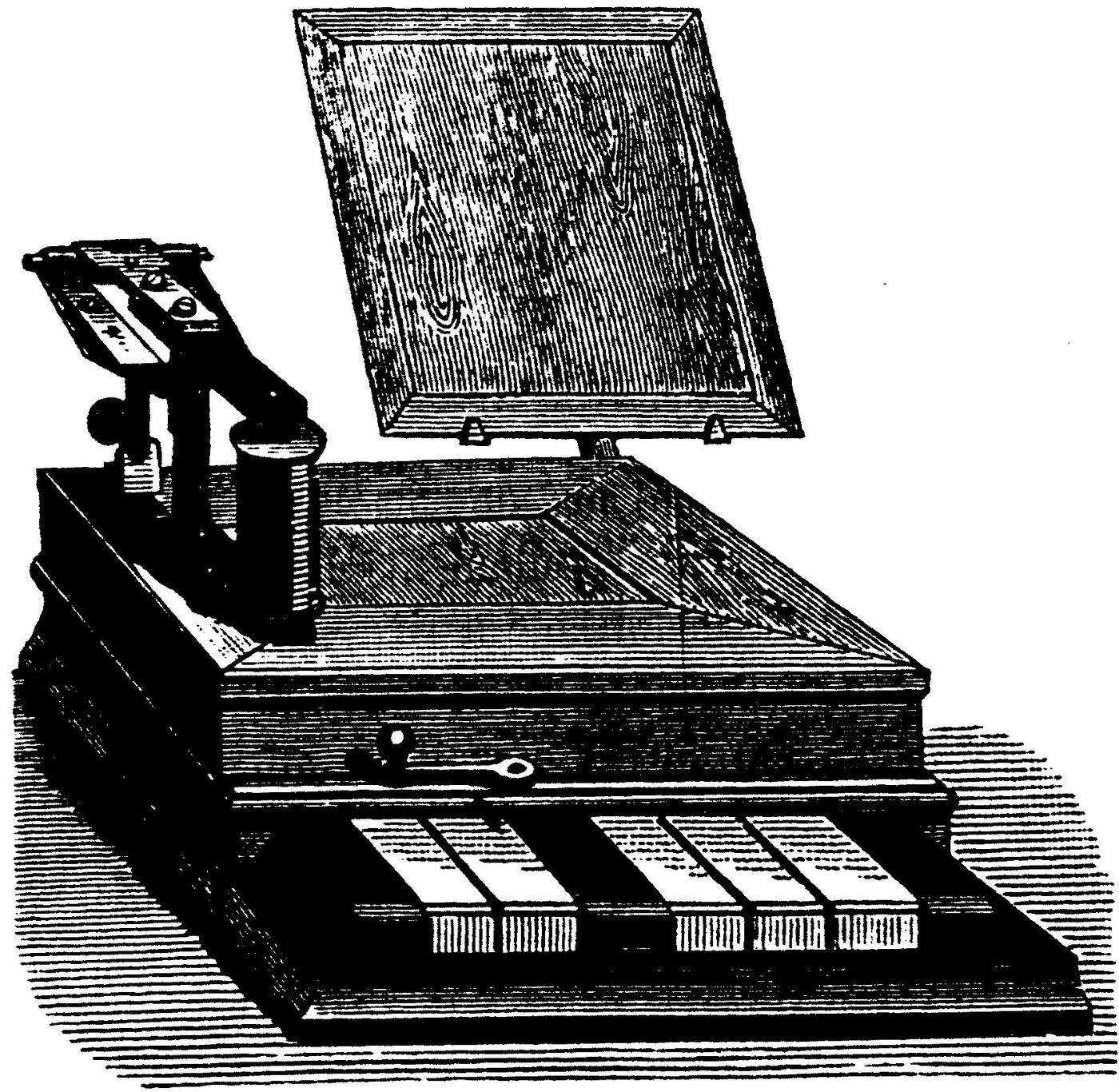
Émile Baudot was a French telegraph engineer, and his 1874 system was designed around the operator's hands. The keyboard had five keys, played like a chord — two for the left hand, three for the right — and a rotating distributor gave each of several operators a slice of the line in turn. The code was arranged so that the commonest letters fell on the easiest chords. The unit of transmission speed, the baud, is named after him.
Then Donald Murray changed the priority from hands to machines. Around 1901 he rearranged the code for a typewriter-style keyboard and a mechanical printer, choosing assignments that minimised WEAR on the machinery rather than effort for the operator. That revision, standardised later as International Telegraph Alphabet No. 2, is what the world's telex networks ran on for most of the twentieth century. A code is shaped by whatever is most expensive at the time — first fingers, then mechanisms, later memory and bandwidth.
The lineage runs straight to ASCII and Unicode. Fixed-length characters, explicit control codes, a shift to extend a small table, and framing bits around each character all survive. ASCII widened to seven bits so that letters and digits and punctuation could coexist without modes — buying robustness with width, the opposite of Baudot's trade. Unicode later did it again, and the shift-state problem reappeared for a while in multi-byte encodings, with exactly the failure mode of step 3.
The idea to keep is the reframing. Morse asks 'what is the shortest way to say this to a person?' Baudot asks 'what is the simplest thing a stupid machine can decode without ever understanding it?' Those questions have different answers, and the second one built the automated world. Compression came back later, once machines were clever enough — but it came back on top of a fixed-length substrate, not instead of one.
Honest limits. Five bits is not enough for real text, so the shift is not optional and the state it creates is a permanent hazard. Fixed length wastes capacity on common letters. There is no error detection whatsoever — a corrupted bit silently becomes a different valid character. Case is absent entirely; telex was upper case for its whole life. And the mechanical teleprinter that made it practical is a heavy, noisy, precisely adjusted machine that needed regular skilled attention.
Materiały z połączonych planów

Powiązane blueprinty
Te blueprinty dzielą się wiedzą — technikami, materiałami lub zasadami
CC0 Domena publiczna
Ten plan jest udostępniany na licencji CC0. Możesz go swobodnie kopiować, modyfikować, rozpowszechniać i wykorzystywać do dowolnych celów, bez konieczności uzyskiwania zgody.
Wesprzyj Makera kupując produkty przez jego plan, za co zarabia Prowizja Makera ustalony przez sprzedawców, lub stwórz nową iterację tego planu i dołącz go jako połączenie w swoim własnym planie, aby dzielić się przychodami.