

Condensed Milk
Before refrigeration, fresh milk was dangerous. In a nineteenth-century city it travelled for hours in the heat, was watered down and adulterated by dealers, and soured fast — "swill milk" from distillery cows killed thousands of infants. Milk simply did not keep, and everyone knew it.
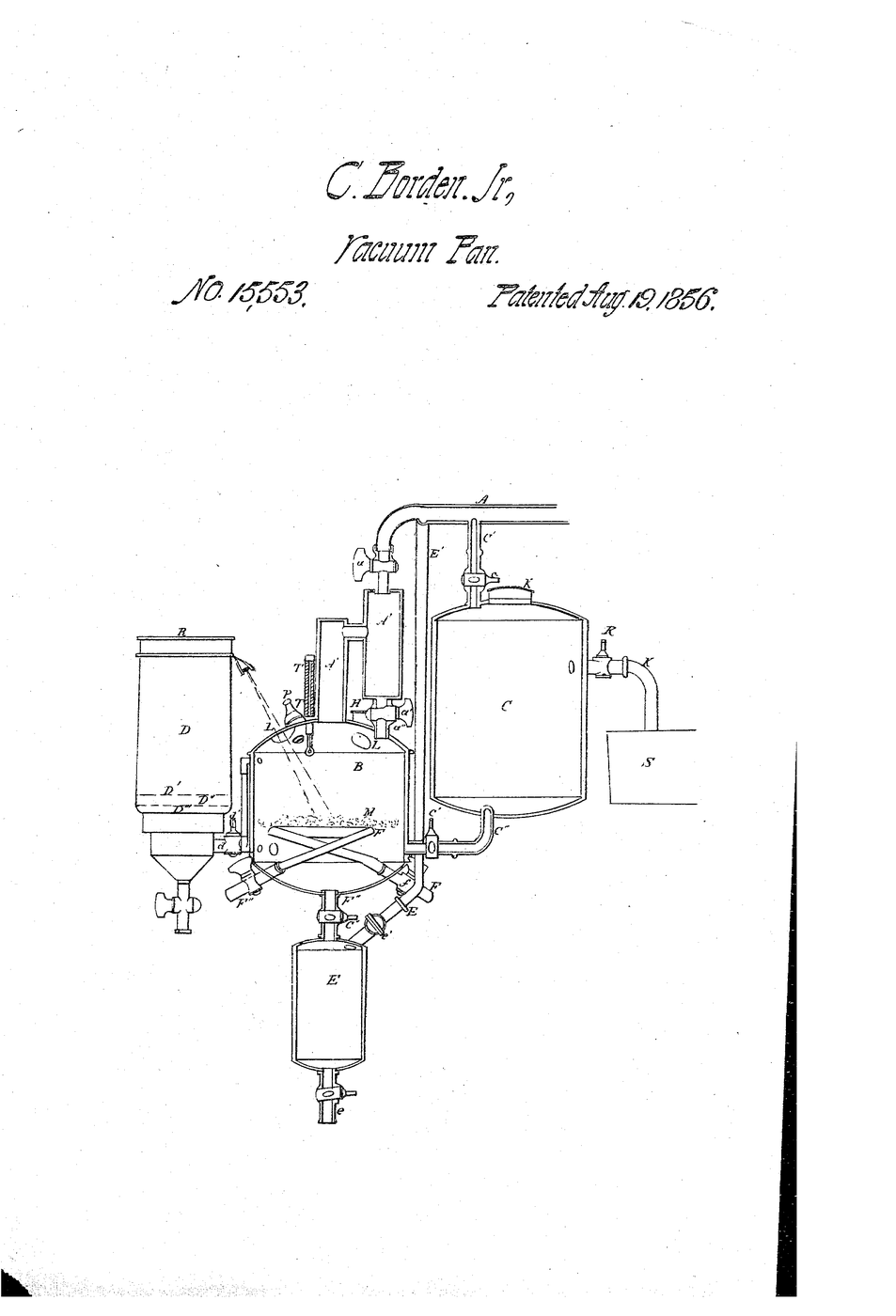
Borden's idea is to boil the water out of milk without ruining it — and the trick is the vacuum. In an open pan, milk hot enough to evaporate quickly scorches and curdles. Under a vacuum, water boils at a much lower temperature, so the milk can be reduced to a fraction of its volume gently, "out of contact with the atmosphere," which also keeps airborne germs out.
Note what his patent does NOT claim: sugar. The sweetened condensed milk in shops came later; Borden's patented process is the vacuum concentration itself. Reduced and canned, milk finally kept for months.
US Patent 15,553, "Improvement in concentration of milk", granted 19 August 1856 to Gail Borden Jr.
Instrukcje
Read the claim: concentrate in vacuo
Read the claim: concentrate in vacuo
Borden claims concentrating milk "in a vacuum-vessel, out of contact with the atmosphere". Note the two ideas: remove water, and keep air out. And note: no sugar in the claim.
Measure and weigh 200 ml of milk
Measure and weigh 200 ml of milk
Start with 200 ml of whole milk. Record its volume and mass — you will reduce it and measure how far.
Materiały do tego kroku:
 Mleko pełnotłuste400 ml
Potrzebne narzędzia:
 Waga szalkowa
Scald it first at 60-90 °C
Scald it first at 60-90 °C
Heat 200 ml gently to 60-90 °C and hold briefly. Borden scalds first: some albumen coagulates and would otherwise coat and scorch the boiler. Note the thin skin that forms.
Potrzebne narzędzia:
 Termometr kuchenny
Boil a second 200 ml HARD in an open pan
Boil a second 200 ml HARD in an open pan
Take fresh milk and boil it fast and hot in an open pan to reduce it. It scorches, browns and skins over. This is why you cannot just boil milk down — the flavour and colour are ruined.
Understand why vacuum lowers the boiling point
Understand why vacuum lowers the boiling point
Water boils when its vapour pressure meets the surrounding pressure. Lower the pressure and it boils cooler — so under vacuum, milk evaporates at 50-60 °C and never scorches. Write down why.
Rig a simple reduced-pressure vessel
Rig a simple reduced-pressure vessel
Put warm milk in a jar and draw air out with a syringe to lower the pressure above it. Watch bubbles form at a temperature far below a normal boil — the vacuum principle, at bench scale.
Materiały do tego kroku:
 Słoik szklany1 sztuka
Potrzebne narzędzia:
 Strzykawka laboratoryjna
Reduce the scalded milk gently to half
Reduce the scalded milk gently to half
Evaporate the scalded milk slowly and gently until it is about half its starting volume. Keep it below a hard boil. It thickens and turns pale cream.
Weigh it and work out the water removed
Weigh it and work out the water removed
Weigh the reduced milk. The mass lost is water driven off. Compute the percentage removed — that is the whole point of "condensed."
Compare the two reductions side by side
Compare the two reductions side by side
Set the gently-reduced milk beside the open-boiled one. Same water removed, completely different product — one pale and sweet-smelling, one brown and burnt. The gentleness is the invention.
Seal a sample hot in a clean jar
Seal a sample hot in a clean jar
Pour the reduced milk hot into a sterilised jar and seal at once. Removing water lowers the moisture microbes need; sealing keeps new ones out. This is what let milk travel and keep.
Materiały do tego kroku:
Słoik szklany1 sztukaCompare against sweetened condensed milk
Compare against sweetened condensed milk
Taste a little shop sweetened condensed milk. It is thick and very sweet — sugar was added as an extra preservative later, and is NOT in Borden's patent. Note the difference between his process and the familiar product.
Reconstitute with water and taste
Reconstitute with water and taste
Add back the water you removed and taste. Concentrating is reversible — that is why condensed milk was shipped dry-ish and made back into drinkable milk far from any cow.
History & Context — the vacuum that made milk keep
History & Context — the vacuum that made milk keep
The patent. US 15,553, "Improvement in concentration of milk", granted 19 August 1856 to Gail Borden Jr. The specification is precise about the mechanism: a vacuum boiler connected to an air-pump and condenser, a vacuum reservoir to hold the new milk out of the air, a thermometer and a vacuum gauge, and the instruction to scald the milk at 150-200 °F first so coagulating albumen does not coat the boiler. Every one of those details is on the page, and steps 3, 5 and 6 reproduce them.
Read what he actually claims — it is not sugar. Borden's patented invention is concentrating milk in a vacuum, out of contact with the atmosphere. The sweetened condensed milk sold today adds a great deal of sugar, which raises the osmotic pressure and helps preserve it — but that is a later commercial refinement, not the patent. Saying "Borden invented sweetened condensed milk" gets the chemistry backwards: his contribution is the gentle vacuum evaporation that keeps milk from scorching (step 9), which works with or without sugar. Unsweetened evaporated milk (sterilised in the can) is the closer descendant of what he patented.
Why it mattered so much. City milk in the 1850s was genuinely lethal — adulterated, unrefrigerated, and often "swill milk" from cows fed distillery waste, which killed enormous numbers of infants. Borden had watched children die on an immigrant ship for want of clean milk, and set out to make milk that could travel and keep. His timing was made by the American Civil War: the Union Army bought his condensed milk by the trainload as a safe, storable field ration, and soldiers came home having learned to trust the can. That government demand turned a struggling idea into the Borden company and the Eagle Brand that followed.
Where it sits in the bigger story. Condensed milk is one of a cluster of nineteenth-century food-preservation breakthroughs — Appert's canning, Pasteur's heat treatment — that together broke the tie between where food was produced and where it could be eaten. That is the quiet revolution behind the industrial city: it could not have been fed on fresh milk from nearby cows, and vacuum-concentrated, canned milk was one of the things that made feeding it possible. The physics you used in step 5 — lower the pressure, lower the boiling point — is still exactly how milk is condensed industrially today, in giant falling-film vacuum evaporators.
Materiały
2- 400 mlZastępnik
- 1 sztukaZastępnik
Wymagane narzędzia
3- Zastępnik
- Zastępnik
- Zastępnik
Powiązane blueprinty
Te blueprinty dzielą się wiedzą — technikami, materiałami lub zasadami



CC0 Domena publiczna
Ten plan jest udostępniany na licencji CC0. Możesz go swobodnie kopiować, modyfikować, rozpowszechniać i wykorzystywać do dowolnych celów, bez konieczności uzyskiwania zgody.
Wesprzyj Makera kupując produkty przez jego plan, za co zarabia Prowizja Makera ustalony przez sprzedawców, lub stwórz nową iterację tego planu i dołącz go jako połączenie w swoim własnym planie, aby dzielić się przychodami.