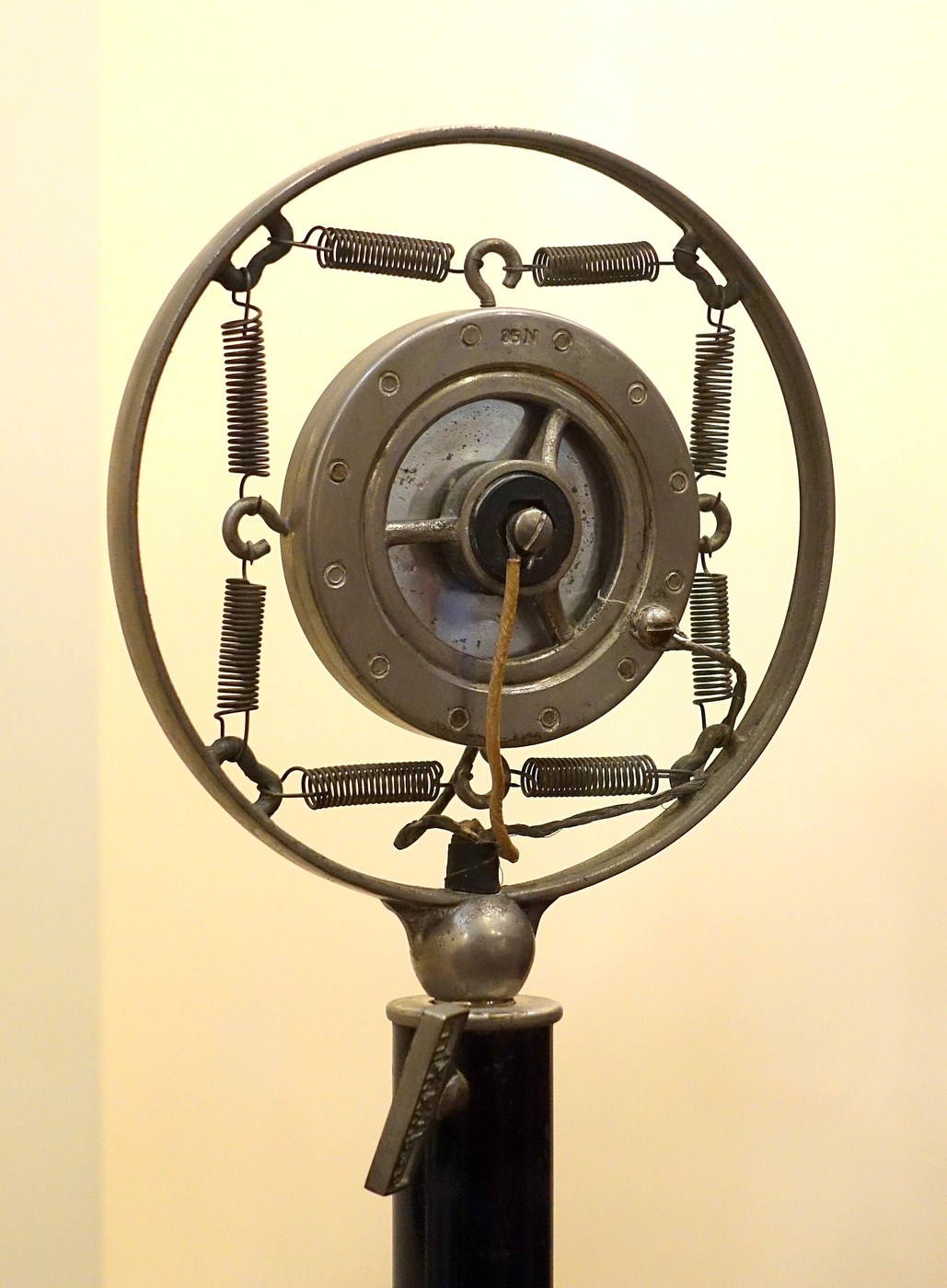


The Carbon Microphone
Bell's telephone worked, and it was too quiet to be a business. Its transmitter generated its own current by moving a magnet — so all the energy in the message came from the speaker's voice, which is a fraction of a watt spread over a room. Across a few miles of wire, that is a whisper.
The carbon transmitter abandons the idea of generating the signal at all. It modulates a current that is already there.
Carbon granules packed loosely behind a diaphragm carry current through thousands of tiny contacts. Press them together and the contacts widen and multiply, so resistance falls; release them and it rises. Sound waves squeeze and relax the packing, and a battery's steady current is shaped into a copy of the sound.
The consequence is amplification without an amplifier. The voice does almost no work — it only nudges the granules — while a battery supplies the power. A device with gain arrived decades before the vacuum tube, built from soot.
The physics is the sensitive part. Resistance at a loose contact is dominated not by the material but by the tiny actual area where two surfaces truly touch, which changes dramatically with the gentlest pressure. That is why it is so sensitive — and why it hisses, packs down and eventually needs a thump.
Instrukcje
Find out how little pressure changes a loose contact
Find out how little pressure changes a loose contact
Rest two pieces of graphite lightly against each other in a circuit with a battery and a meter. Now press them together by hand, gently, and watch the reading.
Expect resistance to fall enormously for a very small force — a large fractional change from a touch you can barely feel.
Then press a solid graphite block's two ends and see almost nothing change.
The difference is the whole subject. The sensitivity is in the CONTACT, not in the carbon. Bulk resistance is a material property and is boring; contact resistance is a geometry that a sound wave can move.
Materiały do tego kroku:
 Blok grafitowy1 sztuka
 Proszek grafitowy50 g
Potrzebne narzędzia:
 Multimetr analogowy
 Przewody pomiarowe z krokodylkami
Use many contacts instead of one
Use many contacts instead of one
Fill a small shallow cup with coarse graphite or crushed carbon granules between two electrodes, and measure resistance while tapping the cup.
Compare the steadiness and the sensitivity with your single contact from step 1.
Expect a granular cell to be less erratic and more linear, because thousands of contacts in parallel average out the wild behaviour of any one.
Note the general move: a single unreliable element becomes a usable component when you use a great many of them at once. The same reasoning appears in composites, in sintered materials and in statistics.
Put a diaphragm on it and speak
Put a diaphragm on it and speak
Close the granule cup with a taut disc of thin card, foil or drum skin so that sound pressure squeezes the granules, and put the cell in series with a battery and a loudspeaker or headphone.
Speak at the diaphragm.
Expect to hear your voice, loudly.
Then compute the honest comparison: measure the electrical power reaching the speaker and estimate the acoustic power arriving at the diaphragm.
Expect the output to be far larger. The extra came from the battery. You have built a device with gain out of a cup of soot, and it is worth pausing on how strange that is.
Find the noise, and where it comes from
Find the noise, and where it comes from
Leave the microphone perfectly still and silent, and listen to the output at high volume.
Expect a persistent hiss and occasional crackles.
Now increase the battery current and listen again; then tap the cell and listen to it settle.
Expect noise to grow with current and to change character after disturbance.
The cause is the mechanism itself: contacts are constantly making and breaking at the micro scale, so the resistance is genuinely fluctuating. This noise is not a defect to be engineered away — it is the same physics as the sensitivity, and you cannot have one without the other.
Pack it down and prove why telephones were thumped
Pack it down and prove why telephones were thumped
Run the microphone continuously, vibrating it gently for a while, and watch the resting resistance and the output level.
Expect the granules to settle and compact, resistance to drift, and sensitivity to fall.
Now rap the case sharply and watch both recover.
You have just discovered why generations of people hit the telephone. It is not superstition and it is not a bad connection: the sensing element loses the loose packing it depends on, and a knock restores it. A component whose correct state is 'not settled' will always drift towards being settled.
History & Context
History & Context
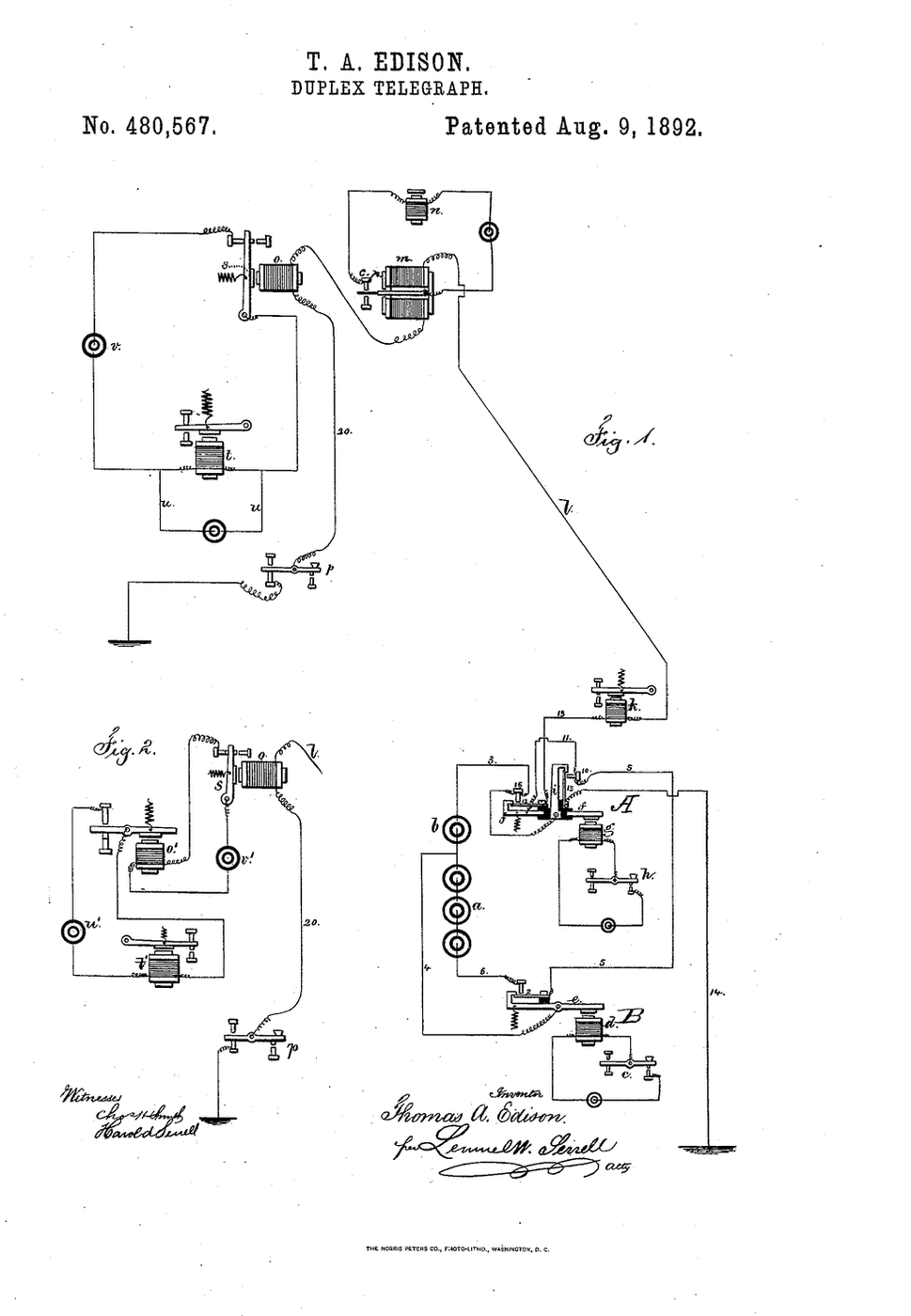
Three people have a serious claim, and the corpus should say so rather than pick one. David Edward Hughes demonstrated a loose-contact carbon transmitter to the Royal Society in 1878, named the microphone, and deliberately did not patent it, holding that it should be free to all. Emile Berliner filed on a tight-contact transmitter in 1877. Thomas Edison patented a carbon transmitter in the same period, and his design — carbon granules, robust and loud — is the one that went into service.
The courts settled it and historians have not. In 1892 the US Supreme Court invalidated Berliner's patent and held that the use of carbon in a telephone transmitter was the invention of Edison. That is legally final and widely disputed on the merits. Per this corpus's rule, function is the payload and attribution is metadata: the mechanism in steps 1–3 is not in doubt, and all three names belong on it.
It is what made the telephone a network instead of a demonstration. Bell's magneto transmitter could not drive a long line; a carbon transmitter with a local battery could. Everything about the telephone system that followed — exchanges like the one in the Strowger blueprint, subscriber loops, the whole idea of a phone in every house — rests on the fact that the instrument itself had gain and could be made for very little money.
It survived for a century because nothing beat it on cost per useful decibel. Carbon transmitters were still standard in telephone handsets into the 1980s, long after far better microphones existed, because they needed no amplifier, no delicate electronics and no maintenance beyond the occasional knock. Better technology does not displace adequate technology until the whole system cost changes — in this case, until cheap transistors made an electret capsule plus an amplifier cost less than a carbon capsule.
Honest limits. It hisses, and the hiss is inseparable from the sensitivity. Frequency response is poor and uneven, which is why old telephone speech is instantly recognisable. It distorts, because resistance does not vary linearly with pressure. The granules pack, so performance drifts and needs mechanical disturbance. It needs a direct current flowing at all times, so it consumes power continuously. And it is position-sensitive — turn it over and it behaves differently.
Materiały
2- 1 sztukaZastępnik
- Zastępnik
Wymagane narzędzia
2- Zastępnik
- Zastępnik
Materiały z połączonych planów

Powiązane blueprinty
Te blueprinty dzielą się wiedzą — technikami, materiałami lub zasadami
CC0 Domena publiczna
Ten plan jest udostępniany na licencji CC0. Możesz go swobodnie kopiować, modyfikować, rozpowszechniać i wykorzystywać do dowolnych celów, bez konieczności uzyskiwania zgody.
Wesprzyj Makera kupując produkty przez jego plan, za co zarabia Prowizja Makera ustalony przez sprzedawców, lub stwórz nową iterację tego planu i dołącz go jako połączenie w swoim własnym planie, aby dzielić się przychodami.