

Quadruplex Telegraphy
A telegraph company's largest asset is the wire, and the obvious way to carry more traffic is to hang more of it. That is the expensive answer, and for a while it was the only one.
Quadruplex telegraphy gets four simultaneous messages onto one existing wire — two in each direction — without adding a strand of copper. It does it by finding properties of the same current that can be varied independently.
A current has a magnitude and it has a direction. Those are not the same fact. So build one receiver that responds only to how much current flows and ignores which way, and another that responds only to which way and ignores how much. Now two operators can key the same wire at once: one switching the amount, one switching the polarity. Neither can see the other's traffic, because each receiver is deaf to the other's variable.
That is duplex in one direction, doubled. The second doubling — sending both ways at once — is a separate trick: a balancing network that mimics the far line, arranged so that your own transmitter's effect cancels at your own receiver. You become deaf to yourself and hear only the distant station.
Two independent dimensions on one wire, and a way to subtract your own voice from what you hear. Capacity is not a property of the copper; it is a property of how cleverly you interrogate it.
Instrukcje
Find two things about a current that vary independently
Find two things about a current that vary independently
With a battery, a reversing switch and a variable resistor, produce four distinct states on one pair of wires: strong-positive, weak-positive, strong-negative, weak-negative.
Tabulate them and confirm that magnitude and polarity can be set in any combination.
Two independent two-valued properties give four states — which is two bits on one wire, at one instant.
Write the general principle down, because it is the whole batch in one line: capacity comes from finding properties that do not interfere with each other. Later engineers found frequency, phase and polarisation the same way.
Materiały do tego kroku:
 Drut miedziany emaliowany20 m
Potrzebne narzędzia:
 Multimetr analogowy
 Przewody pomiarowe z krokodylkami
Build a receiver that ignores polarity
Build a receiver that ignores polarity
Make an electromagnet with a plain iron armature held by a spring, adjusted so it pulls in only above a chosen current.
Feed it your four states.
Expect it to respond to strength only — it pulls in for both strong states and releases for both weak ones, regardless of direction, because an unmagnetised armature is attracted either way.
Note that the threshold is doing real work. It is not measuring current, it is classifying it, and where you set the spring decides where the boundary between 'strong' and 'weak' falls.
Build a receiver that ignores strength
Build a receiver that ignores strength
Now replace the plain armature with a permanent magnet pivoted between the poles, or use a coil acting on a compass needle.
Feed it the same four states.
Expect it to move one way for positive and the other for negative, at both strengths.
Put both receivers on the line at once and run all four states past them, recording each output.
Expect a clean two-by-two table: each receiver reads its own variable and is blind to the other. Two messages are now sharing one wire, and neither operator can tell that the other exists.
Make yourself deaf to your own transmitter
Make yourself deaf to your own transmitter
Build a bridge: the line on one arm, and on the other an artificial line — resistance and capacitance chosen to imitate it. Put your receiver across the bridge and your transmitter across the supply.
Key your own transmitter and adjust the artificial line until your receiver barely moves.
Now have the far end send, and note that you hear it clearly.
This is the balance that makes simultaneous two-way working possible. It is echo cancellation, in 1874, built from a resistor and a capacitor — and it demands that the artificial line match the real one, which is why a change in the weather could put a quadruplex circuit out of adjustment.
Find where it stops working, and why
Find where it stops working, and why
Deliberately mis-set the balance slightly, then let the line's resistance drift, then move the strong/weak threshold closer to the middle. Run traffic through each fault.
Expect cross-talk: one operator's keying appearing faintly as errors in the other's message.
Then measure the margins. Duplex on a single variable has generous room; four states on the same wire cut every margin in half.
Multiplexing spends noise margin to buy capacity. That trade is exactly why a modern link that packs many bits into each symbol needs a cleaner channel than one that packs few — the arithmetic is older than the electronics by a century.
History & Context
History & Context
Thomas Edison built the working quadruplex in 1874, combining an existing duplex idea with his own arrangement for a second independent channel, so that four messages — two each way — ran on one wire. Western Union adopted it and had thousands of miles of quadruplex circuits within a few years. The economics were extraordinary: the marginal cost of doubling and redoubling a line's traffic was a set of instruments at each end against the cost of stringing new wire across a continent.
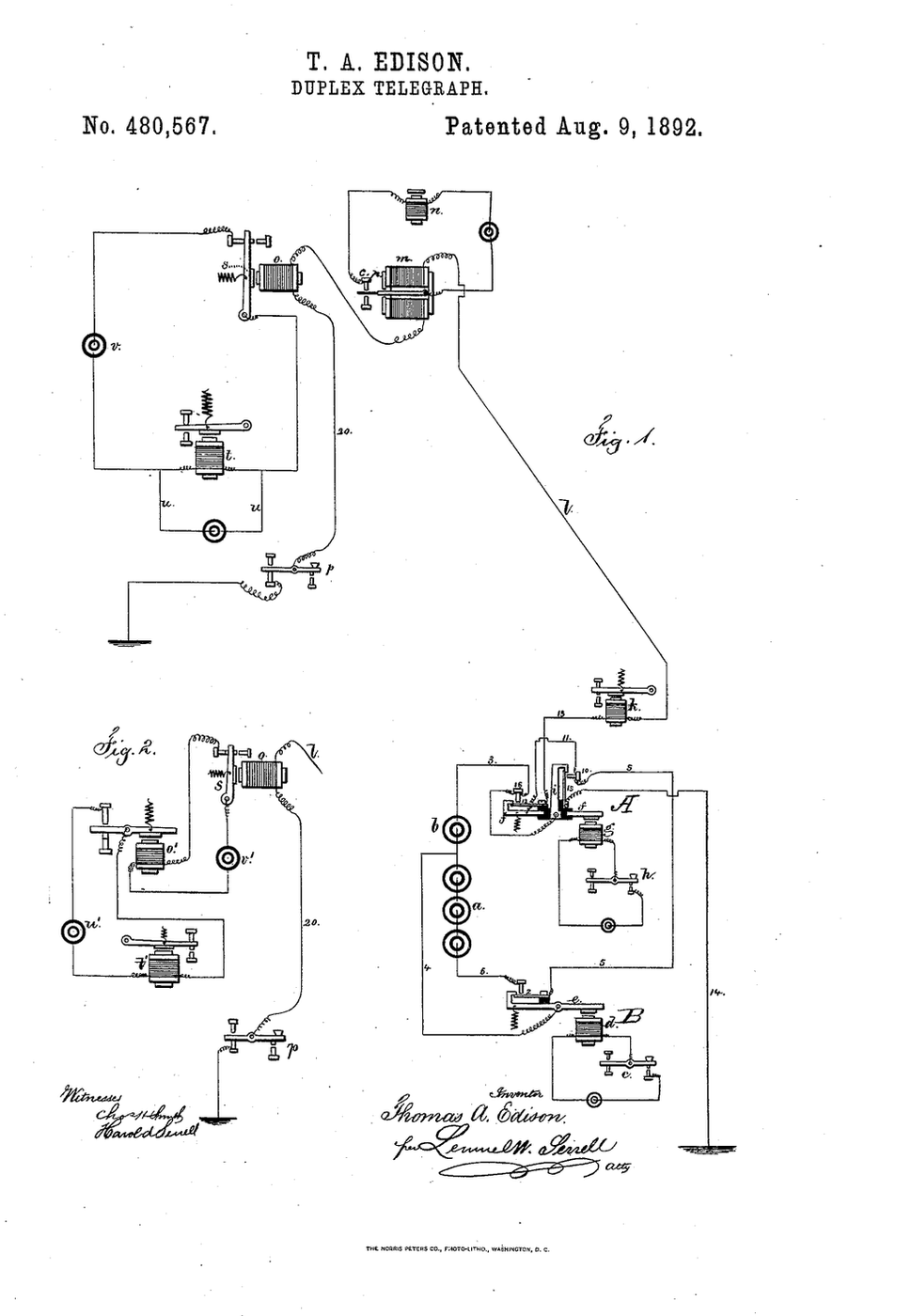
The patent history is a thicket, and it is worth stating plainly rather than tidying. The document reproduced above is US 480,567, 'Duplex Telegraph', filed 1 September 1874 and granted 9 August 1892 — an eighteen-year gap, which is itself the story. Note the title: the patent claims duplex working, two operators sending one way at once by combining current reversal with strength modulation, exactly as in steps 2 and 3. Edison then observes in the specification that combining this with any known method of simultaneous transmission in opposite directions lets four operators send and four receive over one wire. The quadruplex is not one patent; it is this patent plus duplex working, which is why no single tidy number exists. Anyone who quotes one is compressing a mess.
The rights were sold out from under the obvious buyer. Western Union declined, so Edison sold to Jay Gould of the Atlantic and Pacific Telegraph Company for around $30,000, and the resulting ownership fight is a large part of why the paperwork took until 1892 to settle. The mechanism is unambiguous; only the paperwork is not.
It is the ancestor of every multiplexing scheme. Baudot divided time; the quadruplex divided the signal's properties. Later engineers divided frequency (carrier telephony, then radio and cable television), then phase and amplitude together (the constellation diagrams of modern modems), then space (multiple antennas), then wavelength (fibre optics carrying dozens of colours down one strand). Every one is step 1 again: find another property that varies independently.
The balance network had the longer life. The circuit that lets a station transmit and receive at once by subtracting a model of its own signal became the telephone hybrid, and then the echo canceller in every long-distance call, and then the same job done in software in a modem. The trick of cancelling what you already know you sent is one of the most reused ideas in all of communications.
Honest limits. Every margin is tighter, so a quadruplex line needs a better line than a simplex one and constant readjustment as conditions change. The balancing network models a line that is not really constant — temperature, moisture and faults all move it. Cross-talk appears as plausible-looking errors rather than obvious breakage, which makes it hard to diagnose. And it needs four skilled operators and a great deal of apparatus at each end, so it paid only where traffic was already heavy.
Materiały
1- Zastępnik
Wymagane narzędzia
2- Zastępnik
- Zastępnik
Materiały z połączonych planów
Powiązane blueprinty
Te blueprinty dzielą się wiedzą — technikami, materiałami lub zasadami
CC0 Domena publiczna
Ten plan jest udostępniany na licencji CC0. Możesz go swobodnie kopiować, modyfikować, rozpowszechniać i wykorzystywać do dowolnych celów, bez konieczności uzyskiwania zgody.
Wesprzyj Makera kupując produkty przez jego plan, za co zarabia Prowizja Makera ustalony przez sprzedawców, lub stwórz nową iterację tego planu i dołącz go jako połączenie w swoim własnym planie, aby dzielić się przychodami.