Współpraca
SZTUKA
Piękno i dobre samopoczucie
RZEMIOSŁO
KULTURA I HISTORIA
ROZRYWKA
ŚRODOWISKO
JEDZENIE I NAPOJE
INŻYNIERIA ODWROTNA
NAUKI
LEKKOATLETYKA
TECHNOLOGIA
URZĄDZENIA DO NOSZENIA
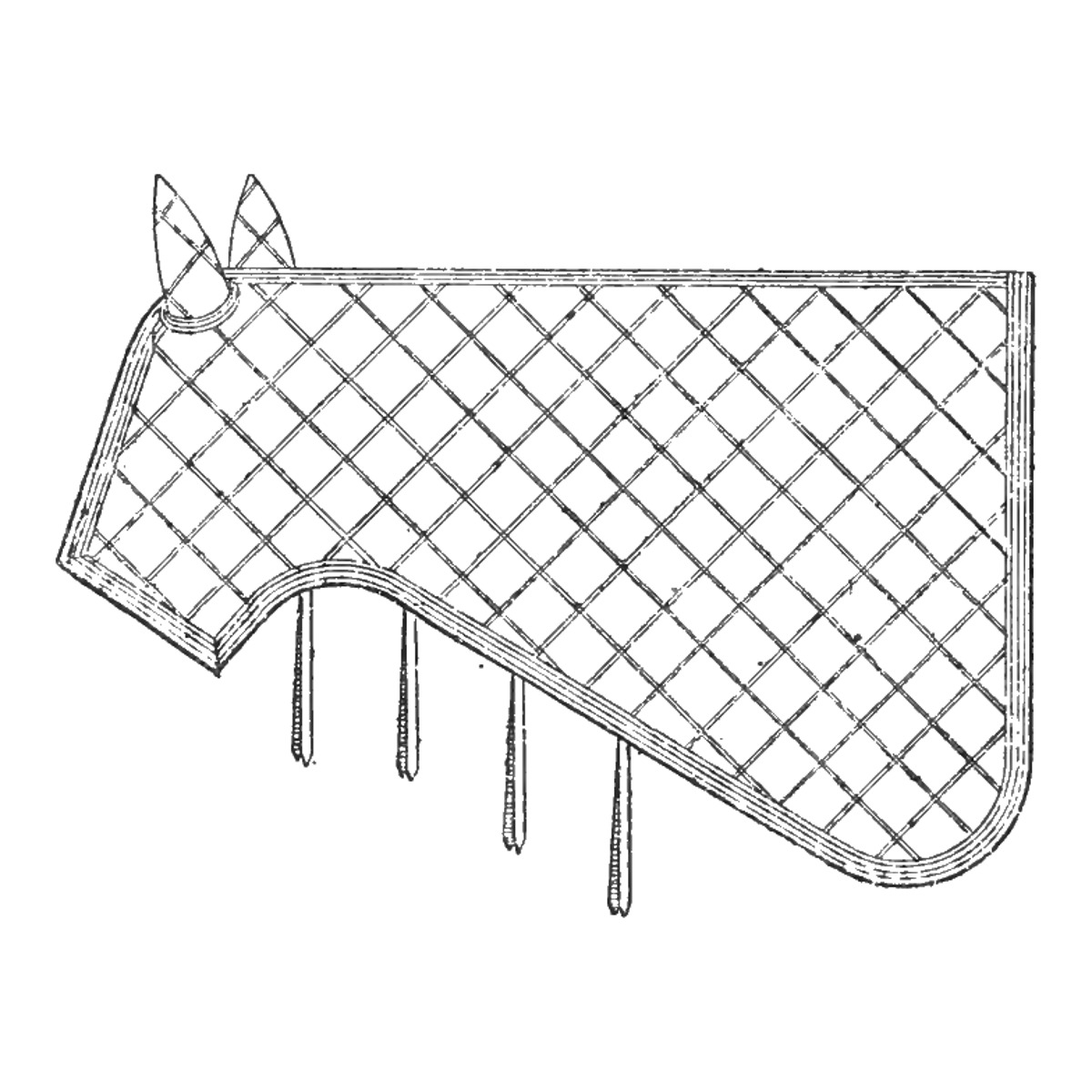


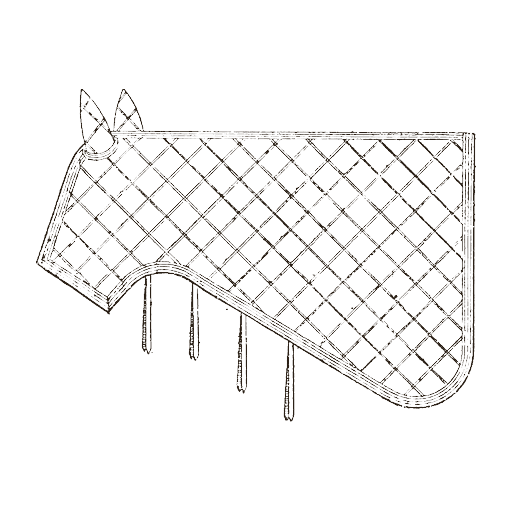
Horse Hood: Two-Piece Cloth Hood With Ear Covers, Bound Edges and Jaw Strap (Hasluck, Saddlery, 1904)
The hood completes a horse's stable suit of sheet, breast cloth and pad cloth, covering the head and neck. This is the hood from Paul N. Hasluck's Saddlery (1904): two pieces of cloth cut to the horse from about 5-1/4 in below the eye back to the shoulder, with ear covers and eye holes, bound all round and fastened under the jaw. It is cut to fit each horse, so he gives few sizes.
Średniozaawansowany
About 1 day
Instrukcje
1
1
His sizes in centimetres
His sizes in centimetres
Wczytywanie notatnika Jupyter…
2
2
Read Saddlery, ch. IX
Read Saddlery, ch. IX
"A hood is needed to complete the suit. A suitable shape is shown by Fig. 29. The hood must be cut to the shape of the horse's neck and head, from a point about 5-1/4 in. below the eye on the nose, then along the ridge of the head and neck to the shoulder, where it should cover the front of the sheet well."
3
3
Cut the two sides
Cut the two sides
Cut the hood in two pieces, one for each side (he says sometimes four, with pieces added to the side flaps for size), shaped to the horse from about 5-1/4 in below the eye on the nose, along the ridge of the head and neck to the shoulder, covering the front of the sheet well. Under the neck, cut all round the throat and down under the head so the two sides meet exactly in the centre. Making a paper pattern on the horse first is our suggestion.
Materiały do tego kroku:
 Sukno wełniane prosto z krosna1 sztuka
Potrzebne narzędzia:
 Brązowy papier pakowy (szary)
 Ołówek
 Nożyczki
 Miara zwijana
4
4
Cut the ear and eye holes
Cut the ear and eye holes
Cut the holes for the ears, and two holes right opposite the eyes. Put the front cut of the cloth opposite the front of the ear.
Potrzebne narzędzia:
NożyczkiOłówek5
5
Make the ear covers
Make the ear covers
Make a cover for each ear: the front part about 1 in larger than the face of the ear all round, the back part large enough to pass round the back of the ear and let it go in easily. Whip the edges together and stitch round the hole at the bottom, all the stitches on the outside.
Materiały do tego kroku:
Sukno wełniane prosto z krosna1 sztuka Nić lniana1 sztuka
 Wosk pszczeli1 sztuka
Potrzebne narzędzia:
Nożyczki Dwie igły rymarskie
6
6
Join the sides
Join the sides
Whip the edges together level along the top of the neck and over the head, down the front of the face. Join any other piece the same way, and always bind the joint, stitching on both sides.
Materiały do tego kroku:
Nić lniana1 sztukaWosk pszczeli1 sztukaPotrzebne narzędzia:
Dwie igły rymarskie7
7
Bind the edges
Bind the edges
Cut the binding cloth 1-1/4 in wide (cloth, patent or Newmarket binding) and turn it round the edges just enough to catch the first row of stitching, about 1/4 in from the edge. Draw it as flat as possible and stitch another row along the inner edge. Where it puckers too much at a sharp turn, as at the throat, cut the puckers out and stitch edge to edge. Put a strip along the joint on the top of the neck, its ends under the binding, then flat strips 1/2 in wide along the side joints and the points of the ear pieces, and round the bottom to cover the ends and the joint. He notes this work can be done by machine.
Materiały do tego kroku:
Sukno wełniane prosto z krosna1 sztukaNić lniana1 sztukaWosk pszczeli1 sztukaPotrzebne narzędzia:
NożyczkiDwie igły rymarskieMiara zwijana8
8
Fit the jaw strap and strings
Fit the jaw strap and strings
Fasten the hood under the jaw with a small strap and buckle. Run cadez strings (ties) from this point to about half-way down the neck on each side, to tie together.
Materiały do tego kroku:
 Skóra uprzężowa1 sztuka
 Żelazna klamra z kolcem1 sztuka
 Bawełniany sznurek kuchenny1 sztukaNić lniana1 sztukaWosk pszczeli1 sztuka
Potrzebne narzędzia:
 Nóż do skóry
 SzydłoDwie igły rymarskie
9
9
Troubleshooting
Troubleshooting
Horse hood troubleshooting.
Flow
Loading...
10
10
History and honest limits
History and honest limits
From **Saddlery**, edited by Paul N. Hasluck, David McKay, 1904 (archive.org saddlery00hasl), chapter IX, "Horse Clothing", hood, pp. 70-74, Fig. 29; every fraction was read on the scan. He gives no overall sizes: the hood is cut to the horse. He does not say what cadez strings are made of; cotton string is our choice. The sheets and breast cloth of the suit are not made here. Kersey, the paper pattern, tools and metric figures are ours.
Materiały
6- Zastępnik
- 4 sztukZastępnik
- 4 sztukZastępnik
- 1 sztukaZastępnik
- 1 sztukaZastępnik
- 1 sztukaZastępnik
Według tego planu powstaje
Powiązane blueprinty
Te blueprinty dzielą się wiedzą — technikami, materiałami lub zasadami
CC0 Domena publiczna
Ten plan jest udostępniany na licencji CC0. Możesz go swobodnie kopiować, modyfikować, rozpowszechniać i wykorzystywać do dowolnych celów, bez konieczności uzyskiwania zgody.
Wesprzyj Makera kupując produkty przez jego plan, za co zarabia Prowizja Makera ustalony przez sprzedawców, lub stwórz nową iterację tego planu i dołącz go jako połączenie w swoim własnym planie, aby dzielić się przychodami.