

Shipping Container
For most of maritime history, cargo was loaded piece by piece. Sacks, barrels, crates and bales were swung aboard one sling at a time and stowed by hand by gangs of dockers — break-bulk. A ship could spend longer tied up being loaded than it spent at sea, and a ship in port earns nothing.
McLean's insight was that the thing you should move is not the goods but the BOX — a standard, stackable unit that is filled once at the factory, never opened at the quay, and lifted between lorry, train and ship as a single piece.
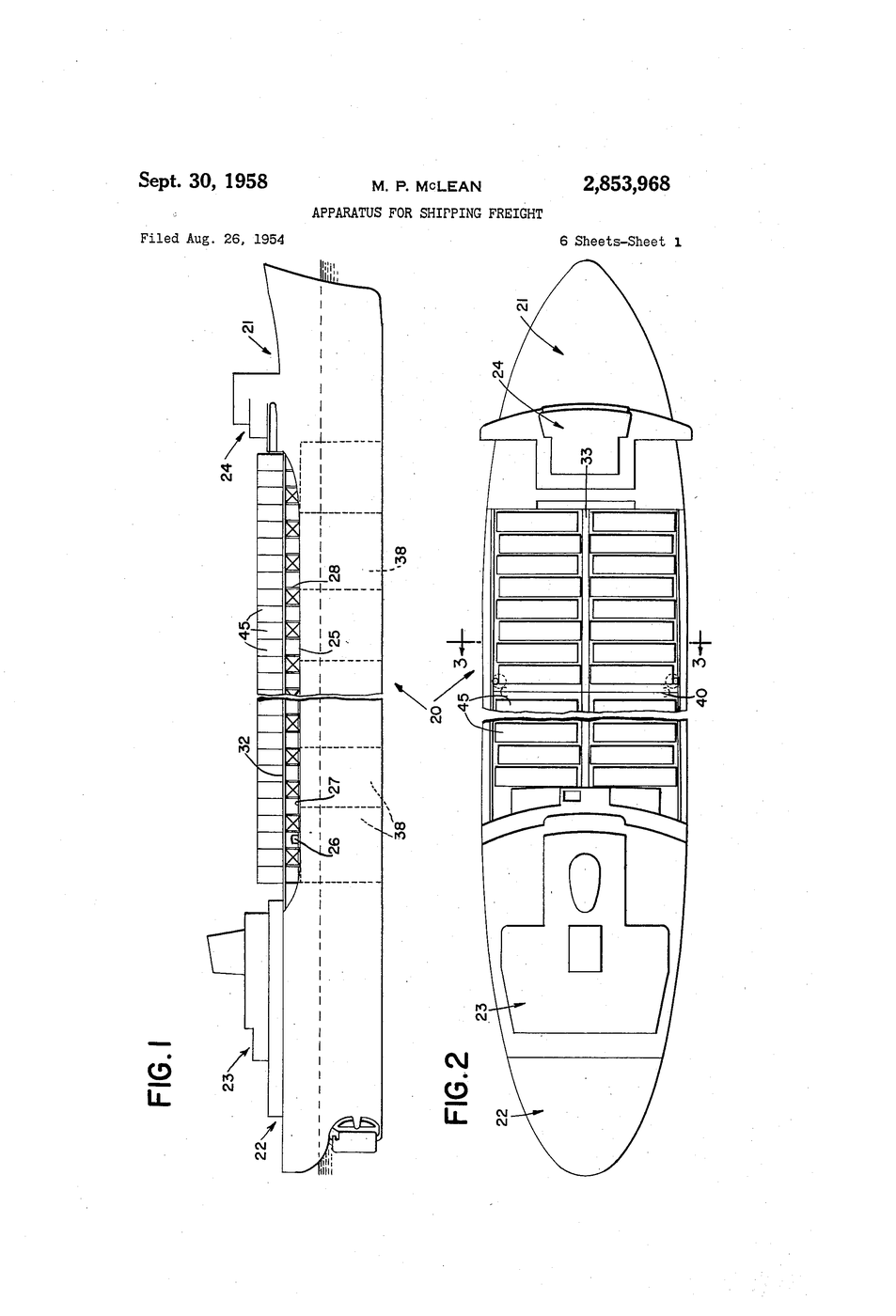
What this particular patent claims is the ship end of that idea. It describes an open framework supported by the weather deck, running the full length of the ship, forming elevated seats that hold containers and trailers above the deck — so a tanker can carry containerised freight on top while still carrying its ordinary bulk cargo in the hull below.
US Patent 2,853,968, "Apparatus for Shipping Freight", granted 30 September 1958 (filed 26 August 1954) to Malcolm P. McLean.
This blueprint is a timed experiment. You will load a ship both ways and measure the difference.
Instrukcje
Read the claim: it is about the framework
Read the claim: it is about the framework
McLean claims an open framework on the weather deck forming elevated container seats along the ship, carrying containers above while bulk cargo rides below. Note that the patent is about the SHIP, not the box.
Build a ship's hold
Build a ship's hold
Cut an open-topped card box 300 × 120 × 80 mm. This is the hold, and it is the same hold for both experiments.
Materiały do tego kroku:
 Arkusze tektury falistej2 arkuszy
Potrzebne narzędzia:
 Nóż introligatorski
Make a break-bulk cargo
Make a break-bulk cargo
Make 30 parcels of assorted sizes and shapes from card and paper — no two alike. Sacks, tubes, flat bundles. This is a real 1950s cargo.
Materiały do tego kroku:
 Brystol3 arkuszy
Potrzebne narzędzia:
 Taśma malarska
Load it break-bulk and time yourself
Load it break-bulk and time yourself
Load all 30 parcels one at a time, packing them as tightly as you can. Time the whole operation. Record it.
Potrzebne narzędzia:
 Stoper
Measure the wasted space
Measure the wasted space
Estimate the hold volume and the total parcel volume. The gap is broken stowage — space paid for and not used. Work out the percentage.
Potrzebne narzędzia:
 Zestaw skalówek architektonicznych
 Papier milimetrowy
Unload it and time that too
Unload it and time that too
Take everything out again, one parcel at a time. Add the unloading time to the loading time — that total is the ship's time in port.
Potrzebne narzędzia:
StoperChoose ONE module
Choose ONE module
Pick a single box size — say 60 × 40 × 40 mm — and write it down. Every container from now on is exactly this. The decision is the invention.
Build ten identical containers
Build ten identical containers
Cut and fold ten boxes to that exact module. Check each against the first — a container that is 2 mm oversize is not a container.
Materiały do tego kroku:
Brystol5 arkuszyPotrzebne narzędzia:
Zestaw skalówek architektonicznychPack the same cargo into them
Pack the same cargo into them
Put all 30 parcels inside the containers, away from the ship. This is the point: the fiddly work happens off the quay, where the ship is not waiting.
Build the deck framework
Build the deck framework
Over the hold, build an open frame of dowels forming seats the exact width of one container, running the full length of the ship — McLean's actual claim.
Materiały do tego kroku:
 Kołek drewniany2 sztuk
Potrzebne narzędzia:
 Pistolet do kleju na gorąco
Load the containers and time it
Load the containers and time it
Drop the ten containers into the frame seats. Time it. Compare with step 4 — and remember the hold below is still free for bulk cargo.
Potrzebne narzędzia:
StoperStack them two high
Stack them two high
Stack a second layer. Identical boxes stack square and carry load through their corners; the odd parcels of step 3 could never have been stacked at all.
Break the standard on purpose
Break the standard on purpose
Add one container 10 mm oversize and try to load and stack it. It fouls the seat, blocks a slot and cannot be stacked. One non-standard box degrades the whole system — that is why containers are agreed internationally, not per company.
Materiały do tego kroku:
Brystol1 arkuszHistory & Context — the box that rewired world trade
History & Context — the box that rewired world trade
The patent. US 2,853,968, "Apparatus for Shipping Freight", granted 30 September 1958, filed 26 August 1954, to Malcolm P. McLean. The specification is about increasing the payload of single-purpose vessels, particularly tankers: an open framework construction supported by the weather deck forms elevated container seats along the full length of the ship, so trailers and containers ride above deck while the hull below still carries its normal bulk cargo. Note the inventor's name as printed — "Malcolm" on the patent, though he is generally known as Malcom McLean.
📌 This patent does not claim the container. It claims the shipboard apparatus for carrying containers. That distinction matters: containerisation was never one invention but a system — the box, the corner fittings, the ship, the crane, the chassis and the standard, each needing the others to be worth anything. A box nobody else can lift is just a crate.
The problem was time in port, not space at sea. Break-bulk loading meant handling every item individually at both ends (steps 4-6), with gangs of dockers, and it left large volumes of unusable broken stowage (step 5). Ships routinely spent as long alongside as they did steaming. Containerisation moves the slow work off the critical path: the box is stuffed at the factory and the ship handles ten lifts instead of a thousand (steps 9-11). The often-quoted figures give break-bulk loading at around $5.83 per ton against roughly $0.16 per ton containerised — the kind of gap that reorganises an economy.
McLean came from trucking, and that is why he saw it. He ran a road haulage business and had watched his drivers wait while their cargo was unloaded sack by sack onto a ship. He bought a shipping company to do it properly, and on 26 April 1956 the converted tanker Ideal X sailed from Port Newark to Houston carrying 58 containers — two years before this patent was granted. Coming from outside shipping is arguably the whole story: the industry's own experts were optimising the loading of break-bulk, not questioning it.
The standard mattered more than the patent. A container is only valuable if every port, ship, crane and lorry in the world can handle it, which requires agreement rather than exclusivity. Container dimensions and corner fittings were standardised internationally through the 1960s, and McLean's company released key patent rights so the design could be adopted freely. Step 13 is the demonstration of why: a system built on a standard is worth more to its owner shared than owned.
Where it sits. Container ships now carry over twenty thousand boxes each, and the twenty-foot equivalent unit is the accounting unit of global trade. The same logic — put irregular things into identical units and handle the units — runs shipping pallets, warehouse totes, and, in a different medium, the fixed-size packets that carry this page across the internet.
Materiały
3- 2 arkuszyZastępnik
- 9 arkuszyZastępnik
- 2 sztukZastępnik
Wymagane narzędzia
6- Zastępnik
- Zastępnik
- Zastępnik
- Zastępnik
- Zastępnik
- Zastępnik
Powiązane blueprinty
Te blueprinty dzielą się wiedzą — technikami, materiałami lub zasadami


CC0 Domena publiczna
Ten plan jest udostępniany na licencji CC0. Możesz go swobodnie kopiować, modyfikować, rozpowszechniać i wykorzystywać do dowolnych celów, bez konieczności uzyskiwania zgody.
Wesprzyj Makera kupując produkty przez jego plan, za co zarabia Prowizja Makera ustalony przez sprzedawców, lub stwórz nową iterację tego planu i dołącz go jako połączenie w swoim własnym planie, aby dzielić się przychodami.