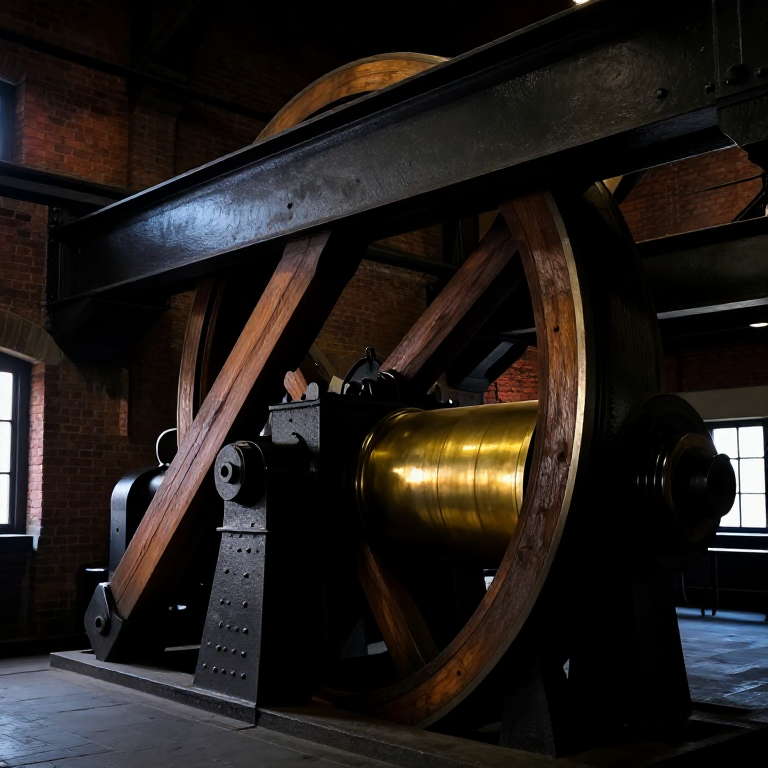


Building a Newcomen Atmospheric Engine — The First Engine to Do Real Work
In 1712 Thomas Newcomen built a machine that changed the world quietly, by pumping water out of coal mines. It was the first engine to turn the heat of a fire into useful mechanical work on a large scale, and every steam engine and motor that followed descends from it.
Its genius is counter-intuitive: the steam does not push the piston. Newcomen's engine fills a cylinder with low-pressure steam, then sprays in cold water to condense that steam into a few drops, leaving a vacuum. The ordinary pressure of the atmosphere — about a tonne on a large piston — then shoves the piston down into the vacuum. That downward stroke rocks a great wooden beam whose far end lifts the mine pump. Because air pressure does the work, it is called an atmospheric engine.
It was thirsty and wasteful, reheating its whole cylinder every stroke, but it was tireless and it worked. For sixty years Newcomen engines drained the mines that supplied the coal that fed the Industrial Revolution — until James Watt's separate condenser made the steam engine efficient enough to drive factories and locomotives.
Instrukcje
Grasp the atmospheric principle
Grasp the atmospheric principle
Build the boiler
Build the boiler
Materiały do tego kroku:
 Blacha miedziana40 kg
 Cegły szamotowe120 sztuk
Cast and bore the cylinder
Cast and bore the cylinder
Materiały do tego kroku:
 Cylinder żeliwny1 sztuka
 Skóra2 sqm
Erect the great beam
Erect the great beam
Materiały do tego kroku:
 Belka z daglezji1 sztuka
Plumb the steam and water pipes
Plumb the steam and water pipes
Materiały do tego kroku:
 Rurka miedziana6 metrów
Potrzebne narzędzia:
 Klucz hydrauliczny
Raise steam
Raise steam
Materiały do tego kroku:
 Węgiel kamienny bitumiczny50 kg
Admit steam and let the piston rise
Admit steam and let the piston rise
Potrzebne narzędzia:
 Zawór parowy
Inject cold water to make the vacuum
Inject cold water to make the vacuum
Potrzebne narzędzia:
Zawór parowyTake the power stroke
Take the power stroke
Materiały do tego kroku:
 Woda30 litrów
Drain and repeat
Drain and repeat
Potrzebne narzędzia:
Zawór parowyMake it self-acting
Make it self-acting
Potrzebne narzędzia:
Klucz hydraulicznyKnow its power and its flaw
Know its power and its flaw
Materiały
8- 40 kgZastępnik
- 120 sztukZastępnik
- 1 sztukaZastępnik
- 2 sqmZastępnik
- 1 sztukaZastępnik
- 6 metrówZastępnik
- Zastępnik
- 30 litrówZastępnik
Powiązane blueprinty
Te blueprinty dzielą się wiedzą — technikami, materiałami lub zasadami


CC0 Domena publiczna
Ten plan jest udostępniany na licencji CC0. Możesz go swobodnie kopiować, modyfikować, rozpowszechniać i wykorzystywać do dowolnych celów, bez konieczności uzyskiwania zgody.
Wesprzyj Makera kupując produkty przez jego plan, za co zarabia Prowizja Makera ustalony przez sprzedawców, lub stwórz nową iterację tego planu i dołącz go jako połączenie w swoim własnym planie, aby dzielić się przychodami.