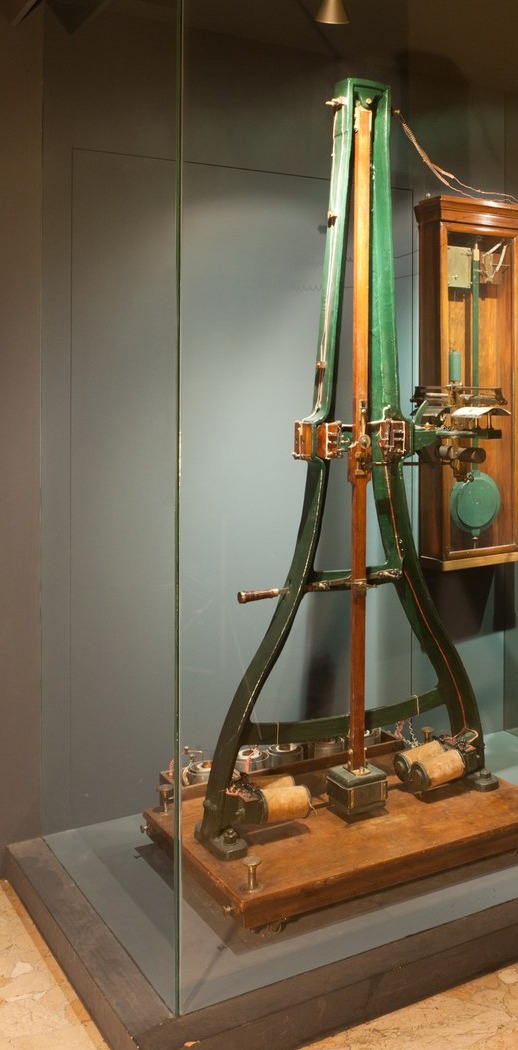


The Pantelegraph
A telegraph sends symbols from an agreed list. A picture is not on any list — a signature, a diagram or a Chinese character has no code number, and inventing one for every possible mark is not a plan.
The pantelegraph solves it by refusing to encode the image at all. It takes the picture apart in space and sends it as a sequence in time.
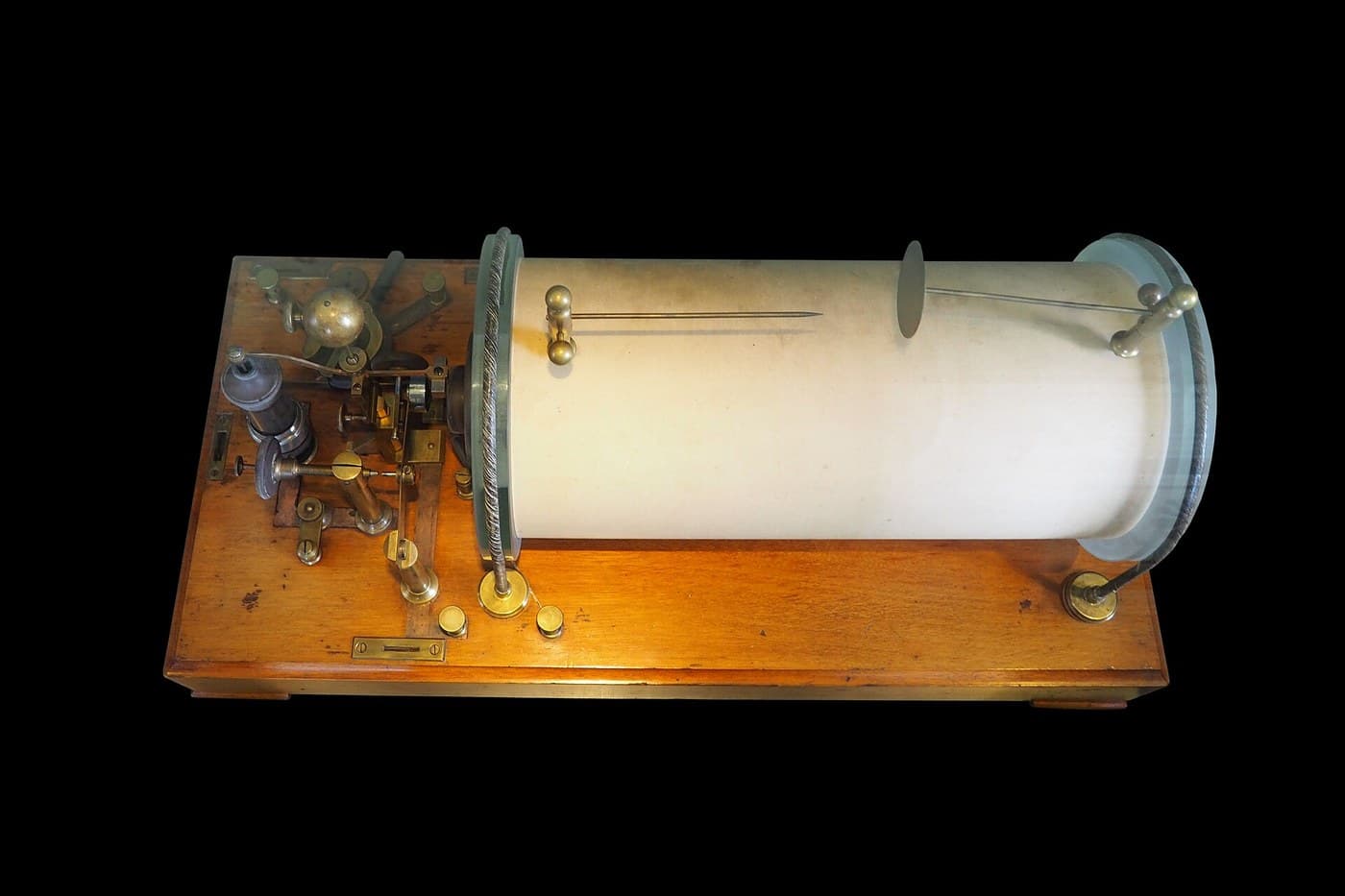
The original is written in insulating ink on a metal plate. A stylus sweeps across it in a line, drops down, sweeps again — a raster, decades before television. Where the stylus touches bare metal, current flows; where it crosses ink, current stops. The picture has become a stream of on and off.
At the far end an identical stylus sweeps in step over paper soaked in potassium ferrocyanide, and current there leaves a blue mark. Sweep for sweep, the image is rebuilt.
And that phrase — in step — is the whole difficulty. If the two styli drift apart by a fraction, the reconstruction shears, slants or turns to mush. So the real invention is not the scanning; it is synchronisation: two pendulums at distant stations, kept beating together by the line itself.
Send the shape rather than the meaning, and you can send anything that can be drawn.
Instrukcje
Turn a picture into a single line of on and off
Turn a picture into a single line of on and off
Draw a simple shape on squared paper. Now read it out loud as a sequence: row by row, square by square, saying only 'mark' or 'blank'.
Have a partner, who has not seen it, fill in a blank grid from your reading.
Expect a faithful copy — and expect it to take a long time.
Count the squares and note the cost: an image needs one decision per cell, so its message length grows with area, while a word costs the same however complicated the thing it names. Pictures are expensive on any channel, and that arithmetic has not changed since.
Materiały do tego kroku:
 Arkusze tektury falistej2 sztuk
Break the copy by getting out of step
Break the copy by getting out of step
Repeat step 1, but have your partner start one cell late, and then repeat with your partner writing at a slightly different row width.
Expect the first error to shift the whole image and the second to shear it into a diagonal smear.
Note which failure is recoverable and which is not. A constant offset is merely a wrong position; a difference in rate destroys the picture progressively, and the longer the transmission the worse it gets.
Write down the conclusion: the two ends must agree about speed far more precisely than they must agree about anything else.
Build a scanner that reads conductivity
Build a scanner that reads conductivity
Write on a metal sheet with an insulating material — varnish, wax crayon or nail polish — and drag a light spring contact across it in lines, in series with a battery and a meter or buzzer.
Expect current where the metal is bare and none where the mark is.
Note what the machine does and does not perceive: it has no idea what the mark means, what colour it is or which way up it is. It reports one bit per position.
That indifference is the strength. A scanner that understands nothing can send handwriting, Chinese, a sketch or a signature with equal success — which is exactly what a code book cannot do.
Materiały do tego kroku:
 Folia miedziana C110 0,025 mm1 arkusz
Potrzebne narzędzia:
 Przewody pomiarowe z krokodylkami
Keep two pendulums beating together
Keep two pendulums beating together
Set up two pendulums of nominally equal length and start them together. Time how long before they visibly disagree.
Then couple them — a light electrical or mechanical nudge from one given to the other once per swing — and repeat.
Expect free pendulums to drift apart within minutes and coupled ones to hold together indefinitely.
This is Caselli's answer, and it is a general one: do not try to build two clocks that agree; build one clock and send it. The line that carries the picture also carries the timing that makes the picture mean anything, and every synchronous system since — television, disk drives, serial data — does some version of it.
Trade resolution against time, and pick a point
Trade resolution against time, and pick a point
Rescan your image with the lines spaced twice as far apart, and again at half the spacing. Record the time each takes and how legible the result is.
Expect time to grow roughly with the square of resolution — halve the line spacing and you have four times as many cells — while legibility improves only until the lines are finer than the strokes of the writing, after which it buys nothing.
Find the point where the marks are just resolved and stop there.
Scan finer than the finest real detail and you are paying for nothing, which is the sampling argument in its plainest form.
History & Context
History & Context
It worked, commercially, in 1865. Giovanni Caselli, an Italian priest and physicist, developed the pantelegraph through the late 1850s; the instruments were built to a high standard by the Paris workshop of Gustave Froment, which is a large part of why it functioned at all. The first pantelegram travelled Lyon to Paris on 10 February 1862, a public service followed, and the world's first commercial facsimile line ran Paris–Lyon from 1865, extending to Marseille in 1867.
It was killed by economics, not by physics. An image costs one signal per cell and a telegram costs a few dozen signals total, so the pantelegraph occupied an expensive line for minutes to send what a clerk could have sent in seconds. Its real market was signatures on bank orders and messages in scripts the telegraph could not encode — genuine needs, but small ones. The service closed around 1870. Being first and working is not sufficient; the cost per message decides.
Everything in it came back. Raster scanning, one bit per cell, a synchronising signal shared down the same channel, and the resolution-versus-time trade are the architecture of the fax machine that swept offices in the 1980s, of mechanical and then electronic television, and of every image sensor since. The fax did not descend from Caselli by an unbroken line of engineers — it was reinvented repeatedly — but it arrived at the same answers, because the problem has few.
The deeper idea: send the SHAPE, not the MEANING. Every symbol-based system, from Chappe's code book to a character encoding, can only transmit what it has an entry for. A system that transmits the marks themselves can carry anything anyone can draw, in any language, including ones its designers never heard of. That is why the fax survived so long in places whose scripts the telex could not handle — and it is the same argument that makes a photograph of a document more universal, and much more expensive, than its text.
Honest limits. It is slow and it monopolises the line. It captures two levels only, so it renders line art and handwriting well and photographs not at all without a halftone trick. It demands a special conductive-ink original and chemically prepared receiving paper. Synchronisation must hold for the whole transmission, so a single disturbance mid-image ruins everything after it. And the machinery is precise, delicate and expensive to keep in adjustment — the reason it stayed a service offered at a few offices rather than a device anybody owned.
Materiały
6- 2 sztukZastępnik
- 1 arkuszZastępnik
- 1 padZastępnik
- 5 metrówZastępnik
- 1 sztukaZastępnik
- 9V Battery Holder10% prowizji1 sztuka$3.57
Wymagane narzędzia
3- Zastępnik
- Zastępnik
- Digital Multimeter - Basic10% prowizji$14.27
Materiały z połączonych planów

Powiązane blueprinty
Te blueprinty dzielą się wiedzą — technikami, materiałami lub zasadami

CC0 Domena publiczna
Ten plan jest udostępniany na licencji CC0. Możesz go swobodnie kopiować, modyfikować, rozpowszechniać i wykorzystywać do dowolnych celów, bez konieczności uzyskiwania zgody.
Wesprzyj Makera kupując produkty przez jego plan, za co zarabia Prowizja Makera ustalony przez sprzedawców, lub stwórz nową iterację tego planu i dołącz go jako połączenie w swoim własnym planie, aby dzielić się przychodami.