SZTUKA
Piękno i dobre samopoczucie
RZEMIOSŁO
KULTURA I HISTORIA
ROZRYWKA
ŚRODOWISKO
JEDZENIE I NAPOJE
INŻYNIERIA ODWROTNA
NAUKI
LEKKOATLETYKA
TECHNOLOGIA
URZĄDZENIA DO NOSZENIA
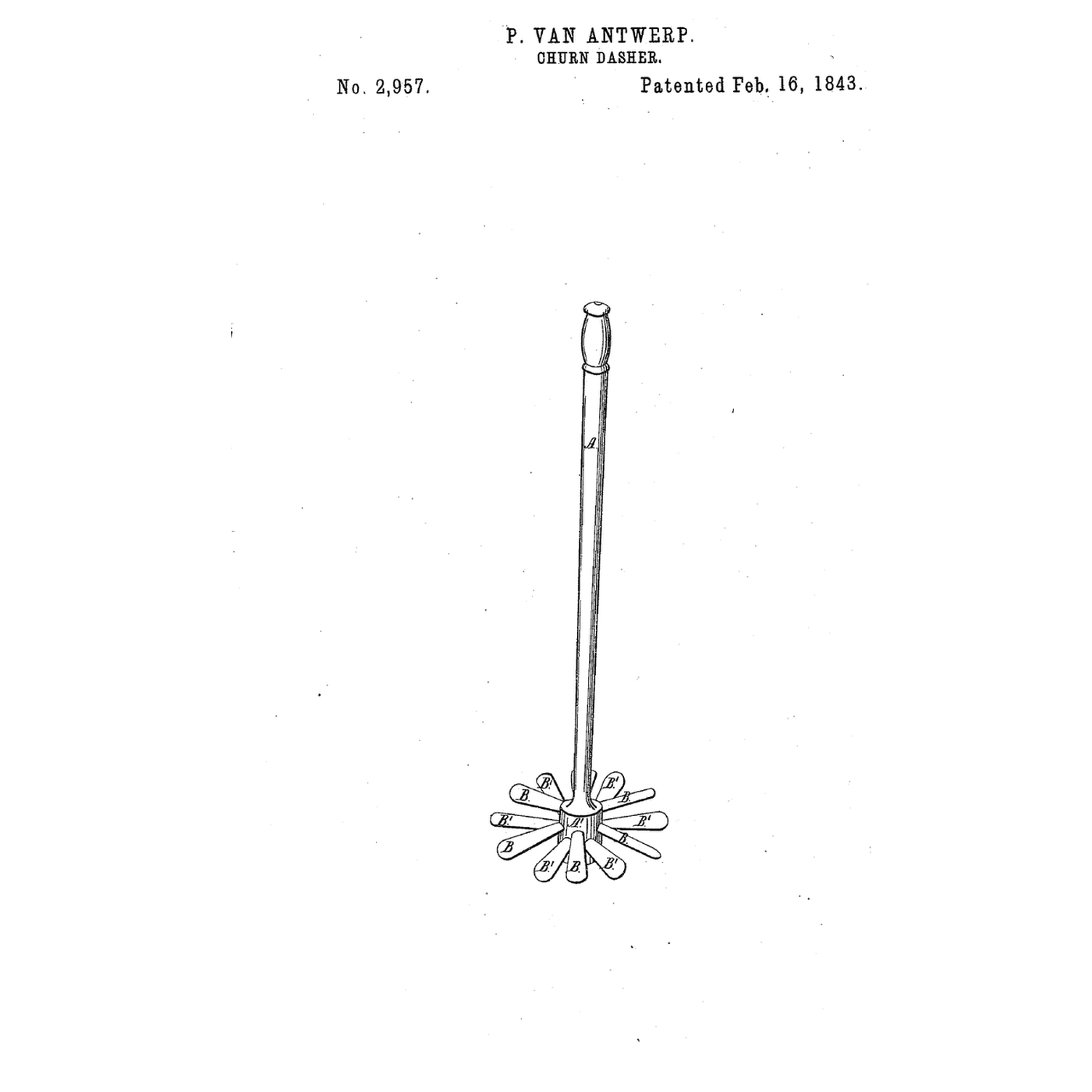


Reacting Churn Dasher: Two Rows of Oars Pitched Opposite Ways
Van Antwerp set out to improve "the common churn or hand dasher," worked up and down in an upright churn.
Peter Van Antwerp of Coeymans, New York, received US 2,957, dated 16 February 1843, for "Van Antwerp's Reacting Churn-Dasher": a knob on the dasher's rod carrying two rows of radial paddles shaped like oars, the upper row pitched one way and the lower row the other, so that "a reaction is also produced in the cream as it is impelled in one direction by the paddles B in the upper series and in the opposite direction by the paddles B' in the lower series." A cork in the end of the knob softens its blow on the churn's bottom.
This rung works out the oars' tilt, then prints the knob and twelve oars, fits them to a rod, and makes butter in a bucket.
Początkujący
About 1 hour, plus printing
Instrukcje
1
1
Tilt and pitch
Tilt and pitch
Wczytywanie notatnika Jupyter…
2
2
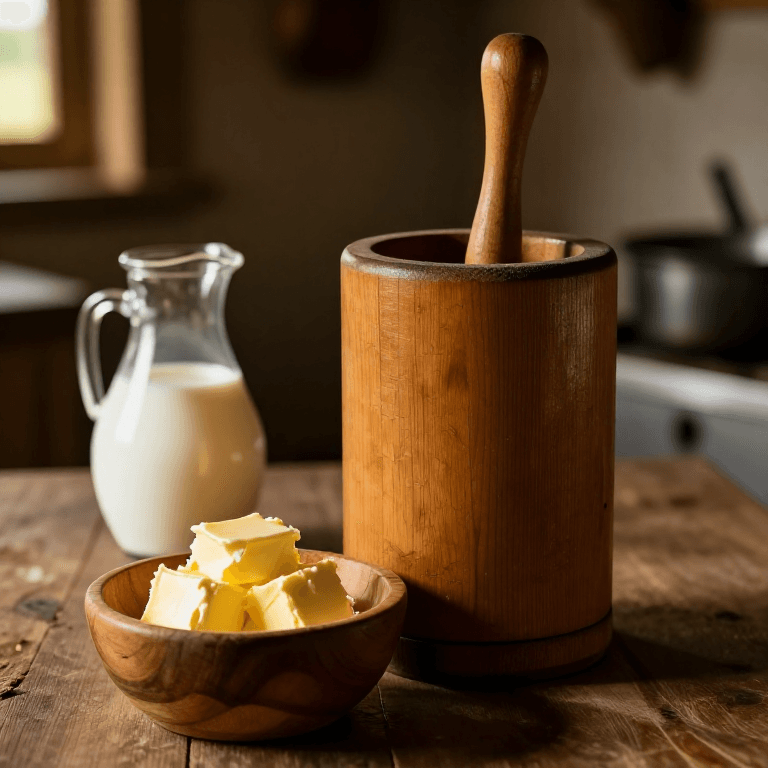
The common dash churn it improves
The common dash churn it improves
The embedded blueprint makes butter by agitating cream. Van Antwerp's dasher works the same up-and-down way, with pitched oars instead of a flat cross.
3
3
Read US 2,957
Read US 2,957
"This mode of constructing the dasher gives it great advantage over the ordinary churn dasher as by the employment of paddles arranged in the manner stated no vacuum is created interfering with the operation of the churn, consequently there is no mingling of air with the cream to obstruct the gathering of the butter."
4
4
Print the knob and oars
Print the knob and oars
Print the knob upright (/uploads/blueprints/reacting-churn-dasher-knob.stl), with supports in its sockets. Its square sockets are turned 45° so each oar's blade takes its pitch, the upper row one way and the lower row, under the gaps, the other. Print twelve oars flat (/uploads/blueprints/reacting-churn-dasher-oar.stl). Print in PETG at 0.2 mm layers, 30 % infill, 4 walls; wash before first use.
Materiały do tego kroku:
 Filament PETG1 sztuka
Potrzebne narzędzia:
 Drukarka 3D z filamentem (FDM)
5
5
Assemble the dasher
Assemble the dasher
Glue the twelve oars into their sockets. Glue a 12 mm hardwood dowel, as long as the bucket is deep plus 150 mm, into the top of the knob. Press a cork into the seat under the knob so it stands proud of the end.
Materiały do tego kroku:
 Kołki z twardego drewna1 sztuka
 Korki1 sztuka
 Klej do drewna1 sztuka
Potrzebne narzędzia:
 Piła ręczna
 Papier ścierny
6
6
Make the churn
Make the churn
Drill a 20 mm hole in the centre of a food-grade 20-litre bucket's lid for the rod.
Materiały do tego kroku:
 Wiadro 20-litrowe1 sztuka
Potrzebne narzędzia:
 Wiertarko-wkrętarka akumulatorowa
 Zestaw otwornic
7
7
The build in 3D
The build in 3D
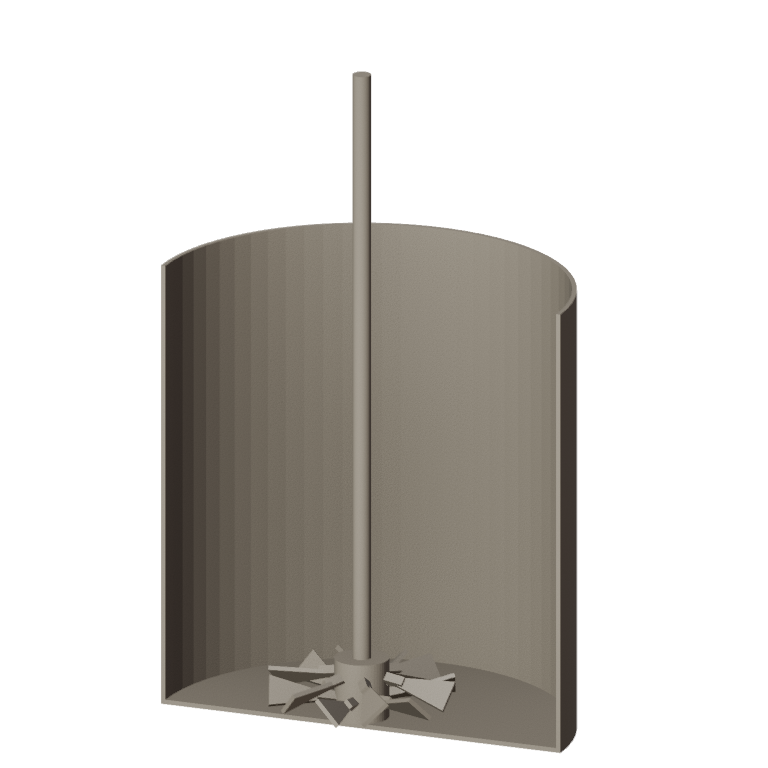
FreeCAD model of this build, not of the patent: the bucket cut away to show the knob on the rod's foot with its upper row of oars tilted down and pitched one way, and the lower row tilted up and pitched the other.
8
8
Dash and make butter
Dash and make butter
Let the heavy cream stand until it reaches about 15 °C, checked with the thermometer. Pour in 1 litre, fit the lid over the rod, and work the dasher up and down like a common dasher. Time until the butter comes. Pour off the buttermilk, add cold water, churn a little and pour off again until it runs clear; work in a pinch of salt and weigh the butter.
Materiały do tego kroku:
 Śmietanka kremówka1000 ml
 Sól morska gruboziarnista1 sztuka
 Woda1 sztuka
Potrzebne narzędzia:
 Termometr z sondą pozostawianą w potrawie
 Stoper
 Cyfrowa waga kuchenna
 Duża misa ze stali nierdzewnej
9
9
Oars that loosen, a dasher that thumps
Oars that loosen, a dasher that thumps
Reacting churn dasher troubleshooting.
Flow
Loading...
10
10
History and honest limits
History and honest limits
**Peter Van Antwerp** of Coeymans, Albany County, New York, received US 2,957, dated 16 February 1843. The knob was about three inches of the rod's lower end, enlarged; the paddles were "broad and flattened at their outer ends where they project into the cream, tapering from thence to their inner ends"; the centre hole could be filled with cement or putty and closed with cork "or other elastic substance" to keep the churn's bottom from being bruised. He claimed combining with the rod the two series of paddles arranged above each other and operating as described.
**Honest limits.** A printed knob and oars stand in for his wooden ones, and a bucket for his churn. FDM prints hold food in their layer lines, so wash well and replace when worn. Your times and weights are the result.
Materiały
8- 1 sztukaZastępnik
- 1 sztukaZastępnik
- 1 sztukaZastępnik
- 1 sztukaZastępnik
- 1 sztukaZastępnik
- 1000 mlZastępnik
- 1 sztukaZastępnik
- 1 sztukaZastępnik
Wymagane narzędzia
9- Zastępnik
- Zastępnik
- Zastępnik
- 1 vendor sell this, none ship to you yetZastępnik
- Zastępnik
- Zastępnik
- Zastępnik
- Zastępnik
Pliki projektowe
1Powiązane blueprinty
Te blueprinty dzielą się wiedzą — technikami, materiałami lub zasadami


CC0 Domena publiczna
Ten plan jest udostępniany na licencji CC0. Możesz go swobodnie kopiować, modyfikować, rozpowszechniać i wykorzystywać do dowolnych celów, bez konieczności uzyskiwania zgody.
Wesprzyj Makera kupując produkty przez jego plan, za co zarabia Prowizja Makera ustalony przez sprzedawców, lub stwórz nową iterację tego planu i dołącz go jako połączenie w swoim własnym planie, aby dzielić się przychodami.