Współpraca
SZTUKA
Piękno i dobre samopoczucie
RZEMIOSŁO
KULTURA I HISTORIA
ROZRYWKA
ŚRODOWISKO
JEDZENIE I NAPOJE
INŻYNIERIA ODWROTNA
NAUKI
LEKKOATLETYKA
TECHNOLOGIA
URZĄDZENIA DO NOSZENIA
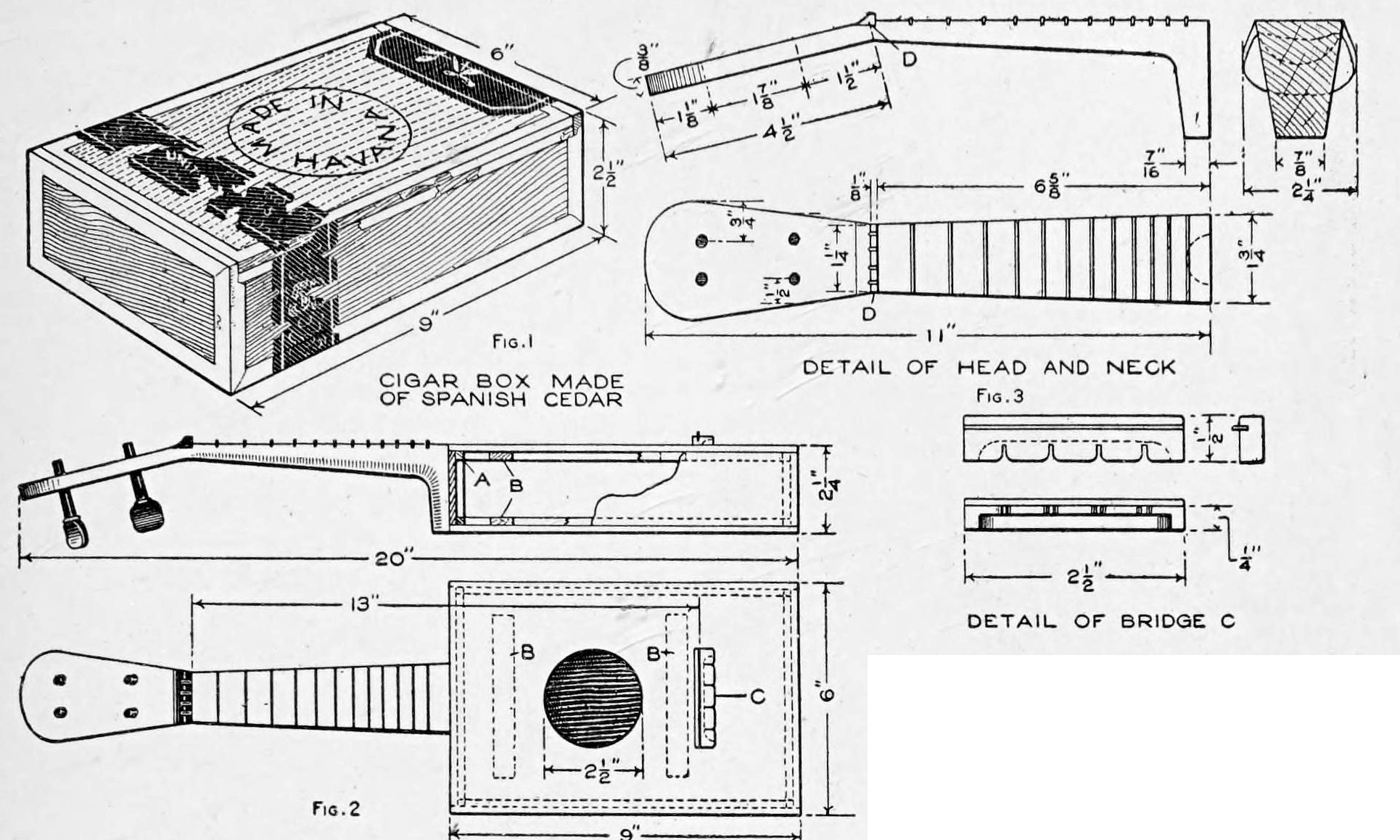


Cigar-Box Hawaiian Ukulele: Spanish-Cedar Body, 11 in Neck and Frets by the Rule of Eighteen (Boy Mechanic, 1919)
S. H. Samuels's ukulele from The Boy Mechanic, Book 3 (1919), made for 30 cents: a Spanish-cedar cigar box rebuilt as a 9 x 6 in body with a 2-1/2 in sound hole, an 11 in cedar or mahogany neck, a notched hardwood bridge, and aluminium frets set by the old rule of 1/18 on a 13 in string length.
Średniozaawansowany
About 2 days
Instrukcje
1
1
Fret table
Fret table
Wczytywanie notatnika Jupyter…
2
2
Read The Boy Mechanic, Book 3
Read The Boy Mechanic, Book 3
"The size of this instrument makes it especially suited to the cigar-box type of body construction."
3
3
Rebuild the box as the body
Rebuild the box as the body
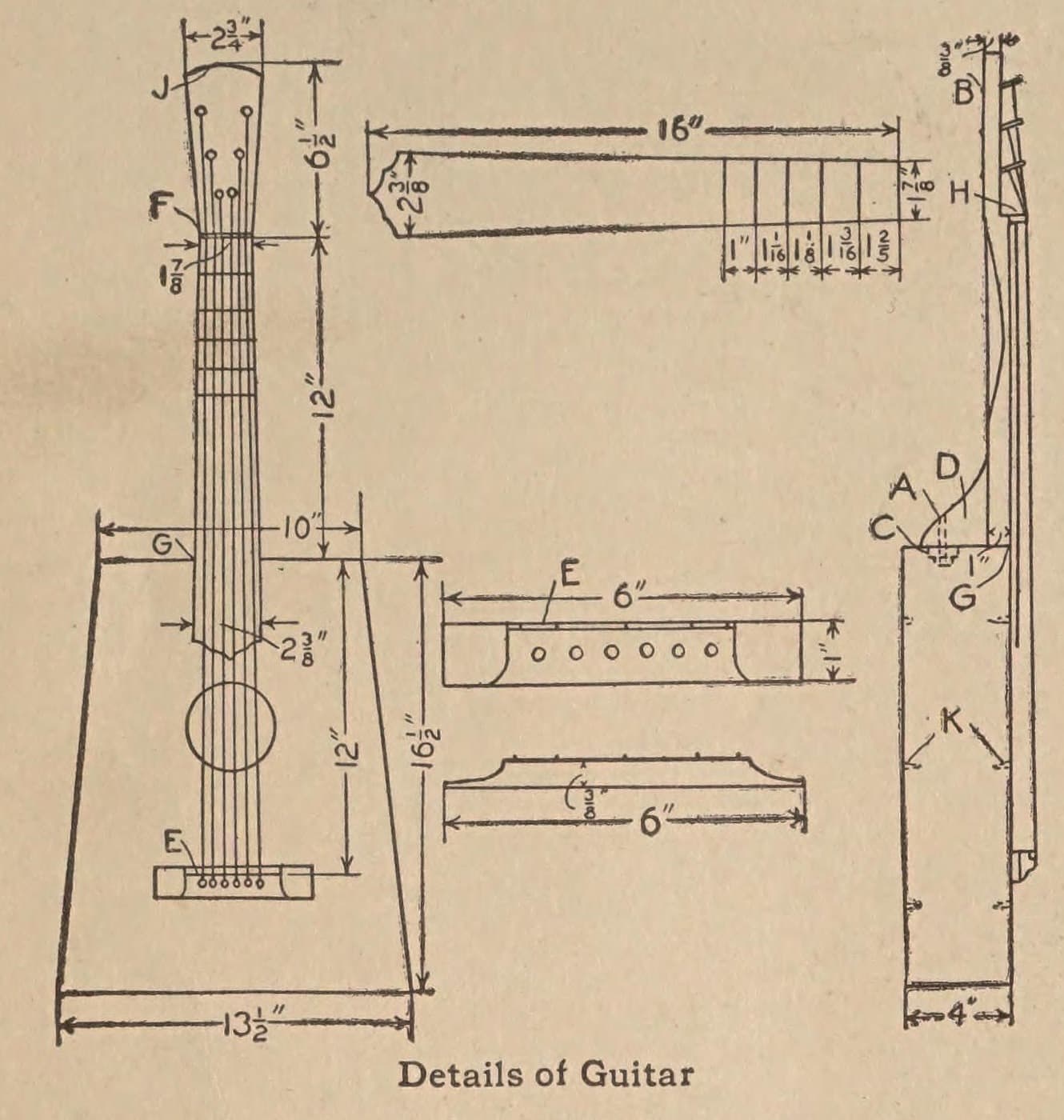
Take a good Spanish-cedar cigar box about 2-1/2 by 6 by 9 in, soak off the paper without marring the wood, take it apart and trim edges with too many or broken nail holes. Fit the parts so top and bottom rest against the sides and ends, the ends between the sides (Fig. 2; drawn 9 by 6 by 2-1/4 in). Cut a 2-1/2 in hole in the top 3-3/4 in from the neck end. Make corner strips A 1/4 in square and strips B 1/4 by 5/8 by 4-1/2 in for under the top and on the bottom.
Materiały do tego kroku:
 Deska cedrowa1 sztuka
Potrzebne narzędzia:
 Piłka włosowa
 Nóż do skóry
 Strug ręczny
 Kompas
 Linijka
4
4
Make the neck, nut and bridge
Make the neck, nut and bridge
Cut the neck from Spanish cedar or mahogany, 11 in long, best in one piece (or with the peg extension and the wide body end glued on and doweled): head 4-1/2 in, fingerboard 6-5/8 in from the 1/8 in nut, 1-1/4 in wide at the nut and 1-3/4 in at the body, heel 7/16 in, section 7/8 by 2-1/4 in as drawn (Fig. 3). Make the nut D of mahogany or walnut with the grain lengthwise, notched for the strings as spaced. Make the bridge C of hard wood, 2-1/2 in long and 1/2 in high, hollowed under the notched edge, with a metal string contact.
Materiały do tego kroku:
 Deska z drewna liściastego1 sztuka
 Kołek drewniany1 sztuka
 Klej zwierzęcy1 sztuka
 Taśma mosiężna1 sztuka
Potrzebne narzędzia:
 Piła ręcznaPiłka włosowaNóż do skóry
 Pilniki (pilnik ręczny)
 Wiertarka ręczna
5
5
Fret the fingerboard
Fret the fingerboard
Measure the string length from the bridge contact to the nut (13 in here). Set the first fret 1/18 of that distance from the nut, the second 1/18 of the distance from the first fret to the bridge, and so on (notebook). Cut grooves 1/8 in deep and drive in frets of aluminium (or brass) 1/16 by 3/16 in, tight enough to need no fastening.
Materiały do tego kroku:
Taśma mosiężna1 sztukaPotrzebne narzędzia:
Piła ręczna Piła do metaluPilniki (pilnik ręczny)Linijka
 Ołówek
 Młotek
6
6
Assemble and finish
Assemble and finish
Glue the body's end to the neck with animal glue, reinforced by screws, its upper edge parallel with the fingerboard and the fingerboard flush with the top. Glue the body (without the top) to that end; when dry, glue in the strips, bridge and finally the top. Clean, sandpaper, stain and shellac or varnish. Fit tuning pegs (bought or made) and a set of strings.
Materiały do tego kroku:
Klej zwierzęcy1 sztuka Wkręty do drewna1 sztuka
 Papier ścierny1 sztuka
 Politura szelakowa1 sztuka
 Kołki stroikowe4 sztuk
 Struny do ukulele1 sztuka
Potrzebne narzędzia:
 Ścisk stolarski listwowy
 Wkrętak płaski
 Pędzel szeroki
7
7
Troubleshooting
Troubleshooting
Ukulele troubleshooting.
Flow
Loading...
8
8
History and honest limits
History and honest limits
From "A Homemade Hawaiian Ukulele" by S. H. Samuels, in **The Boy Mechanic, Book 3**, Popular Mechanics, 1919 (Project Gutenberg 71856; checked on the archive.org scan boymechanic0003unse, pp. 358-359). He gives the box as about 2-1/2 in deep; his drawing shows 2-1/4 in. He names no stain and no string type. The fret table, its equal-temperament comparison and the metric figures are ours.
Materiały
10- 1 sztukaZastępnik
- 1 sztukaZastępnik
- 1 sztukaZastępnik
- 1 sztukaZastępnik
- 1 sztukaZastępnik
- 1 sztukaZastępnik
- 1 sztukaZastępnik
- 1 sztukaZastępnik
- 4 sztukZastępnik
- 1 sztukaZastępnik
Wymagane narzędzia
14- Zastępnik
- Zastępnik
- Zastępnik
- Zastępnik
- Zastępnik
- Zastępnik
- Zastępnik
- Zastępnik
- Zastępnik
- 1 vendor sell this, none ship to you yetZastępnik
- Zastępnik
- Zastępnik
- Zastępnik
- Zastępnik
Według tego planu powstaje
Powiązane blueprinty
Te blueprinty dzielą się wiedzą — technikami, materiałami lub zasadami
CC0 Domena publiczna
Ten plan jest udostępniany na licencji CC0. Możesz go swobodnie kopiować, modyfikować, rozpowszechniać i wykorzystywać do dowolnych celów, bez konieczności uzyskiwania zgody.
Wesprzyj Makera kupując produkty przez jego plan, za co zarabia Prowizja Makera ustalony przez sprzedawców, lub stwórz nową iterację tego planu i dołącz go jako połączenie w swoim własnym planie, aby dzielić się przychodami.