SZTUKA
Piękno i dobre samopoczucie
RZEMIOSŁO
KULTURA I HISTORIA
ROZRYWKA
ŚRODOWISKO
JEDZENIE I NAPOJE
INŻYNIERIA ODWROTNA
NAUKI
LEKKOATLETYKA
TECHNOLOGIA
URZĄDZENIA DO NOSZENIA
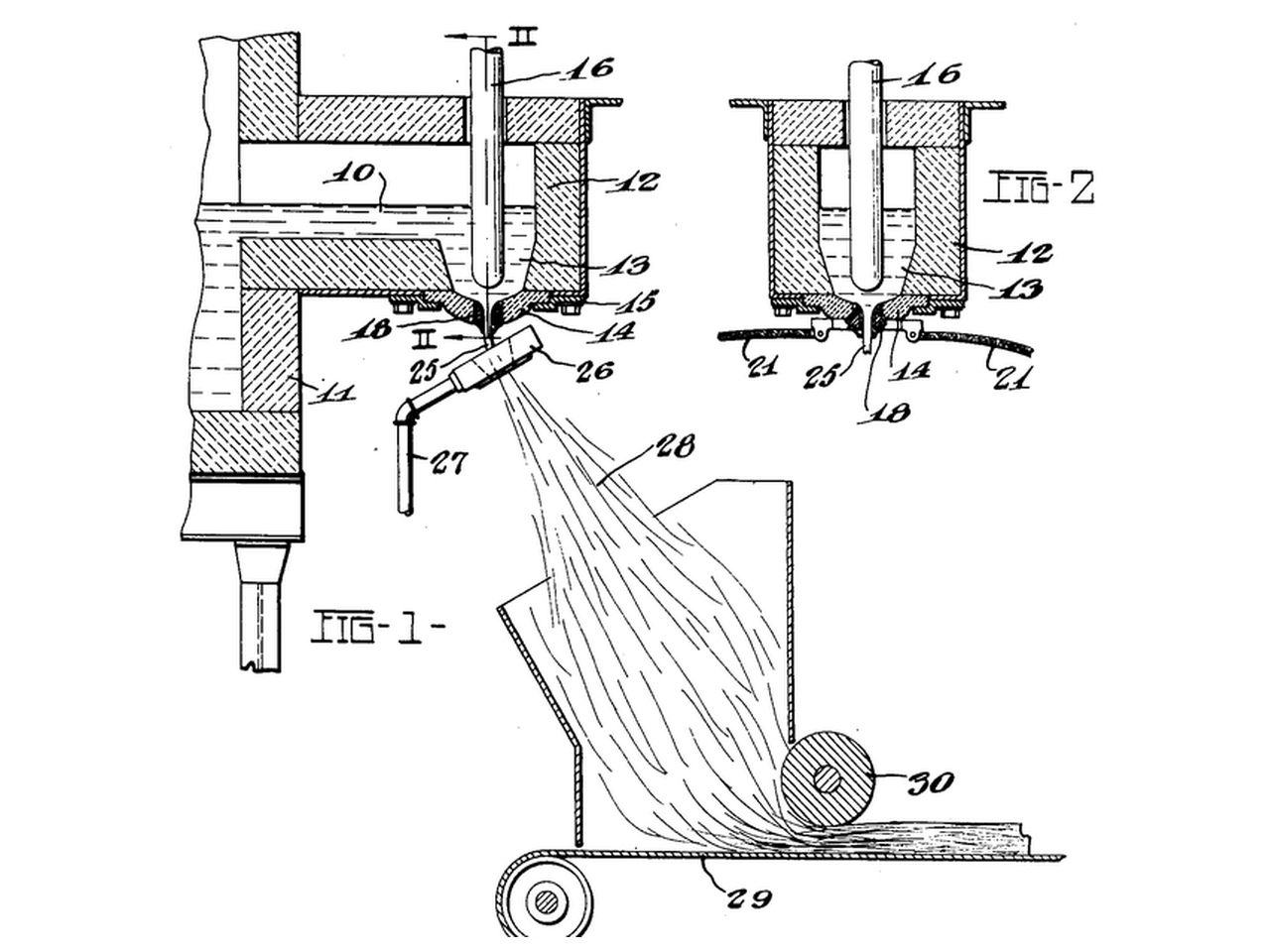


Glass Wool
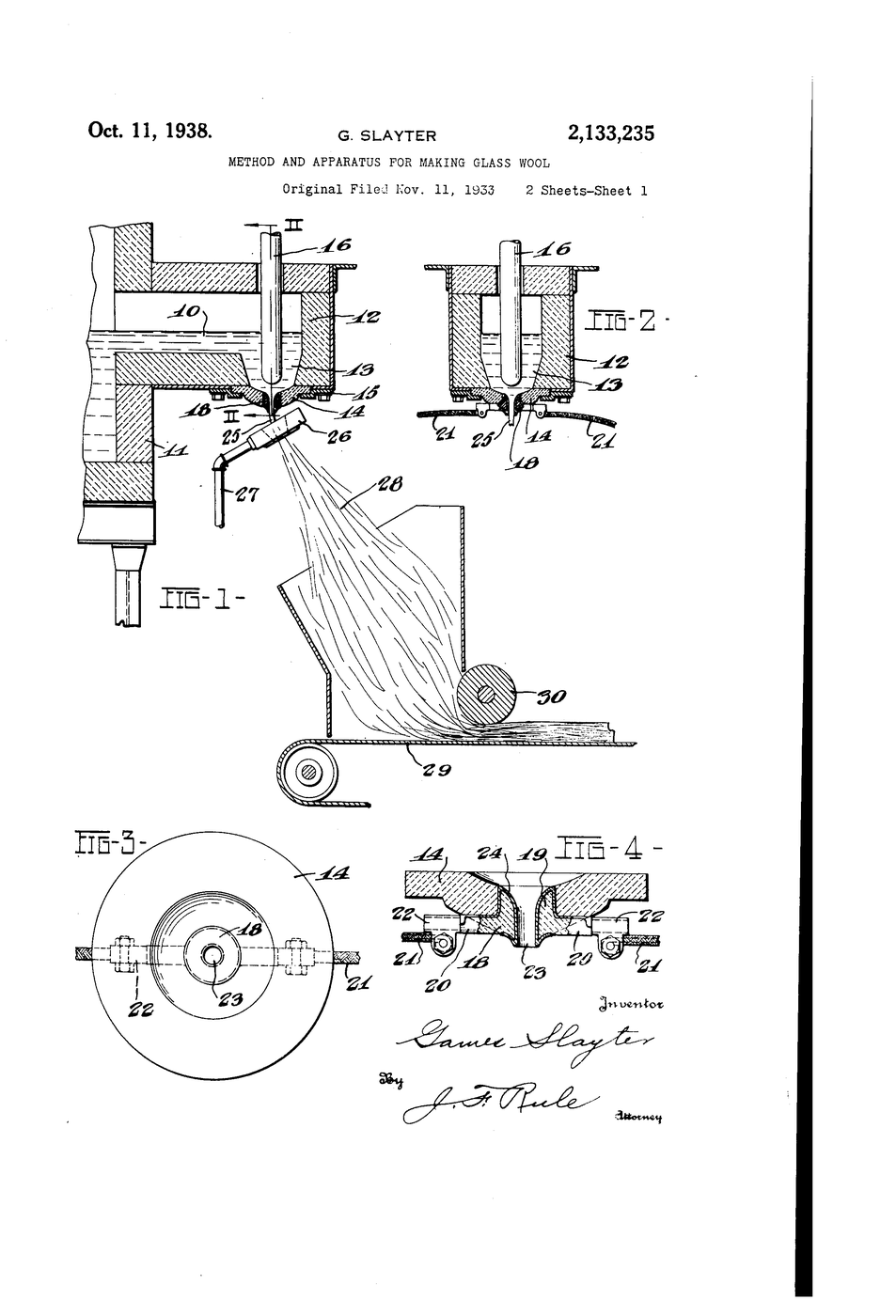
Glass wool was made before the 1930s by blowing steam at a falling thread of molten glass, but by the time the glass reached the blast it had cooled too far to draw really fine fibres. Games Slayter at Owens-Illinois brought the blast right up to the bushing the glass leaves the furnace through, while it was still at furnace heat.
**US 2,133,235**, "Method and apparatus for making glass wool", Slayter, assigned to Owens-Illinois, filed 11. November 1933, granted 11. October 1938. Its FIGURE 1 (the picture above) shows the furnace, the bushing, the steam blast and the wool piling onto a conveyor. The same work led to Owens-Corning Fiberglas in 1938.
**You measure what it is for**: three jars of hot water - bare, in glass wool, in cotton wool - logged by an Arduino, and the cooling curves turned into heat-loss figures.
Początkujący
2 hours
Instrukcje
1
1
Wire the logger
Wire the logger
Probes' red to 5V, black to GND, data (yellow) together to D2, with a 4.7 kΩ resistor from D2 to 5V. Install the OneWire and DallasTemperature libraries. Warm each probe in your hand in turn to learn which index is which.
three_jar_cooling_logger.inocpp
Materiały do tego kroku:
 Czujnik temperatury DS18B203 sztuk
 Zestaw rezystorów1 zestaw
 Zestaw przewodów Dupont (męsko-żeńskich)1 zestaw
Potrzebne narzędzia:
 Arduino Uno R3
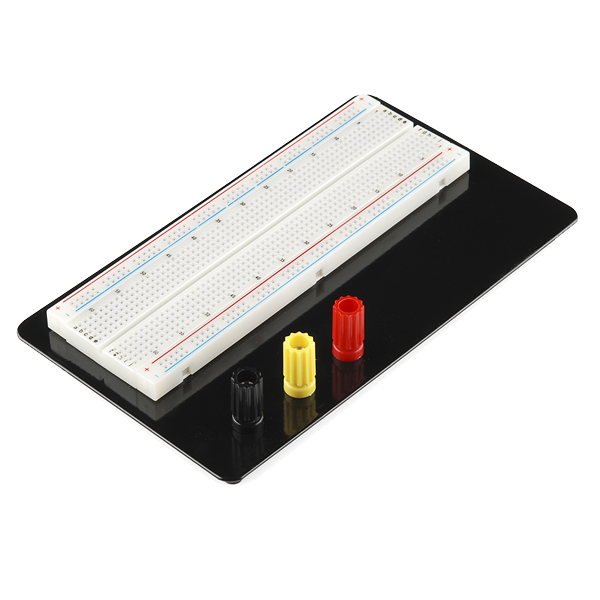 Breadboard - Classic
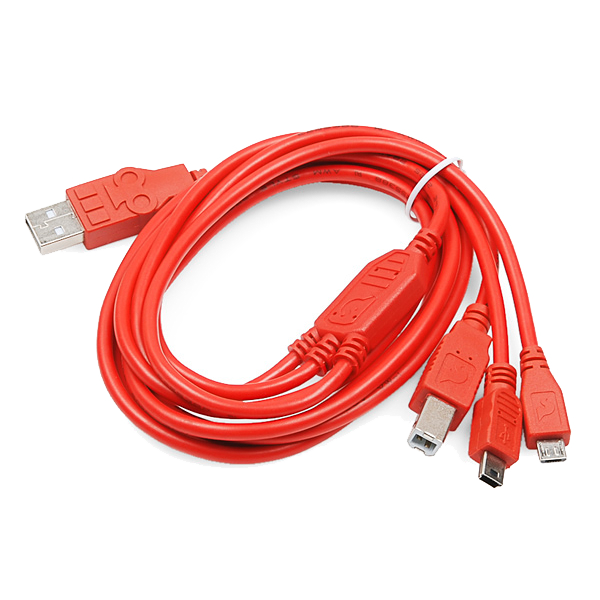 SparkFun Cerberus USB Cable - 1.8 meter
2
2
Prepare three jars
Prepare three jars
Drill a 7 mm hole in each of three identical lids. Push a probe through each so its tip sits mid-jar. Seal the hole with tape.
Materiały do tego kroku:
 Słoiki szklane z pokrywkami3 sztuk
 Taśma malarska1 rolka
Potrzebne narzędzia:
 Wiertarko-wkrętarka akumulatorowa
 Zestaw wierteł
3
3
Wrap two of them
Wrap two of them
Gloves, long sleeves, mask, glasses. Put glass wool inside a plastic bag, then wrap jar 2 in it 30 mm thick all round and under, and tape. Wrap jar 3 the same way in cotton wool. Leave jar 1 bare.
Materiały do tego kroku:
 Izolacja z wełny szklanej1 rolka
 Wata bawełniana1 opakowanie
 Worki foliowe4 sztukTaśma malarska1 rolka
Potrzebne narzędzia:
 Skórzane rękawice robocze
 Maska przeciwpyłowa
 Okulary ochronne bezbarwne
 Nożyczki
4
4
Fill and log
Fill and log
Boil water. Pour 500 ml into each jar, one after another, and close the lids. Start the serial monitor and log for 90 minutes. Note the room temperature.
Potrzebne narzędzia:
 Czajnik elektryczny szklany
 Cylinder miarowy
5
5
Fit the curves
Fit the curves
Wczytywanie notatnika Jupyter…
6
6
History & Context
History & Context
**What the patent specifies:** a steam blast applied at the bushing itself, so the glass stream is drawn while still at furnace temperature, giving very fine wool. **Modern build (derived):** commercial glass-wool insulation, handled wrapped.
Continuous glass filament for textiles and reinforcement followed from the same laboratory. Its limits: loose fibres irritate skin, eyes and lungs, so it is always handled covered, and like any fibrous insulation it loses most of its value when wet or compressed.
Materiały
8- 3 sztukZastępnik
- Zastępnik
- Zastępnik
- 3 sztukZastępnik
- 2 rolekZastępnik
- 1 rolkaZastępnik
- 1 opakowanieZastępnik
- 4 sztukZastępnik
Wymagane narzędzia
11- 1 vendor sell this, none ship to you yetZastępnik
- Breadboard - Classic10% prowizji$9.36
- SparkFun Cerberus USB Cable - 1.8 meter10% prowizji$5.60
- 1 vendor sell this, none ship to you yetZastępnik
- Zastępnik
- Zastępnik
- Zastępnik
- Zastępnik
- Zastępnik
- Zastępnik
- Zastępnik
Powiązane blueprinty
Te blueprinty dzielą się wiedzą — technikami, materiałami lub zasadami
CC0 Domena publiczna
Ten plan jest udostępniany na licencji CC0. Możesz go swobodnie kopiować, modyfikować, rozpowszechniać i wykorzystywać do dowolnych celów, bez konieczności uzyskiwania zgody.
Wesprzyj Makera kupując produkty przez jego plan, za co zarabia Prowizja Makera ustalony przez sprzedawców, lub stwórz nową iterację tego planu i dołącz go jako połączenie w swoim własnym planie, aby dzielić się przychodami.