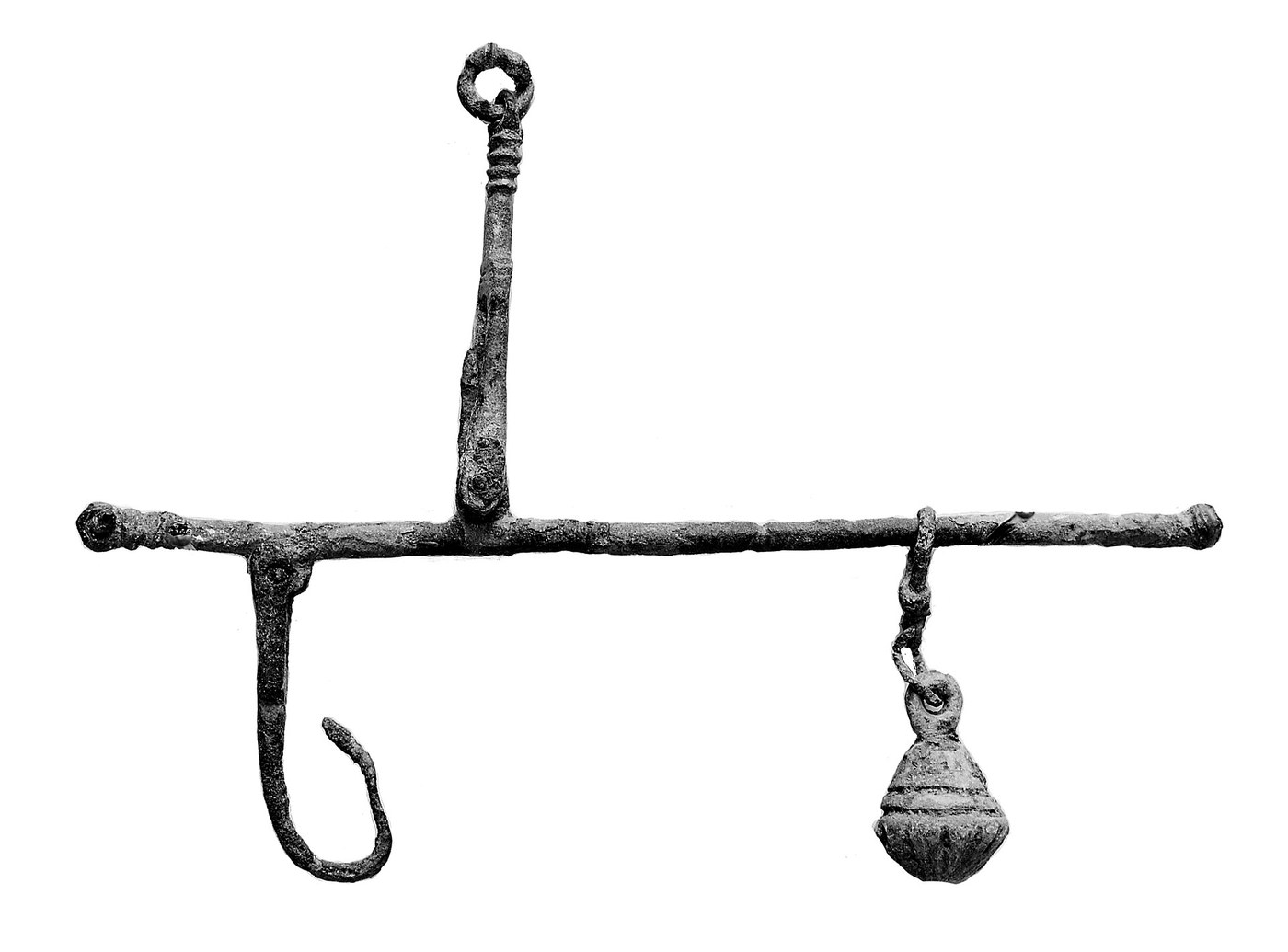


Steelyard Balance
Instrukcje
Find the law of the lever yourself
Find the law of the lever yourself
Establish the rule before building anything that relies on it.
- Balance a rigid bar on a central pivot.
- Hang a known mass at a measured distance on one side.
- Balance it with a different mass on the other and record both distances.
Materiały do tego kroku:
 Pręt ze stali niskowęglowej1 bar
 Cyfrowa waga kuchenna1 sztuka
 Linijka1 sztuka
Move the pivot off centre
Move the pivot off centre
Now break the symmetry deliberately.
- Re-hang the beam so the pivot sits near one end.
- Hang the load from the SHORT arm.
- Slide a single counterweight along the LONG arm until it balances.
Materiały do tego kroku:
 Sznurek bawełniany1 rolka
Graduate the beam
Graduate the beam
Turn the balance point into a reading.
- Hang a known mass and mark where the counterweight balances.
- Repeat for several known masses.
- Check the spacing between your marks.
Add a second pivot for a second range
Add a second pivot for a second range
Roman steelyards commonly have two or three suspension hooks. Build the second.
- Fit another pivot point closer to the load end.
- Hang from that one and re-graduate.
- Compare the two scales.
History and context
History and context
The steelyard is Roman in its familiar form — the Latin is statera — and hundreds survive from across the empire, in bronze, often with decorated counterweights cast as busts. Similar unequal-arm balances appear independently in China as the gancheng, and the type is old enough that a single origin is not worth asserting.
Its weakness is exactly its strength. Because the reading depends on a DISTANCE rather than on comparing two weights directly, a steelyard can be falsified in ways an equal-arm balance cannot: shave the beam, shift the pivot, use a counterweight that is slightly light, or file the graduations. Medieval market regulation is full of provisions about checking and stamping steelyards, and the equal-arm balance kept its reputation for honesty for that reason — with two equal arms, any tampering shows up when you swap the pans.
The name has nothing to do with steel. It is generally traced to the Steelyard, the London trading base of the Hanseatic League on the Thames, where such balances were in daily use. The etymology is contested, and it is worth flagging as a folk explanation rather than a settled fact.
Still in service. Doctors' beam scales work this way — a sliding poise along a graduated arm — and so do many mechanical crane and lorry scales. The moment principle also underlies the crane's load chart and the counterweight on a tower crane, which is a steelyard the size of a building.
Materiały
4- Zastępnik
- 1 sztukaZastępnik
- 1 sztukaZastępnik
- 1 rolkaZastępnik
Powiązane blueprinty
Te blueprinty dzielą się wiedzą — technikami, materiałami lub zasadami
CC0 Domena publiczna
Ten plan jest udostępniany na licencji CC0. Możesz go swobodnie kopiować, modyfikować, rozpowszechniać i wykorzystywać do dowolnych celów, bez konieczności uzyskiwania zgody.
Wesprzyj Makera kupując produkty przez jego plan, za co zarabia Prowizja Makera ustalony przez sprzedawców, lub stwórz nową iterację tego planu i dołącz go jako połączenie w swoim własnym planie, aby dzielić się przychodami.