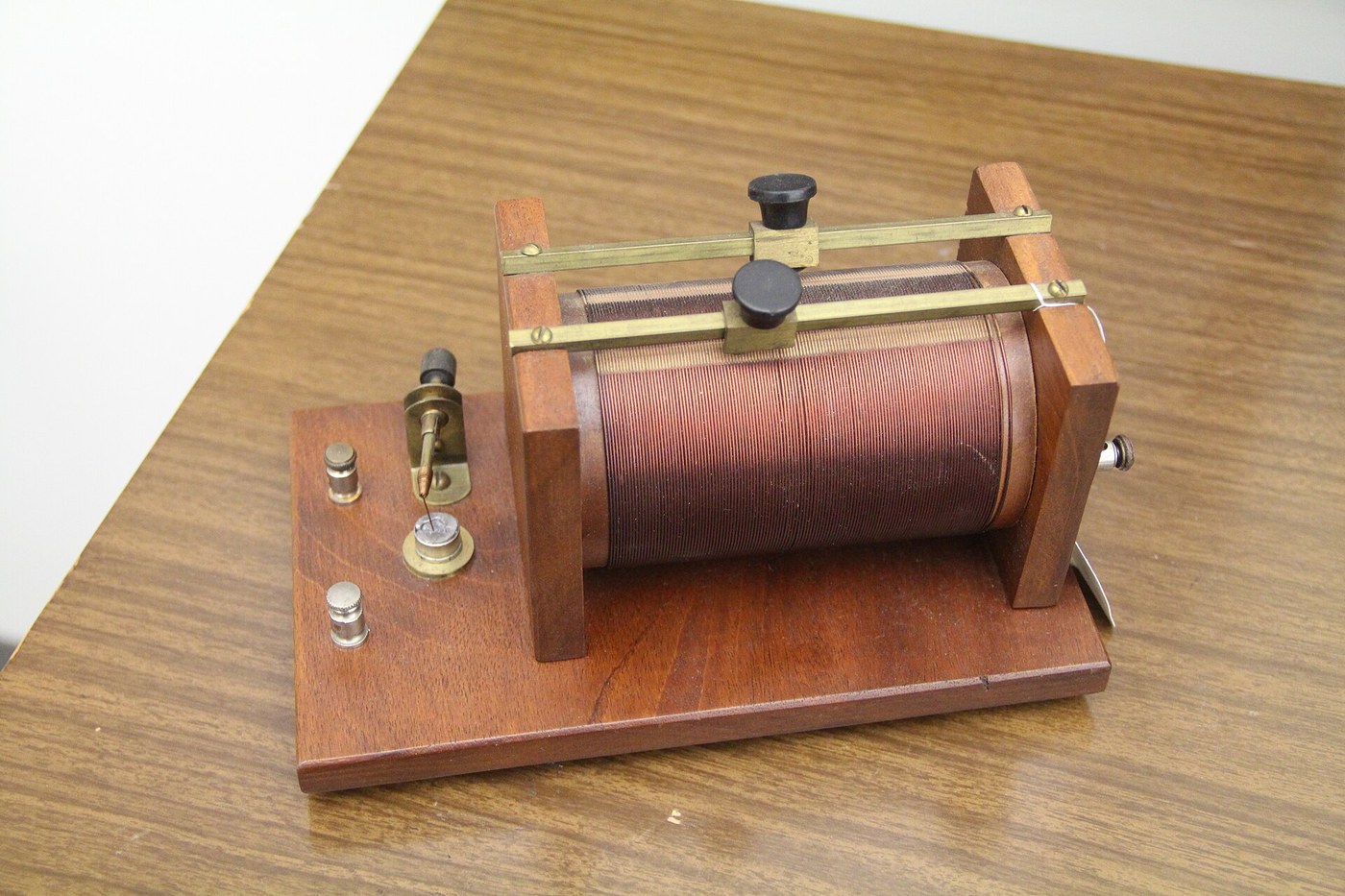


Syntonic Tuning
Early wireless had a fault that nobody could design around: every receiver heard every transmitter. A spark transmitter radiates across an enormous span of frequencies at once, and a coherer answers to anything that arrives. Two stations working at the same time simply ruined each other, so the air could hold exactly one conversation.
Syntonic tuning fixes it by making both ends selective — by giving them a preference.
An inductor and a capacitor together have a natural frequency, exactly as a pendulum has one. Drive them at that frequency and the response builds enormously; drive them at another and almost nothing happens. Put such a circuit in the transmitter so it radiates a narrow band instead of a broad crash, and an identical one in the receiver so it answers only near that band, and the pair become a private channel.
The crucial word is syntony — both ends tuned to the same note. Tuning only the receiver is not enough: a transmitter that shouts everywhere still jams everyone, and no amount of selectivity at the far end recovers spectrum that was never left free.
This is the invention that turns the air from a single shared shout into a medium with channels. Everything since — every station, every band, every allocation — is this idea plus a regulator.
Instrukcje
Hear resonance in something you can see
Hear resonance in something you can see
Hang several pendulums of different lengths from one loose horizontal string. Set one swinging.
Watch the others.
Expect only the one of matching length to build up a large swing, while the rest barely move — even though all of them receive exactly the same disturbance through the string.
Say the principle out loud before touching any electronics: selectivity does not require a filter that blocks things. It requires a system that ACCUMULATES energy at one frequency and fails to accumulate it at others.
Potrzebne narzędzia:
 Miara zwijana
Build the electrical pendulum
Build the electrical pendulum
Wind a coil and connect it across a capacitor. Excite the circuit briefly and observe the result on an oscilloscope.
Expect a decaying oscillation at a definite frequency — a ringing.
Change the capacitor and watch the frequency move; change the coil and watch it move again.
Note the exchange taking place: energy sloshes from the magnetic field of the coil to the electric field of the capacitor and back, exactly as a pendulum trades height for speed. Same equation, different wardrobe.
Materiały do tego kroku:
 Drut miedziany emaliowany30 m
Potrzebne narzędzia:
 Oscyloskop analogowy
Measure how sharply it prefers its own note
Measure how sharply it prefers its own note
Drive your tuned circuit from a signal generator, sweep the frequency, and plot the response.
Expect a peak. Measure its width relative to its centre frequency — that ratio is the circuit's Q.
Now add resistance deliberately and sweep again.
Expect the peak to get lower and broader.
Losses and selectivity are the same quantity seen twice: a circuit that wastes energy cannot accumulate it, and a circuit that cannot accumulate cannot discriminate. Chasing selectivity means chasing losses, which is why tuned circuits are built with thick wire, good insulators and air.
Prove that tuning the receiver alone is not enough
Prove that tuning the receiver alone is not enough
Set up two transmitters — one broadband and crashing, one tuned and narrow — and a tuned receiver. Run each against the receiver in turn, then both together.
Expect the tuned receiver to reject the tuned transmitter it is not matched to, and to be swamped by the broadband one whatever you do.
Write the conclusion down carefully, because it is the reason for the word syntonic: a broad transmitter destroys everyone's selectivity, including that of people who have done nothing wrong. Spectrum discipline is a shared obligation, not a private optimisation — which is why radio has been regulated almost since it existed.
Find the price of being narrow
Find the price of being narrow
Send a rapidly keyed message through a very sharply tuned circuit, then through a broader one, and compare what emerges.
Expect the sharp circuit to blur fast keying — the ringing takes time to build and time to die, so quick changes are smeared.
Measure how the maximum usable keying speed falls as Q rises.
This is the same trade as everywhere else in the batch: narrow in frequency means slow in time. It is not an engineering shortcoming to be designed out; it is a property of waves, and every filter, every radio channel and every fibre link obeys it.
History & Context
History & Context
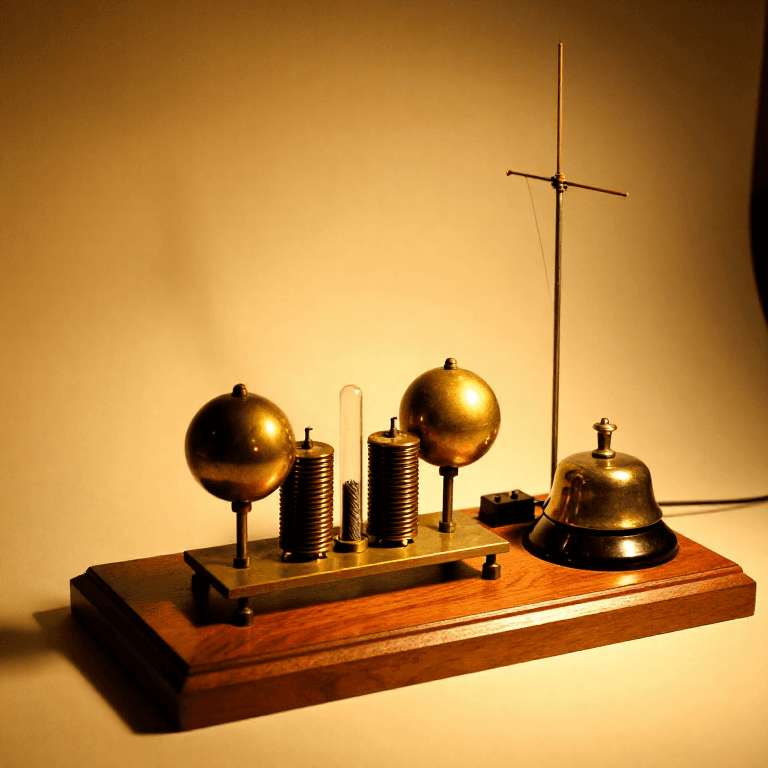
Oliver Lodge patented it, and then watched somebody else own radio. In 1897 he took out a British patent for improvements in syntonised telegraphy without wires, and the corresponding US patent 609,154, 'Electric Telegraphy', issued in August 1898. Lodge was a physicist of the first rank who had demonstrated wireless signalling before Marconi and was, by most accounts, more interested in the physics than in the company. The Marconi Company acquired his tuning patent in 1912, which tells you where the commercial power sat.
Marconi's own 'four sevens' patent covered a related tuning arrangement and became one of the most valuable patents of the era. The priority arguments between Lodge, Marconi, Tesla and Braun ran for decades in several countries and were decided differently in different jurisdictions. This corpus states the mechanism and lists the claimants rather than crowning one — the resonance in step 2 is not anybody's opinion.
Tuning is what created the CONCEPT of a station. Before syntony there was 'wireless', a single shared shout. After it, there are frequencies, and a frequency can be allocated, licensed, sold and fought over. Every radio band plan, every broadcast licence, every mobile-spectrum auction descends from the moment it became possible for two transmitters to coexist. A technical property became a form of property.
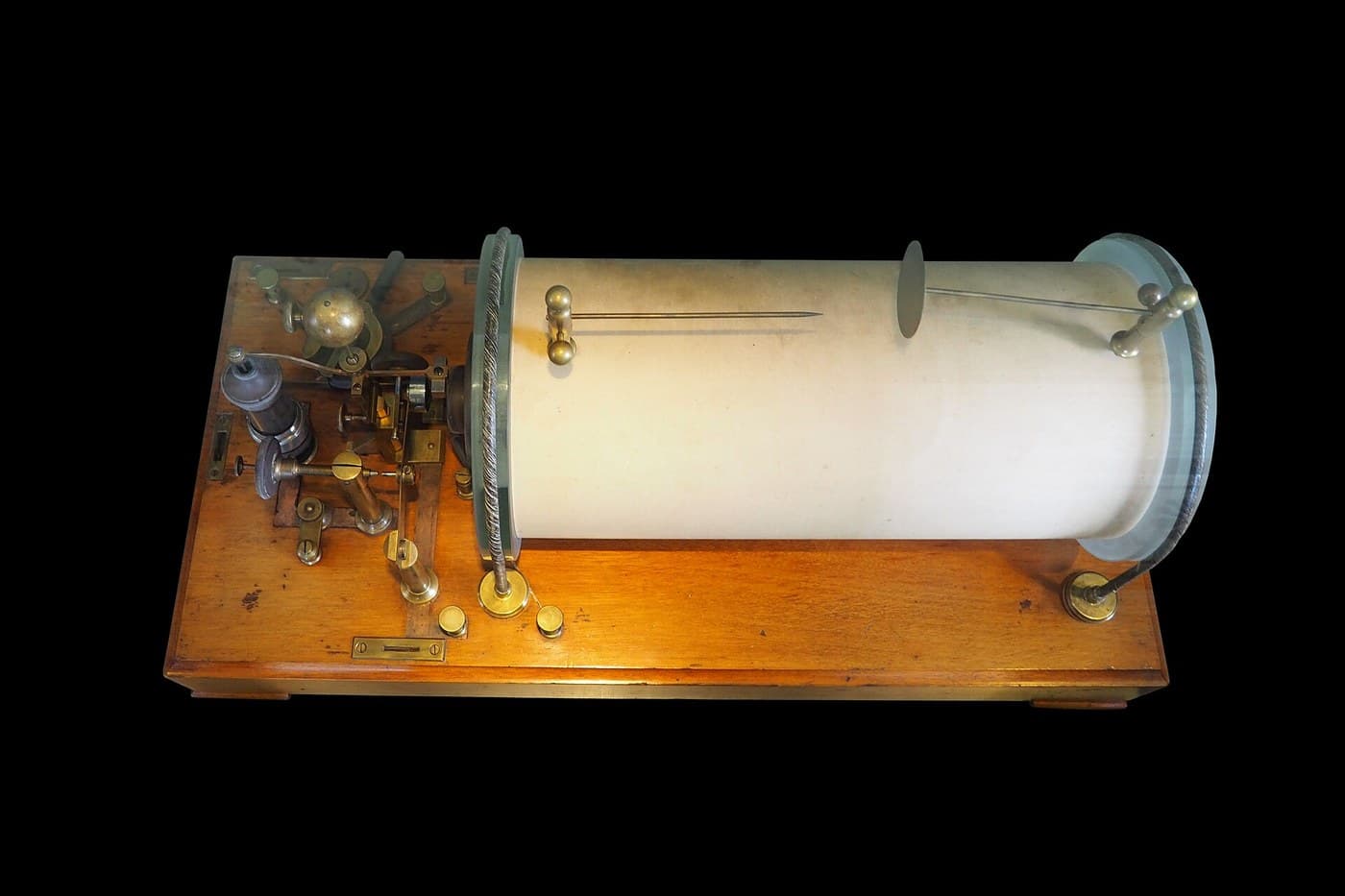
It also made the spark transmitter obsolete by its own logic. A spark is inherently broadband — a violent transient, exactly like the induction coil's interrupter — so the more seriously anyone took syntony, the more obviously spark had to go. Continuous-wave transmitters, the Poulsen arc, the alternator and finally the vacuum tube followed, each narrower than the last. Adopting a principle can condemn the machine you adopted it for.
Honest limits. Selectivity costs speed, so a very sharp channel carries slow traffic. High Q needs low loss, which means bulky air-spaced components and good insulators. A single tuned circuit is not very selective; real receivers cascade several, and each one costs signal. Tuned circuits drift with temperature and with anything conductive nearby, including the operator's hand. And selectivity is not privacy — anybody who tunes to your frequency hears you perfectly.
Materiały
1- Zastępnik
Wymagane narzędzia
2- 1 vendor sell this, none ship to you yetZastępnik
- Zastępnik
Materiały z połączonych planów

Powiązane blueprinty
Te blueprinty dzielą się wiedzą — technikami, materiałami lub zasadami


CC0 Domena publiczna
Ten plan jest udostępniany na licencji CC0. Możesz go swobodnie kopiować, modyfikować, rozpowszechniać i wykorzystywać do dowolnych celów, bez konieczności uzyskiwania zgody.
Wesprzyj Makera kupując produkty przez jego plan, za co zarabia Prowizja Makera ustalony przez sprzedawców, lub stwórz nową iterację tego planu i dołącz go jako połączenie w swoim własnym planie, aby dzielić się przychodami.