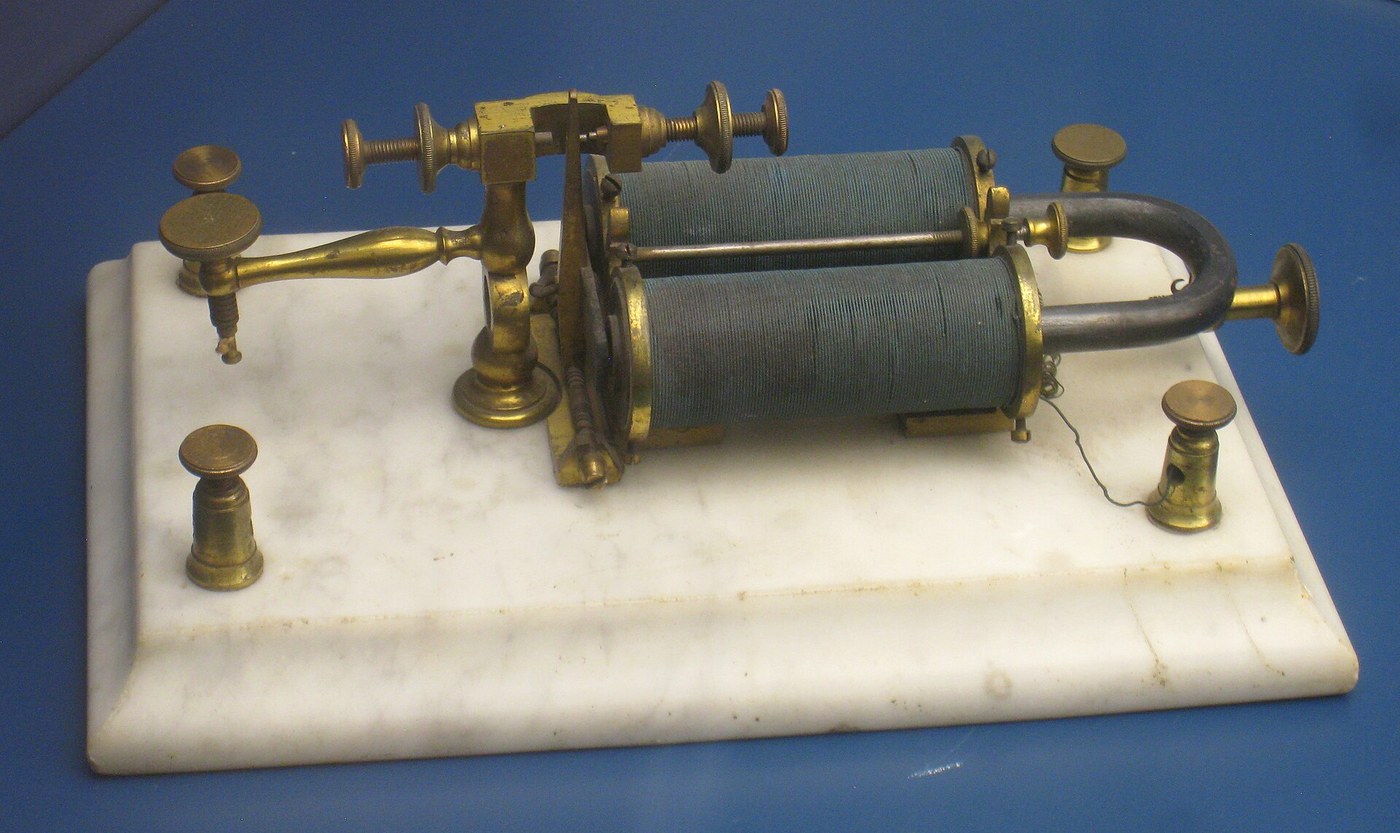


The Telegraph Relay
A signal on a wire gets weaker with distance, and it never gets stronger again. Beyond some length the click at the far end is too feeble to hear, and no amount of care at the sending end fixes it — thicker wire and a bigger battery buy kilometres, not continents.
The relay refuses the whole framing. It does not try to strengthen the arriving signal. It uses the arriving signal, weak as it is, to operate a switch on a completely fresh circuit with its own battery.
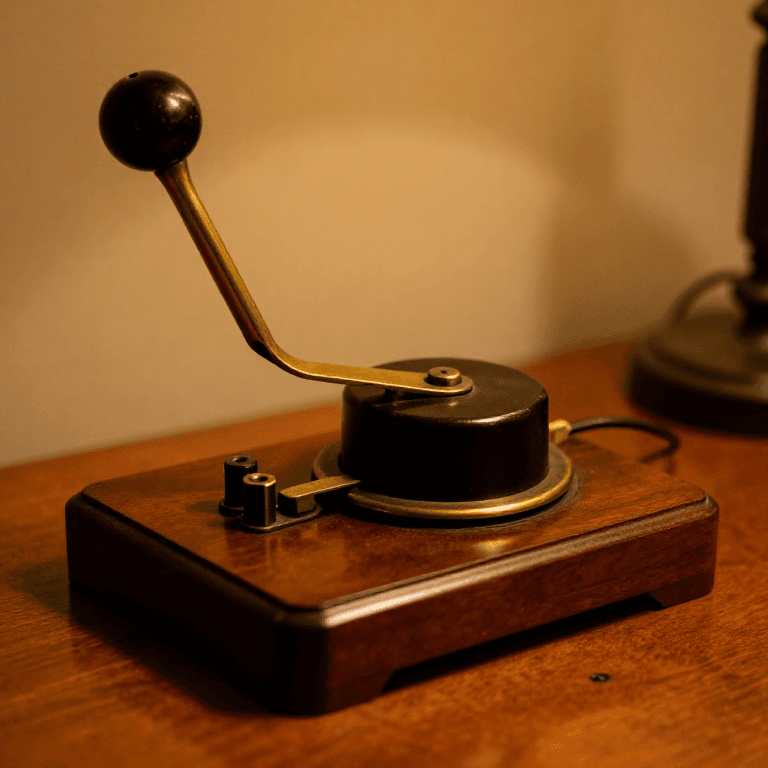
An electromagnet wound with many turns of fine wire responds to a current far too small to work a sounder. Its armature closes a second circuit, and that circuit — local, short, full-strength — does the actual work.
The consequence is the important part. The output is not a copy of the input; it is a reconstruction. The incoming pulse may have arrived smeared, drooping and half-buried in noise, and what leaves is a clean, square, full-amplitude pulse, because the outgoing circuit only ever does two things: fully on, fully off. Timing passes through; degradation does not.
So the reach becomes unlimited in principle. Chain relays, and the signal is rebuilt at every stage instead of accumulating damage. Every repeater, every logic gate and every digital link since is this idea.
Instrukcje
Watch a signal die on a long line
Watch a signal die on a long line
Wire a battery, a switch and a small electromagnet in series, then insert increasing lengths of thin wire — or a chain of resistors standing in for line resistance.
Measure the current with a multimeter at each length and note where the electromagnet stops pulling its armature.
Expect current to fall roughly in proportion to added resistance, and the mechanical action to fail abruptly well before the current reaches zero.
That gap matters: there is a wide band where a signal is clearly still present but can no longer do useful work. Everything that follows lives in that band.
Materiały do tego kroku:
 Drut miedziany emaliowany20 m
 Drut stalowy ocynkowany1 m
Potrzebne narzędzia:
 Multimetr analogowy
 Przewody pomiarowe z krokodylkami
Make a coil that answers to almost nothing
Make a coil that answers to almost nothing
Wind two electromagnets on identical iron cores: one with a few dozen turns of thicker wire, one with many hundreds of turns of the finest wire you have.
Find the smallest current that just moves the armature of each.
Expect the many-turns coil to respond to a far smaller current, because the pull follows ampere-turns — current multiplied by the number of turns — not current alone.
You have not amplified anything. You have built a detector sensitive enough to notice what survives the line, which is a different and cheaper thing.
Let the weak circuit switch a strong one
Let the weak circuit switch a strong one
Mount the sensitive coil so its armature closes a second, entirely separate circuit with its own battery and a loud sounder or lamp.
Now operate the far end of your long line and listen to the local circuit.
Expect a full-strength click from a signal that could not make a sound by itself.
Trace where the energy comes from and say it out loud: the line supplies the decision, the local battery supplies the power. Separating those two is the entire invention, and it is worth more than any component in it.
Prove that the output is rebuilt, not copied
Prove that the output is rebuilt, not copied
Deliberately degrade the incoming signal — long line, weak battery, a poor connection that makes it ragged — and compare the input and the relay's output on an oscilloscope, or by ear.
Expect the input to be rounded, drooping and noisy and the output to be square and full-amplitude.
Then push further until the relay starts to miss or chatter, and note where the cliff is.
This is the whole difference between a signal that survives a hundred stages and one that does not. Degradation that is thrown away at every stage cannot accumulate; degradation that is merely amplified always does.
Chain them, and find what still accumulates
Chain them, and find what still accumulates
Put two or three relays in series, each driving the next through a length of line, and send a message through the chain.
Expect the amplitude at the end to be as good as at the start, however many stages you add.
Now measure what does not recover: the delay. Time a single stage, then the whole chain.
Expect delay to add up stage by stage, and expect the crispness of the timing — how faithfully a short pulse stays short — to decay slowly even though amplitude does not.
Amplitude is restored; time is not. Every long digital link since has the same asymmetry.
History & Context
History & Context
Joseph Henry demonstrated the principle and did not patent it. He showed a small current working an electromagnet that closed a second circuit, and regarded it — explicitly — as a contribution to science rather than property. Samuel Morse and Alfred Vail built it into the working telegraph, and the resulting arguments about who invented what ran for decades. Henry's choice is why the idea spread as fast as it did.
It is what made the telegraph a NETWORK rather than a line. Without relays, range is set by wire resistance and battery voltage, and every route is a separate engineering problem. With them, distance stops being interesting — you add stages. The relay is the reason a message could cross a continent, and the reason the Morse Telegraph blueprint's sounder is worth building at all.
Then it became a way to think, not just a way to reach. A relay whose contacts feed other relays' coils computes: series contacts are AND, parallel contacts are OR, a normally-closed contact is NOT, and a relay wired to hold itself in remembers. Whole telephone exchanges and early computers were built from nothing else. The vacuum tube and then the transistor replaced the hardware and kept the model exactly.
The one idea to carry away. Regenerate, do not amplify. An amplifier magnifies the noise along with the signal, so errors compound down a chain; a device that makes a fresh clean decision at each stage throws the noise away. That single distinction is the reason digital signals can cross an ocean and analogue ones cannot — and it was discovered by people trying to make a click audible in the next county.
Honest limits. It is mechanical, so it is slow — milliseconds, not nanoseconds — and its contacts wear, pit and bounce. It needs a local power source at every station, which means a person to maintain every one. It restores amplitude but adds delay. And it makes a hard decision at a threshold, so a signal that arrives right at the threshold produces chatter rather than an honest failure, which is the most annoying fault in the system to find.
Materiały
2- Zastępnik
- Zastępnik
Wymagane narzędzia
2- Zastępnik
- Zastępnik
Materiały z połączonych planów

Powiązane blueprinty
Te blueprinty dzielą się wiedzą — technikami, materiałami lub zasadami
CC0 Domena publiczna
Ten plan jest udostępniany na licencji CC0. Możesz go swobodnie kopiować, modyfikować, rozpowszechniać i wykorzystywać do dowolnych celów, bez konieczności uzyskiwania zgody.
Wesprzyj Makera kupując produkty przez jego plan, za co zarabia Prowizja Makera ustalony przez sprzedawców, lub stwórz nową iterację tego planu i dołącz go jako połączenie w swoim własnym planie, aby dzielić się przychodami.