SZTUKA
Piękno i dobre samopoczucie
RZEMIOSŁO
KULTURA I HISTORIA
ROZRYWKA
ŚRODOWISKO
JEDZENIE I NAPOJE
INŻYNIERIA ODWROTNA
NAUKI
LEKKOATLETYKA
TECHNOLOGIA
URZĄDZENIA DO NOSZENIA
Masking Tape: Crepe Paper and an Adhesive That Never Dries
Painting a car in two colours needs a sharp line between them. The paint shops of the 1920s masked with gummed paper, which had to be wetted on and soaked off, or with cloth-backed adhesive tape, whose edges frayed and stretched and whose adhesive the lacquer solvents loosened.
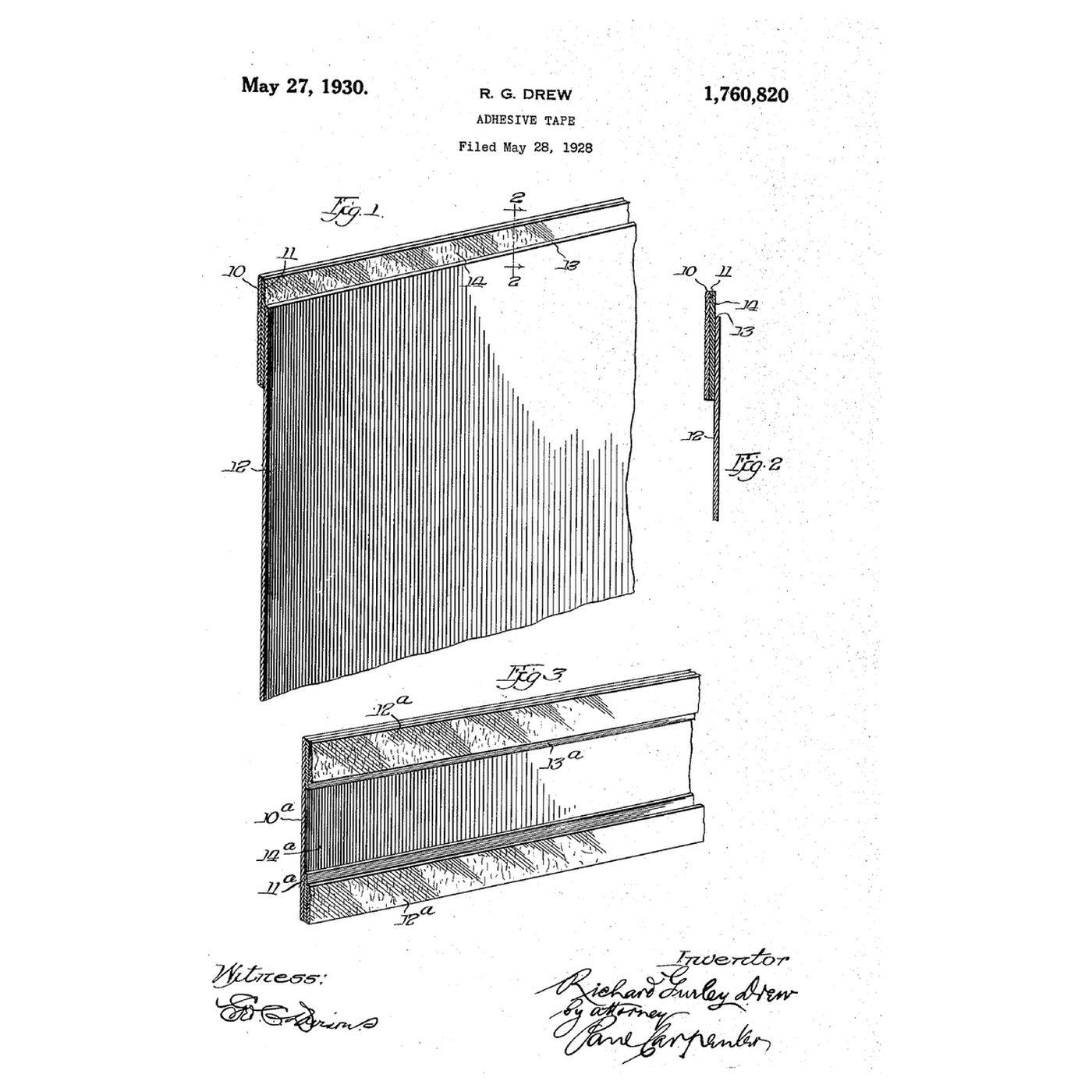
Richard Gurley Drew of St. Paul, assignor to Minnesota Mining & Manufacturing, filed US 1,760,820 on 28 May 1928; it was granted on 27 May 1930 (the specification is stamped as reissued in April 1934). His tape is paper, creped or crimped so it stretches, coated with an adhesive that is "normally non-drying" and sticks by pressure alone, and treated so that paint solvents do not reach the adhesive through the backing.
This rung works out why crepe lets tape follow curves and how the peel angle sets the force to remove it, and masks a two-colour panel.
Początkujący
About 2 hours
Instrukcje
1
1
Curves, stretch and peel
Curves, stretch and peel
Wczytywanie notatnika Jupyter…
2
2
An earlier pressure-sensitive tape
An earlier pressure-sensitive tape
The adhesive bandage used a pressure-sensitive adhesive on a backing a few years before. The embedded blueprint shows it.
3
3
Read US 1,760,820
Read US 1,760,820
Drew's invention relates to "pressure energizable adhesives, adhesive sheets or coatings, preferably water insoluble and normally non-drying." He describes it for the paint shop: "in finishing automobile bodies with lacquers, paints or the like of a plurality of colors, difficulty is found in limiting the application owing to the diffusion of the spray"; to get "a clear and cleancut line of demarcation between several colors", masks of adhesive tape had been used.
Ordinary gummed paper tape, wetted to stick, "adheres so tenaciously that to remove the same requires softening of the adhesive material with large quantities of water", and the soaked paper tears. Cloth-backed tape costs more, and "the woven fabric is distensible to an extent which will make its edges irregular and unsuitable for stripping".
His material may be applied "to paper which is toweled or crimped or otherwise shaped to present a surface other than flat and which has an extensibility beyond that of the flat paper web."
4
4
Mask a two-colour panel
Mask a two-colour panel
Paint a piece of plywood one colour of acrylic and let it dry fully. Lay masking tape along a straight line and round a curve drawn with the compass; note the smallest radius the tape follows without wrinkling or tearing. Press the edges down firmly.
Paint the second colour over the edge of the tape. Pull the tape while the paint is still slightly soft, back over itself at a low angle, and compare with a strip pulled straight up. Look at the line with a hand lens: a clean line, a bleed under the edge, or lifted base paint.
Materiały do tego kroku:
 Taśma malarska1 sztuka
 Zestaw farb akrylowych1 sztuka
 Płyta sklejkowa1 sztuka
Potrzebne narzędzia:
 Zestaw pędzli
 Linijka
 Zestaw papierów ściernych
 Lupa ręczna 10x
 Nóż introligatorski
5
5
Masking tape that lets you down
Masking tape that lets you down
Masking tape troubleshooting.
Flow
Loading...
6
6
History and honest limits
History and honest limits
**Richard Gurley Drew** filed US 1,760,820 on 28 May 1928 as a continuation in part of an application of 11 April 1927, assigned to **Minnesota Mining & Manufacturing Company**; it was granted on 27 May 1930.
**Honest limits.** The stretch limits and adhesive energy in the notebook are assumed examples; the peel formula ignores the backing's stiffness.
Materiały
3- 1 sztukaZastępnik
- 1 sztukaZastępnik
- 1 sztukaZastępnik
Wymagane narzędzia
5- Zastępnik
- Zastępnik
- Zastępnik
- Zastępnik
- Zastępnik
Powiązane blueprinty
Te blueprinty dzielą się wiedzą — technikami, materiałami lub zasadami
Adhesive Bandage
autor: Bob
NAUKI
34
0
0
0
0
0
Vulcanizing Rubber with Sulfur — The Accidental Discovery That Put Tyres on the Road
autor: Charlie
Przemysłowy
86
0
0
0
3
0
Drying Is Not Evaporating: Three Different Mechanisms, Three Different Films
autor: Mary
Chemia
25
0
0
0
0
0

Adhesion: Four Tests, and Three of Them Destroy the Part
autor: Charlie
Chemia
21
0
0
0
0
0

Making Paper from Wood Pulp — The Groundwood Process That Made Paper Cheap
autor: Glorfindel
Papiernicze
56
0
0
0
1
0
CC0 Domena publiczna
Ten plan jest udostępniany na licencji CC0. Możesz go swobodnie kopiować, modyfikować, rozpowszechniać i wykorzystywać do dowolnych celów, bez konieczności uzyskiwania zgody.
Wesprzyj Makera kupując produkty przez jego plan, za co zarabia Prowizja Makera ustalony przez sprzedawców, lub stwórz nową iterację tego planu i dołącz go jako połączenie w swoim własnym planie, aby dzielić się przychodami.