SZTUKA
Piękno i dobre samopoczucie
RZEMIOSŁO
KULTURA I HISTORIA
ROZRYWKA
ŚRODOWISKO
JEDZENIE I NAPOJE
INŻYNIERIA ODWROTNA
NAUKI
LEKKOATLETYKA
TECHNOLOGIA
URZĄDZENIA DO NOSZENIA



The Perforated Paper Roll: Bonds That Break One Sheet at a Time
A roll of paper divided into sheets needs lines of weakness that part at a gentle pull — but only one at a time, and without tearing across the sheet.
Seth Wheeler of Albany, New York, filed US 459,516 on 10 June 1891; it is dated 15 September 1891. His "wrapping or toilet paper roll" has sheets "only partially separated", with the points of attachment between them placed "alternately out of parallel lines" through the roll, so that a pull on the free end "will not be transmitted in a direct line through a series of sheets" and each sheet separates easily on its own. His drawing shows the roll hung on a simple fixture with the paper coming over the top.
This rung works out how much paper a roll holds and what the bonds must carry, and tests rolls with different bond patterns.
Początkujący
About 2 hours
Instrukcje
1
1
Length on a roll and bond strength
Length on a roll and bond strength
Wczytywanie notatnika Jupyter…
2
2
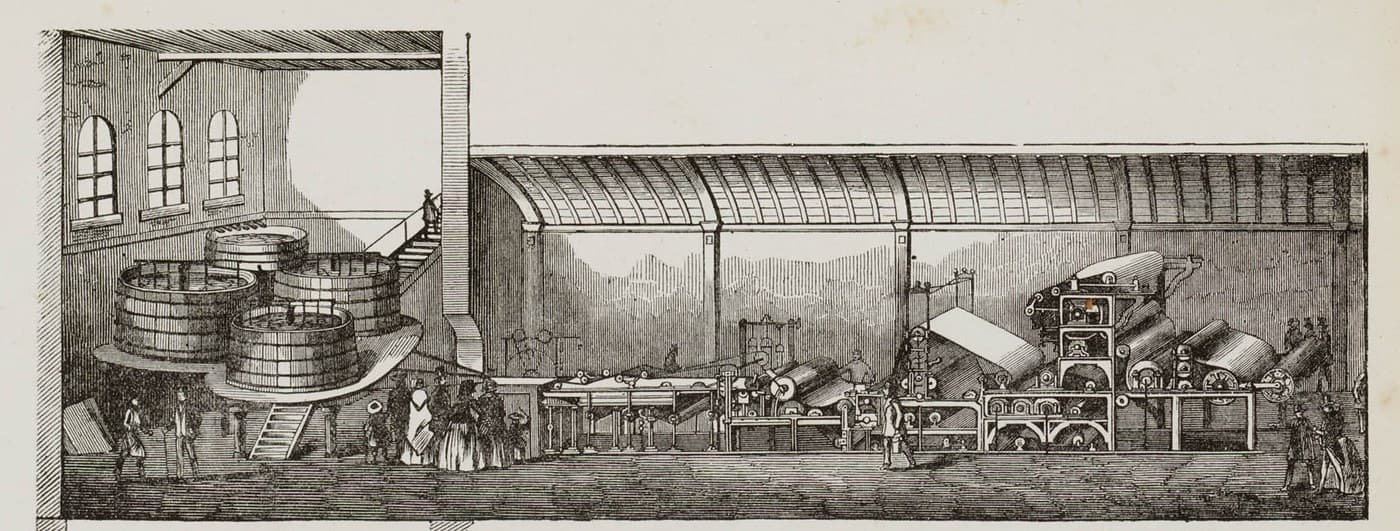
Where continuous paper comes from
Where continuous paper comes from
Rolls of paper became possible when paper was made in a continuous web. The embedded blueprint shows the machine.
3
3
Read US 459,516
Read US 459,516
Wheeler's roll is "so constructed that the points of attachment and severance between the sheets will be alternately out of parallel lines running through the whole body of the sheets, so that a pull upon the free end of the web will not be transmitted in a direct line through a series of sheets, but will be diverted by the spaces opposite the connecting points of the sheet pulled upon, thereby producing a transverse strain upon the next line of connecting points sufficient to break them."
Earlier roll-makers had put "the connecting points or bonds in parallel lines, or nearly so", so that if the free end were pulled in line with them "a long series of sheets may be drawn from the roll unless the free movement of the roll is prevented by friction or other means." Other inventors had instead built holders to stop the roll unwinding — "more or less complicated, liable to derangement, and expensive".
In Fig. 1 the points e and e′ lie near the margins and "alternate through the whole roll"; nearer the centre (f, f′) "they should be narrower to avoid any probability of tearing into the body of the sheets". Other figures show two points alternating with one, and an oblique form of sheet. "My improved roll may be used on the simplest holders."
4
4
Make bond patterns and pull them
Make bond patterns and pull them
Cut three long strips of paper towel. On each, every 11 cm, cut across the strip with a craft knife on the cutting mat, leaving bonds uncut: on the first, two 5 mm bonds at the edges on every line; on the second, one 5 mm bond alternating from edge to edge line by line, as Wheeler did; on the third, one 5 mm bond in the middle of every line.
Roll each strip onto a card tube, hang it on a dowel and pull the free end at a steady rate, sometimes straight and sometimes towards one side. Count how many sheets come off per pull and whether any sheet tears across. Hook the spring scale to the end to read the parting force.
Materiały do tego kroku:
 Ręcznik papierowy1 sztuka
 Brystol1 sztuka
 Kołki z twardego drewna1 sztuka
 Papier toaletowy1 sztuka
Potrzebne narzędzia:
 Nóż introligatorski
 Mata do cięcia samoregenerująca
 Linijka
 Siłomierz (waga sprężynowa)
5
5
A paper roll that misbehaves
A paper roll that misbehaves
Perforated roll troubleshooting.
Flow
Loading...
6
6
History and honest limits
History and honest limits
**Seth Wheeler** of Albany, New York, filed US 459,516 on 10 June 1891; it is dated 15 September 1891. He claims a roll of partially separated sheets whose points of attachment are arranged out of line from sheet to sheet.
**Honest limits.** Roll sizes, paper thickness and tear forces in the notebook are examples; tearing depends on the fibre, the moisture and the pull's direction.
Materiały
4- 1 sztukaZastępnik
- 1 sztukaZastępnik
- 1 sztukaZastępnik
- 1 sztukaZastępnik
Wymagane narzędzia
4- Zastępnik
- Zastępnik
- Zastępnik
- Zastępnik
Powiązane blueprinty
Te blueprinty dzielą się wiedzą — technikami, materiałami lub zasadami




CC0 Domena publiczna
Ten plan jest udostępniany na licencji CC0. Możesz go swobodnie kopiować, modyfikować, rozpowszechniać i wykorzystywać do dowolnych celów, bez konieczności uzyskiwania zgody.
Wesprzyj Makera kupując produkty przez jego plan, za co zarabia Prowizja Makera ustalony przez sprzedawców, lub stwórz nową iterację tego planu i dołącz go jako połączenie w swoim własnym planie, aby dzielić się przychodami.