SZTUKA
Piękno i dobre samopoczucie
RZEMIOSŁO
KULTURA I HISTORIA
ROZRYWKA
ŚRODOWISKO
JEDZENIE I NAPOJE
INŻYNIERIA ODWROTNA
NAUKI
LEKKOATLETYKA
TECHNOLOGIA
URZĄDZENIA DO NOSZENIA
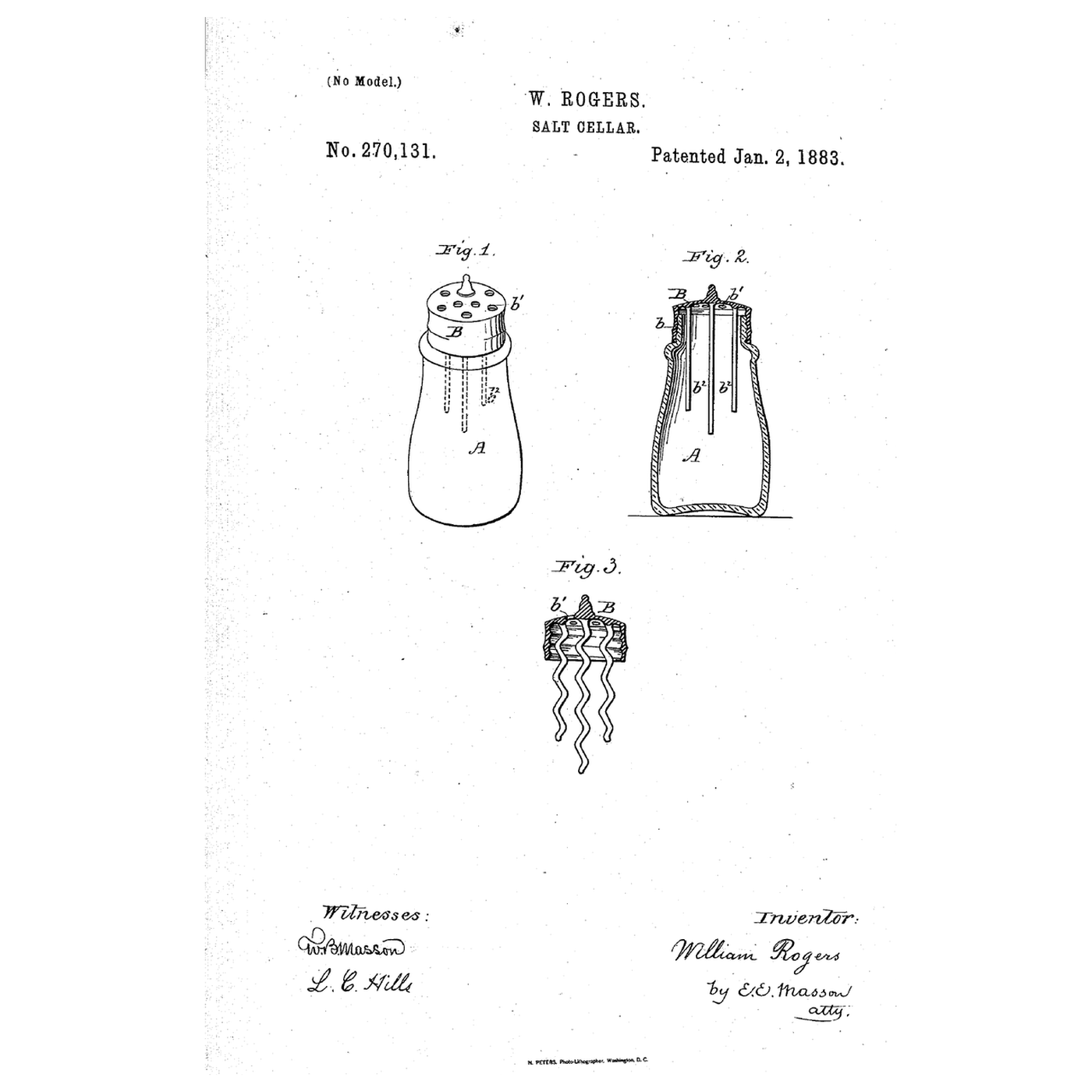


The Salt Shaker: Wires Under the Cap That Break the Lumps
Salt in an open dish stays loose; salt in a shaker, in a damp kitchen, cakes into a lump that nothing will shake out.
William Rogers of Hartford, Connecticut, received US 270,131, dated 2 January 1883 (filed 8 November 1882), for a salt-holder with a screw cap whose holes have "a series of parallel wires" soldered beneath them "to prevent the salt from caking and break lumps that may have formed". Shaken, "the salt is projected against the cover and its wires, and the attrition thus produced liberates it in a finely-pulverized condition."
This rung works out why damp salt stops and how hole size matters, then tests a shaker with and without wires after a damp night.
Początkujący
About 1 day
Instrukcje
1
1
Humidity, grains and holes
Humidity, grains and holes
Wczytywanie notatnika Jupyter…
2
2
Breaking lumps before a sieve
Breaking lumps before a sieve
Kistler's sifter broke flour lumps against a breaker before the sieve; Rogers does the same for salt. The embedded blueprint shows the sifter.
3
3
Read US 270,131
Read US 270,131
"My invention relates to salt-holders for table use having a cap with apertures through which the salt is ejected, and means within the holder to prevent the salt from consolidating in a mass or in lumps".
"Heretofore various devices have been placed in salt-holders to prevent the salt from adhering to the sides thereof. They consist most commonly of a single rod, terminating in a pronged portion ... but these devices have been only partially successful in securing a proper delivery of salt."
The cap has "a series of apertures, b', through which the salt is ejected, and between these apertures are soldered or otherwise attached to the under side of the cap B a series of parallel wires, b2, at suitable distances apart to prevent the salt from caking and break lumps that may have formed, as these wires operate in about the same manner as the parallel wires of a wire screen." With wavy wires "the salt can be very promptly reduced to fine particles even if caked in one mass".
4
4
A damp night, then shake
A damp night, then shake
Take two identical glass jars and punch the same holes in both lids. Under one lid, glue or solder three parallel lengths of stainless steel wire across the holes, a few millimetres below them.
Fill both with table salt and leave them overnight, lids off, in a closed storage box with a bowl of warm water, to make the air damp. In the morning put the lids on. Shake each ten times over a bowl on a scale and weigh what comes out; repeat three times. Compare the two, and look at the lumps left inside.
Materiały do tego kroku:
 Sól kuchenna200 g
 Drut ze stali nierdzewnej1 sztuka
 Woda1 litrów
Potrzebne narzędzia:
 Słoik szklany
 Pudło do przechowywania
 Miska
Miska Waga cyfrowa
 Solniczka
5
5
A salt shaker that clogs or pours
A salt shaker that clogs or pours
Salt shaker troubleshooting.
Flow
Loading...
6
6
History and honest limits
History and honest limits
**William Rogers** of Hartford, Connecticut, filed US 270,131 on 8 November 1882; it is dated 2 January 1883.
**Honest limits.** The patent gives no sizes. The grain size and hole sizes are examples; the arching rule is a rule of thumb, and 75 % is the commonly quoted deliquescence humidity for sodium chloride at room temperature.
Materiały
3- 200 gZastępnik
- 1 sztukaZastępnik
- 1 litrówZastępnik
Wymagane narzędzia
5- Zastępnik
- Zastępnik
- Zastępnik
- Zastępnik
- Zastępnik
Powiązane blueprinty
Te blueprinty dzielą się wiedzą — technikami, materiałami lub zasadami




CC0 Domena publiczna
Ten plan jest udostępniany na licencji CC0. Możesz go swobodnie kopiować, modyfikować, rozpowszechniać i wykorzystywać do dowolnych celów, bez konieczności uzyskiwania zgody.
Wesprzyj Makera kupując produkty przez jego plan, za co zarabia Prowizja Makera ustalony przez sprzedawców, lub stwórz nową iterację tego planu i dołącz go jako połączenie w swoim własnym planie, aby dzielić się przychodami.