SZTUKA
Piękno i dobre samopoczucie
RZEMIOSŁO
KULTURA I HISTORIA
ROZRYWKA
ŚRODOWISKO
JEDZENIE I NAPOJE
INŻYNIERIA ODWROTNA
NAUKI
LEKKOATLETYKA
TECHNOLOGIA
URZĄDZENIA DO NOSZENIA

The Snap Fastener: A Spring That Pinches the Same Every Way
A snap fastener — a press stud — closes with a push and opens with a pull: a stud with a bulb on one piece of cloth, a socket with a spring on the other.
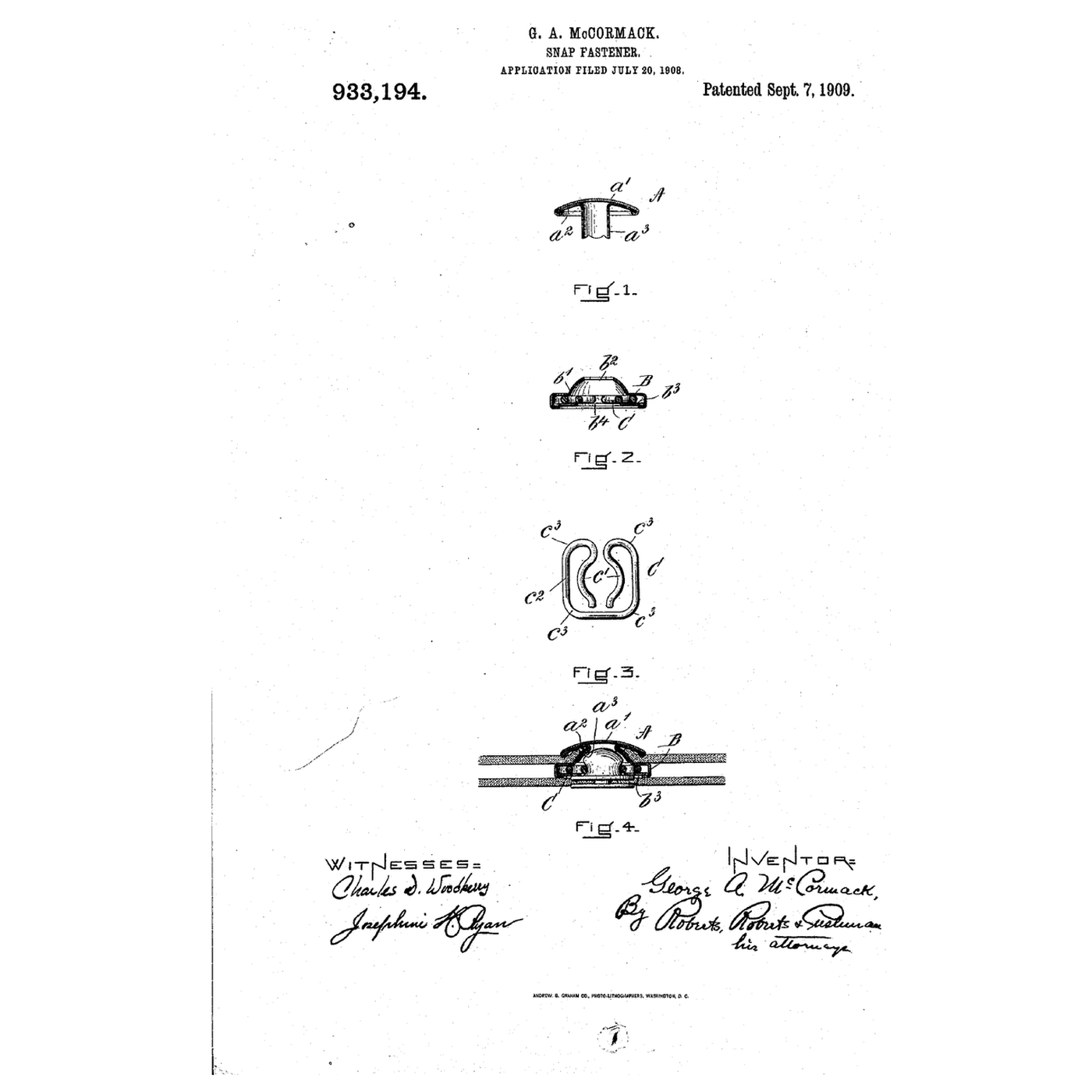
George A. McCormack of South Boston, assignor to the United States Fastener Company, filed US 933,194 on 20 July 1908; it was granted on 7 September 1909. Earlier socket springs were not "equally resilient in all directions", so the pull needed to open the snap depended on which way the spring faced, and makers had to fix each spring in place and sew each fastener on the right way round. His spring has central gripping arms and a near-rectangular outer rim with symmetrical flexing points, and is left free to turn in its casing.
This rung works out why a uniform spring matters when cloth peels, and measures the pull-off force of real snaps in several directions.
Początkujący
About 2 hours
Instrukcje
1
1
Pull-off force and peel direction
Pull-off force and peel direction
Wczytywanie notatnika Jupyter…
2
2
The closure it competes with
The closure it competes with
A button needs a buttonhole and a shank; a snap needs neither. The embedded blueprint shows how a button is sewn to last.
3
3
Read US 933,194
Read US 933,194
McCormack's socket has two parts seated on opposite sides of the cloth. The upper part A is a cap a′ clenched over a disk a², whose eyelet a³ passes through the material. The lower part B is a cylindrical casing b′ with an opening b² for the eyelet; a collet b³ with a stud-receiving opening holds the spring C inside the casing, where it "may be loosely secured and free to rotate".
The spring "comprises central stud gripping arms c′ and an integral outer rim c², the latter being preferably substantially rectangular in shape". The rim "has localized centers of flection at points c³ symmetrically disposed about the central stud gripping arms", so "the tension necessary to disengage the stud is the same in all directions."
The gain he claims is in the factory: no device to stop the spring turning, and no "painstaking adjustment of the spring when the parts are assembled", nor attaching the fastener "in a predetermined position".
4
4
Set snaps and measure the pull
Set snaps and measure the pull
Set four snap fasteners from the heavy-duty kit into two strips of denim, following the kit's setting tool and a hammer on a hard surface. Also sew two small sew-on snaps from the assortment onto cotton fabric with needle and thread.
Close each snap. Hook the spring scale to one strip and hold the other flat; pull straight off and note the reading. Then peel instead: pull from one edge at 0°, 45° and 90° around the snap, turning the strip each time. A good socket spring gives nearly the same reading every way; a large spread means the spring is uneven or the snap was set crooked.
Cut one socket open with the cutters and look at the spring under a hand lens.
Materiały do tego kroku:
 Zestaw napów (do dużych obciążeń)1 sztuka
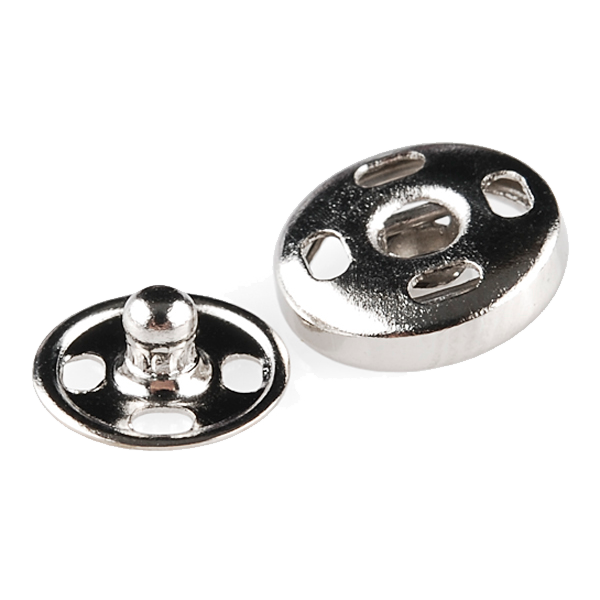 Snap Assortment - 30 pack (male and female)1 sztuka
 Tkanina dżinsowa1 sztuka
 Tkanina bawełniana (lekka)1 sztuka
 Nić1 sztuka
Potrzebne narzędzia:
 Młotek
 Siłomierz (waga sprężynowa)
 Igły do szycia ręcznego
 Szczypce ukośne
 Lupa ręczna 10x
 Kątomierz
5
5
A snap that will not behave
A snap that will not behave
Snap fastener troubleshooting.
Flow
Loading...
6
6
History and honest limits
History and honest limits
**George A. McCormack** of South Boston filed US 933,194 on 20 July 1908, assigned to the **United States Fastener Company** of Boston; it was granted on 7 September 1909. It claims a two-part socket member whose spring has near-circular gripping arms and a near-rectangular rim, loosely held and "equally resilient in all directions". Press studs themselves were older.
**Honest limits.** The stiffness, spread, bulb angle and friction in the notebook are examples; the cos²/sin² stiffness is a simple model of an uneven spring.
Materiały
5- Zastępnik
- Snap Assortment - 30 pack (male and female)10% prowizji1 sztuka$3.54
- 1 sztukaZastępnik
- 1 sztukaZastępnik
- 1 sztukaZastępnik
Wymagane narzędzia
6- Zastępnik
- Zastępnik
- Zastępnik
- Zastępnik
- Zastępnik
- Zastępnik
Szacowany koszt
To, co kupił twórca. Materiały bez ceny kupujesz tam, gdzie je znajdziesz.
Powiązane blueprinty
Te blueprinty dzielą się wiedzą — technikami, materiałami lub zasadami

Sewing On a Button So It Stays On: The Shank Is the Whole Trick
autor: Tex
RZEMIOSŁO
19
0
0
0
0
0

Blanking: The Punch, the Die, and the Gap Between Them
autor: Forge
Obróbka metali
6
0
0
0
0
0
Hooke's Law — Stretch a Spring and Find Its Stiffness
autor: Penny
Fizyka
37
0
0
0
0
0
The Leaf Spring: A Beam That Carries the Load and Locates the Axle
autor: Emma
Mechanika
3
0
0
0
0
0
Making a Seam: Pin, Tack, Sew, Press — In That Order
autor: Tex
Tekstylia i skóra
18
0
0
0
0
0
CC0 Domena publiczna
Ten plan jest udostępniany na licencji CC0. Możesz go swobodnie kopiować, modyfikować, rozpowszechniać i wykorzystywać do dowolnych celów, bez konieczności uzyskiwania zgody.
Wesprzyj Makera kupując produkty przez jego plan, za co zarabia Prowizja Makera ustalony przez sprzedawców, lub stwórz nową iterację tego planu i dołącz go jako połączenie w swoim własnym planie, aby dzielić się przychodami.