SZTUKA
Piękno i dobre samopoczucie
RZEMIOSŁO
KULTURA I HISTORIA
ROZRYWKA
ŚRODOWISKO
JEDZENIE I NAPOJE
INŻYNIERIA ODWROTNA
NAUKI
LEKKOATLETYKA
TECHNOLOGIA
URZĄDZENIA DO NOSZENIA
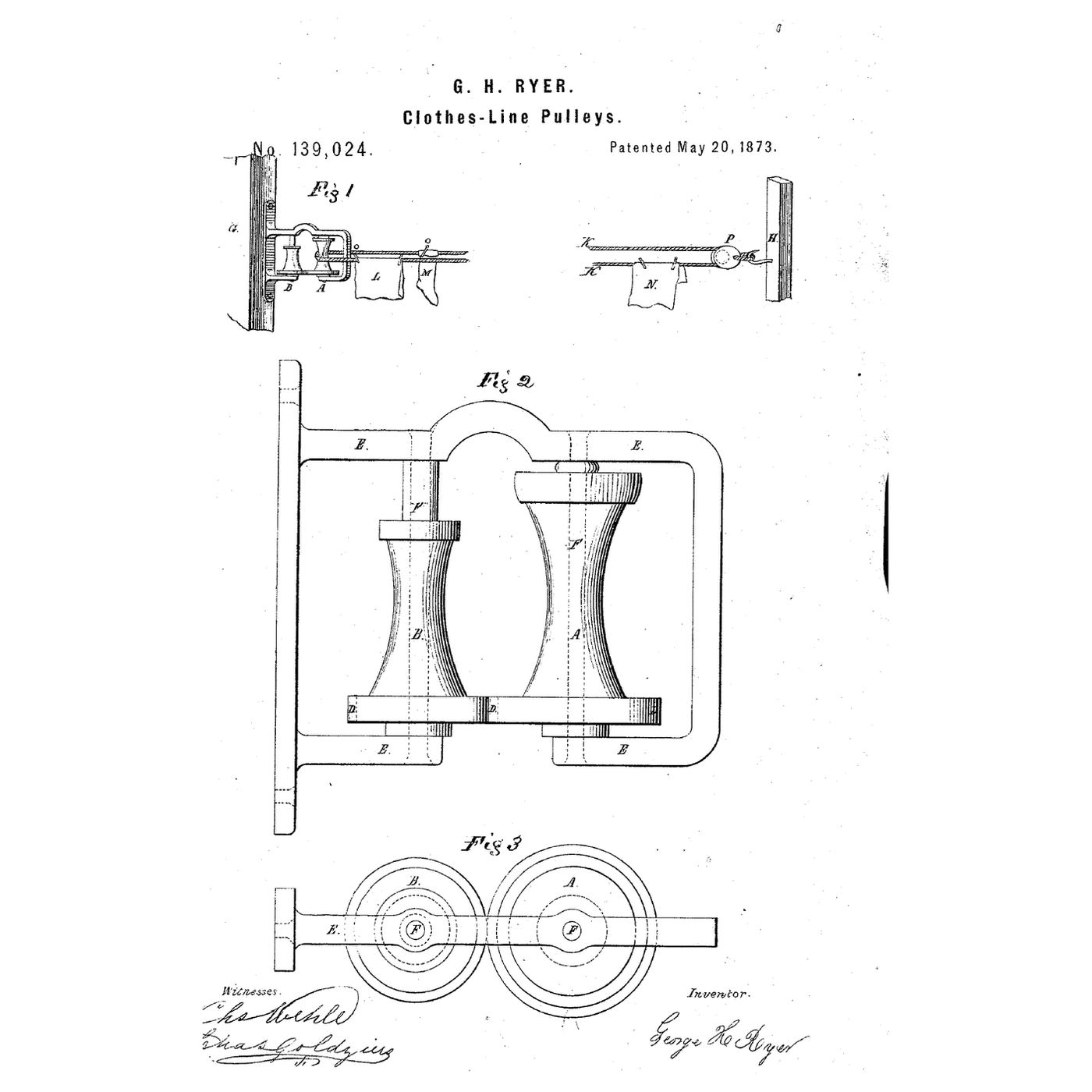


The Two-Pulley Clothesline: Let the Washing Pass the End
A clothesline on two pulleys lets washing be hung from one spot and sent out along the line. As usually rigged, only one of its two runs can carry washing.
George H. Ryer of New York received US 139,024, dated 20 May 1873 (filed 24 October 1872), for clothes-line pulleys arranged so that "two blocks or pulleys are used, allowing the clothes to pass between them, and thus allowing the whole rope or line to be used for hanging clothes on, instead of the present method, whereby only one-half of the line can be used".
This rung computes how hard a loaded line pulls on its ends, then rigs a line, loads it and measures sag and pull.
Początkujący
About 1 hour
Instrukcje
1
1
Sag, pull and length
Sag, pull and length
Wczytywanie notatnika Jupyter…
2
2
Pulleys, from the beginning
Pulleys, from the beginning
The embedded blueprint builds a block and tackle; here pulleys only turn the line, and the tension is set by the load and the sag.
3
3
Read US 139,024
Read US 139,024
"The invention consists in an arrangement whereby on one end of the line two blocks or pulleys are used, allowing the clothes to pass between them, and thus allowing the whole rope or line to be used for hanging clothes on, instead of the present method, whereby only one-half of the line can be used for that purpose."
"A is the large pulley over which the clothes-line or rope passes. B is the small pulley, revolving in an opposite direction from the large pulley; the lower circle of the two pulleys touch, and are covered by two India-rubber bands or rings, D D, which permit the clothes to pass through without injury to them."
"The reason for two pulleys is to prevent the clothes-line from coming off."
4
4
Hanging a loop line, as a program
Hanging a loop line, as a program
Przestrzeń Blockly
Loading Blockly workspace...
5
5
Load a line and measure it
Load a line and measure it
Tie a clothesline between two firm points about 3 m apart, with a force meter in the line at one end. Peg equal weights (filled water bottles work) at equal spacing along it.
Measure the sag at the middle with the ruler and read the pull on the force meter. Tighten the line to halve the sag and read again. Put your span, weight per metre and sag into the notebook's formula and compare with the force meter.
Materiały do tego kroku:
 Sznur do bielizny1 sztuka
 Komplet klamerek do bielizny - drewno1 sztuka
Potrzebne narzędzia:
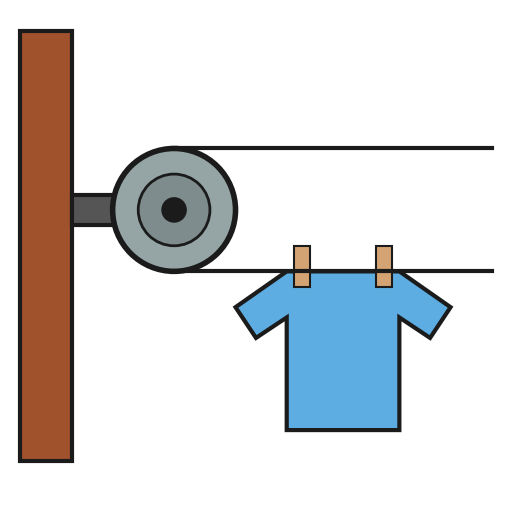 Bloczek do sznura na pranie
 Krążek
 Siłomierz (waga sprężynowa)
 Ciężarek
 Linijka
6
6
A line that sags, slips or snags
A line that sags, slips or snags
Clothesline troubleshooting.
Flow
Loading...
7
7
History and honest limits
History and honest limits
**George H. Ryer** of New York filed US 139,024 on 24 October 1872; it is dated 20 May 1873.
**Honest limits.** The tension formula assumes an evenly loaded line with a small sag; bunched washing pulls harder. The span, load and sags are examples. Your force-meter readings are the measurement.
Materiały
2- 1 sztukaZastępnik
- Zastępnik
Powiązane blueprinty
Te blueprinty dzielą się wiedzą — technikami, materiałami lub zasadami

CC0 Domena publiczna
Ten plan jest udostępniany na licencji CC0. Możesz go swobodnie kopiować, modyfikować, rozpowszechniać i wykorzystywać do dowolnych celów, bez konieczności uzyskiwania zgody.
Wesprzyj Makera kupując produkty przez jego plan, za co zarabia Prowizja Makera ustalony przez sprzedawców, lub stwórz nową iterację tego planu i dołącz go jako połączenie w swoim własnym planie, aby dzielić się przychodami.