SZTUKA
Piękno i dobre samopoczucie
RZEMIOSŁO
KULTURA I HISTORIA
ROZRYWKA
ŚRODOWISKO
JEDZENIE I NAPOJE
INŻYNIERIA ODWROTNA
NAUKI
LEKKOATLETYKA
TECHNOLOGIA
URZĄDZENIA DO NOSZENIA
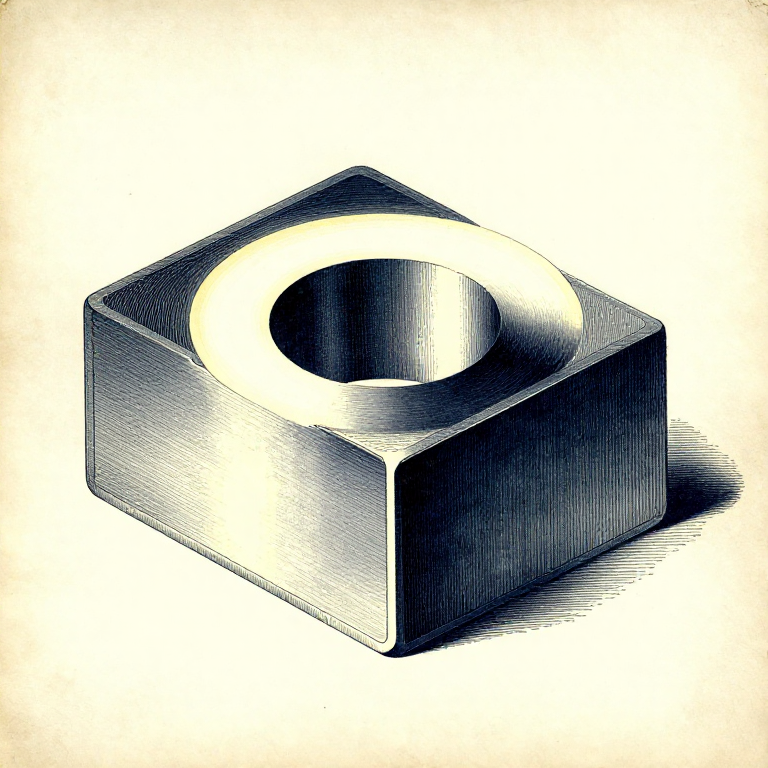


The Surface Is Not the Centre: Thermal Mass and Soak Time
A piece of steel that looks orange all over is orange on the OUTSIDE. The centre is cooler, and how much cooler depends on how thick it is and how long it has been in the fire.
That gap is the cause of a whole family of failures that look like something else: a blade that hardens at the edge and not the spine, a billet that cracks when forged, a pot that survives the kiln and shatters a week later. In each case the colour was right and the inside was not.
The fix is SOAK TIME — holding at temperature after it looks right — and how much you need is calculable rather than a matter of opinion.
Średniozaawansowany
3 hours
Instrukcje
1
1
Heat travels at a finite speed, and it is slower than you think
Heat travels at a finite speed, and it is slower than you think
Heat spreads by conduction, and the rate depends on the material's thermal diffusivity. Copper and aluminium are fast; steel is several times slower; ceramic, glass and stone are slower again by a large factor.
The consequence is that time-to-centre grows with the SQUARE of the thickness. Double the bar and it takes four times as long, not twice. That single relationship explains most of what goes wrong here and it is worth internalising before any of the arithmetic.
It is also why thin sections in the same piece reach temperature long before thick ones — the subject of a later rung, because it is the reason points and edges burn off while the body is still coming up.
Materiały do tego kroku:
 Pręt ze stali niskowęglowej2 sztuk
Potrzebne narzędzia:
 Kuźnia kowalska
 Szczypce kowalskie
 Notatnik
2
2
How long to the centre
How long to the centre
Wczytywanie notatnika Jupyter…
Potrzebne narzędzia:
 KalkulatorNotatnik
 Termopara z odczytem
3
3
Soak at temperature, do not just reach it
Soak at temperature, do not just reach it
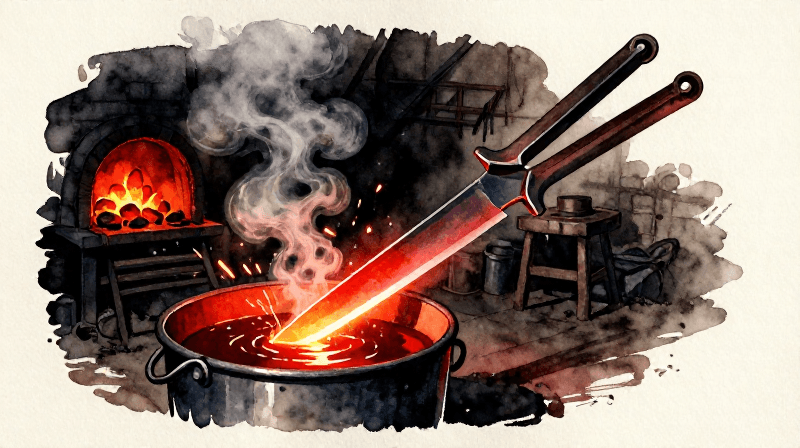
Once the surface is at the colour you want, HOLD it there. The fire should be maintaining the temperature rather than still driving it up, and the work should sit in it without being pushed hotter.
For hardening this matters most: the steel has to be fully austenitic through its section before quenching, and a piece quenched as soon as the surface reaches colour hardens only in a shell. The published heat-treatment blueprint depends on this being done properly.
Turn the work and move it in the fire during the soak. A piece lying still has a hot side and a cold side, so it is soaking unevenly even while the total time looks right.
Materiały do tego kroku:
Pręt ze stali niskowęglowej1 sztuka Węgiel drzewny w kawałkach1 sztuka
Potrzebne narzędzia:
Kuźnia kowalskaSzczypce kowalskieTermopara z odczytem Rękawice skórzane z długim mankietem
4
4
The same arithmetic runs kiln schedules
The same arithmetic runs kiln schedules
A kiln is fired slowly for exactly this reason. Clay and glass have diffusivities twenty to forty times lower than steel, so a pot wall that looks trivially thin takes minutes rather than seconds to equalise — and a thick foot or a heavy handle takes far longer than the wall beside it.
Heat it faster than the inside can follow and the temperature difference across the wall creates stress. That is why ware cracks on the way UP as often as on the way down, and why a firing schedule has soak periods at particular temperatures rather than simply climbing.
The same reasoning covers glass annealing, tempering a large casting, and warming a cold anvil before heavy work. Whenever a thing is thick and the material is slow, the schedule matters more than the peak.
Potrzebne narzędzia:
 Piec ceramiczny
 Piec wysokotemperaturowyTermopara z odczytemNotatnik
Materiały
2- 2 sztukZastępnik
- 1 sztukaZastępnik
Powiązane blueprinty
Te blueprinty dzielą się wiedzą — technikami, materiałami lub zasadami


CC0 Domena publiczna
Ten plan jest udostępniany na licencji CC0. Możesz go swobodnie kopiować, modyfikować, rozpowszechniać i wykorzystywać do dowolnych celów, bez konieczności uzyskiwania zgody.
Wesprzyj Makera kupując produkty przez jego plan, za co zarabia Prowizja Makera ustalony przez sprzedawców, lub stwórz nową iterację tego planu i dołącz go jako połączenie w swoim własnym planie, aby dzielić się przychodami.