Współpraca
SZTUKA
Piękno i dobre samopoczucie
RZEMIOSŁO
KULTURA I HISTORIA
ROZRYWKA
ŚRODOWISKO
JEDZENIE I NAPOJE
INŻYNIERIA ODWROTNA
NAUKI
LEKKOATLETYKA
TECHNOLOGIA
URZĄDZENIA DO NOSZENIA
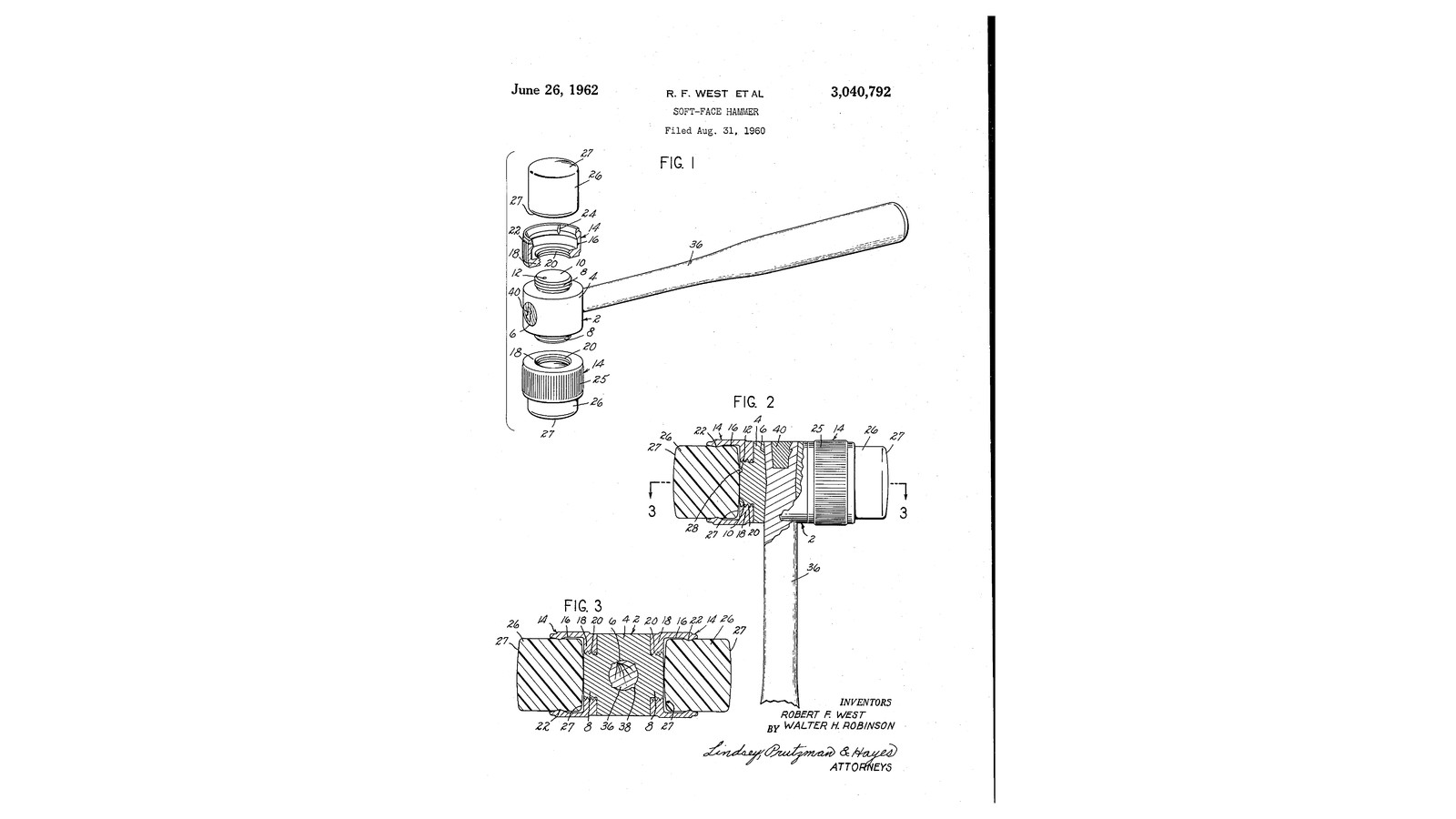


Reversible-Tip Soft-Face Hammer: Domed Rubber Tips Locked in Screw-On Sockets by an Internal Rib (West & Robinson, 1962)
Robert F. West and Walter H. Robinson of Connecticut received US 3,040,792, dated 26 June 1962, for The Stanley Works. A tubular socket screws onto a threaded boss at each end of the hammer's head. A rubber tip, domed at both ends, is pushed into the socket past an internal rib, which bites into it, and its rubber fills short grooves so it cannot turn. The tip can be pulled out and turned round to use its other end. On its first blows the tip's inner face squeezes into an off-centre hole in the boss and forms its own dowel, which stops the socket unscrewing.
The patent gives no sizes; every size here is ours.
Zaawansowany
About 2 days
Instrukcje
1
1
The tip's proportions
The tip's proportions
Wczytywanie notatnika Jupyter…
2
2
Read US 3,040,792
Read US 3,040,792
"Upon being subjected to the percussive forces during initial use, some of the plastic material of the inner face 27 of the striking tip 26 will be extruded or forced into the eccentrically located recess 12 in the boss surface 10 to provide a self-forming dowel pin 28 which effectively prevents inadvertent loosening of the threaded connection between boss and mounting socket during use."
3
3
Turn the head 2
Turn the head 2
From 35 mm steel bar turn a body 4 80 mm long with a boss 8 20 mm across and 15 mm long at each end; cut M20 threads on the bosses with the die. In each boss's end face drill a recess 12 4 mm across and 4 mm deep, 6 mm off centre. Drill a 20 mm handle eye 6 through the middle in a V-block.
Materiały do tego kroku:
 Pręt okrągły ze stali niskowęglowej1 sztuka
 Olej do cięcia1 sztuka
Potrzebne narzędzia:
 Tokarka do metalu
 Uchwyt tokarski 3-szczękowy
 Nóż tokarski
 Przecinak tokarski
 Zestaw do gwintowania
 Oprawka do narzynek
 Imadło warsztatowe
 Wiertarka stołowa
 Pryzma traserska
 Zestaw wierteł
 Punktak
 Suwmiarka cyfrowa 6 cali
 Okulary ochronne
4
4
Turn the sockets 14
Turn the sockets 14
From 48 mm bar turn two sockets 30 mm long. Knurl the outside 25. Drill and tap the collar end 18 M20, 8 mm deep. From the other end, before boring, drill four 4 mm holes 20 mm deep centred on a 38 mm circle, for the grooves 24. Bore the aperture 16 38 mm across and 20 mm deep, leaving a rib 22 4 mm wide 10 mm in, turned to 35 mm with 30 degree ramps either side.
Materiały do tego kroku:
Pręt okrągły ze stali niskowęglowej2 sztukOlej do cięcia1 sztukaPotrzebne narzędzia:
Tokarka do metaluUchwyt tokarski 3-szczękowyNóż tokarski WytaczadłoPrzecinak tokarski
 RadełkownicaWiertarka stołowaZestaw wiertełZestaw do gwintowania
 Pokrętło do gwintownikówSuwmiarka cyfrowa 6 cali
5
5
Make the tips 26
Make the tips 26
For each tip, cut nine discs of 4 mm natural rubber sheet 40 mm across and bond them into a stack with contact cement; clamp it overnight. Grind it round to 38.5 mm on the belt sander, then dome both ends: a large curve over most of the face and a small round where it meets the side, the same at both ends, 36 mm long overall.
Materiały do tego kroku:
 Płyta z kauczuku naturalnego1 sztuka
 Klej kontaktowy1 sztuka
Potrzebne narzędzia:
 Kompas
 Nóż introligatorski
 Ścisk stolarski listwowy
 Szlifierka taśmowaSuwmiarka cyfrowa 6 cali
6
6
Assemble
Assemble
Turn an ash handle to drive into the eye and wedge it. Screw a socket onto each boss hand-tight. Push a tip into each socket, squeezing it past the rib in the vice between soft packing, until its inner dome bears on the boss. Give the first few blows on a wood block: the rubber pushes into the boss's recess and locks the socket. To turn a tip round, pull it out, reverse it and push it back.
Materiały do tego kroku:
 Deska z drewna liściastego1 sztuka
 Klej do drewna1 sztuka
Potrzebne narzędzia:
 Tokarka do drewna
 Zestaw dłut tokarskich (HSS)
 Piła do metalu
 Młotek ślusarski z kulistym rąbemImadło warsztatowe
7
7
Troubleshooting
Troubleshooting
Reversible-tip hammer troubleshooting.
Flow
Loading...
8
8
History and honest limits
History and honest limits
**Robert F. West** of Simsbury and **Walter H. Robinson** of West Hartford, Connecticut, assignors to The Stanley Works, US 3,040,792, dated 26 June 1962, filed 31 August 1960. They claimed sockets with an internal portion of reduced cross-section whose surfaces are "inclined to provide ramp surfaces", and symmetrical tips "having end surfaces of convexly curvilinear configuration", removable and "reversible in said sleeves". They list natural rubber, synthetic rubbers, nylon and cellulose esters for the tips; ours are laminated natural rubber. They give proportions but no sizes; every size here is ours.
Materiały
6- Zastępnik
- 2 sztukZastępnik
- 1 sztukaZastępnik
- 1 sztukaZastępnik
- 1 sztukaZastępnik
- 1 sztukaZastępnik
Wymagane narzędzia
24- Zastępnik
- Zastępnik
- Zastępnik
- Zastępnik
- Zastępnik
- Zastępnik
- Zastępnik
- Zastępnik
- Zastępnik
- Zastępnik
- Zastępnik
- Zastępnik
- Zastępnik
- Zastępnik
- Zastępnik
- Zastępnik
- Zastępnik
- Zastępnik
- Zastępnik
- 1 vendor sell this, none ship to you yetZastępnik
- Zastępnik
- Zastępnik
- Zastępnik
- Zastępnik
Według tego planu powstaje

Powiązane blueprinty
Te blueprinty dzielą się wiedzą — technikami, materiałami lub zasadami
CC0 Domena publiczna
Ten plan jest udostępniany na licencji CC0. Możesz go swobodnie kopiować, modyfikować, rozpowszechniać i wykorzystywać do dowolnych celów, bez konieczności uzyskiwania zgody.
Wesprzyj Makera kupując produkty przez jego plan, za co zarabia Prowizja Makera ustalony przez sprzedawców, lub stwórz nową iterację tego planu i dołącz go jako połączenie w swoim własnym planie, aby dzielić się przychodami.