
Сотрудничество
ИСКУССТВО
КРАСОТА И ЗДОРОВЬЕ
РЕМЕСЛО
КУЛЬТУРА И ИСТОРИЯ
РАЗВЛЕЧЕНИЯ
ЭКОЛОГИЯ
ЕДА И НАПИТКИ
ОБРАТНАЯ ИНЖЕНЕРИЯ
НАУКИ
СПОРТ
ТЕХНОЛОГИИ
НОСИМЫЕ УСТРОЙСТВА
Wishbone-Mast Ice Yacht: 16 ft Backbone, Twin-Pole Mast and Double Lateen Booms (Boy Mechanic, 1919)
Woody

Создано

Woody

13. ноябрь 2026NO
3
0
0
0
0

Wishbone-Mast Ice Yacht: 16 ft Backbone, Twin-Pole Mast and Double Lateen Booms (Boy Mechanic, 1919)

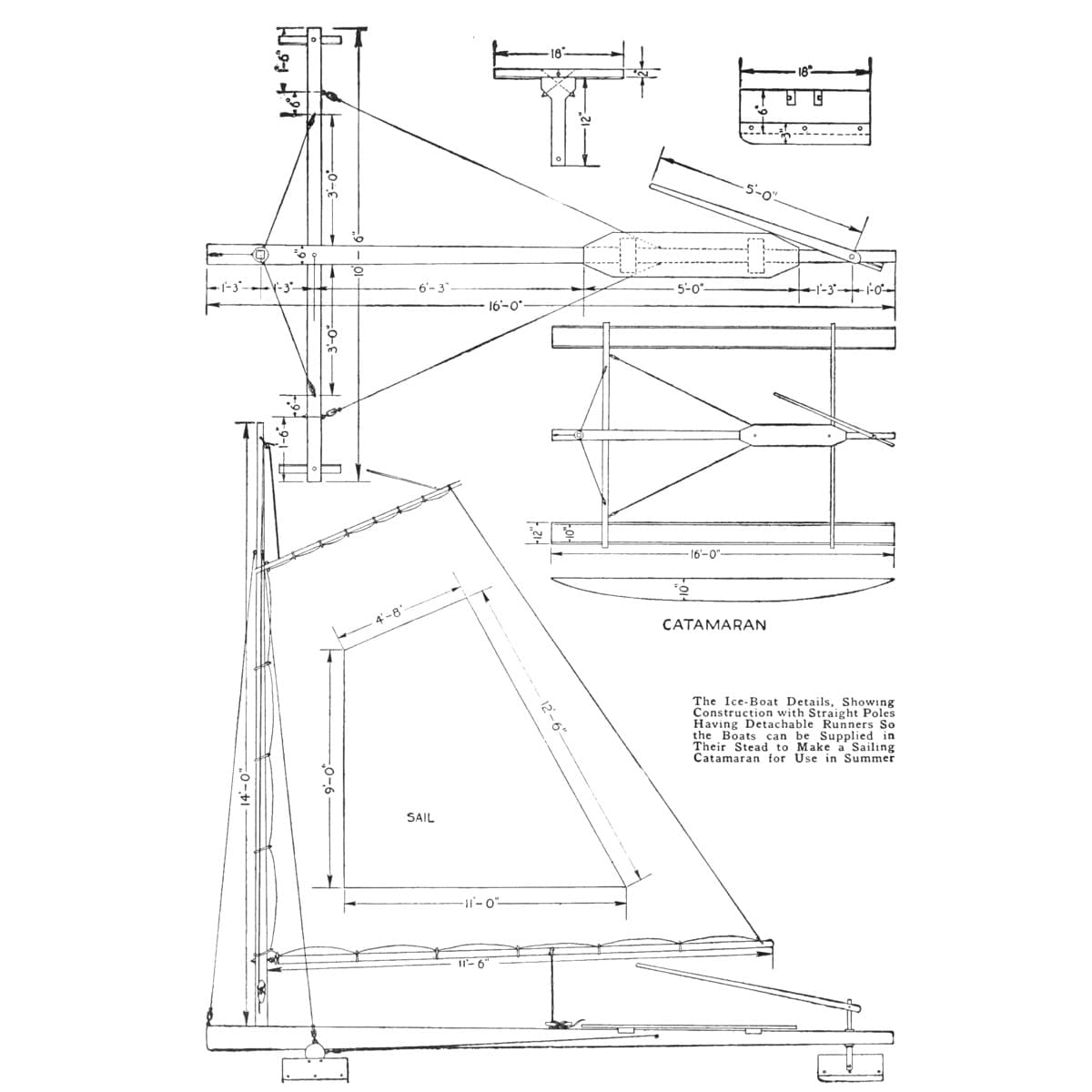
John F. Pjerrou's ice yacht from The Boy Mechanic, Book 3 (1919), for one or two passengers: a 16 ft spruce backbone on a 12 ft 6 in runner plank, oak runners shod with half-round iron, a mast of two 12 ft poles joined at the head, and two lateen sails on a yard and two 16 ft booms that spread into a V when running before the wind. It takes down for storage.
Продвинутый
Several weeks

Инструкции

1

Main sizes and the mast's height

Загрузка блокнота Jupyter…
2

Read The Boy Mechanic, Book 3

"The dimensions given are for a small yacht, and care must be taken, in adapting the design, to maintain proper proportions for stability and safety."
3

Make the backbone and runner plank

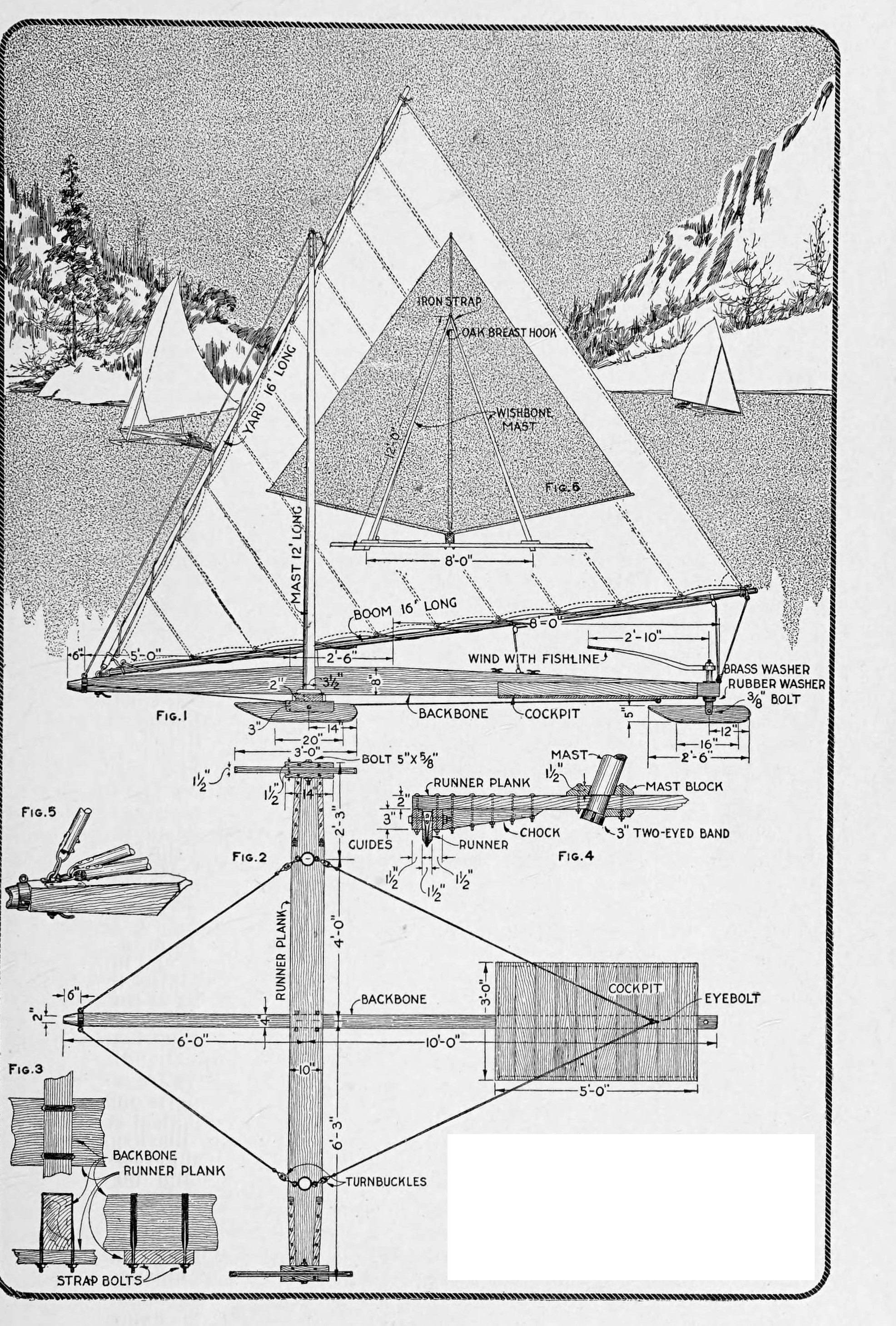
Use only the best straight-grained spruce or white pine. Backbone: 4 in thick, 16 ft long and 8 in high at the centre, with a ridge 8 in high and 2 ft 6 in long; taper it from the middle, 5 ft 6 in from the forward end, to 4 in at each end, and fit a three-eye metal ring at the bow (Figs. 1, 5). Runner plank: 2 in thick, 10 in wide, 12 ft 6 in long, tapered to 8 in at the ends. Set the backbone on the plank at right angles, 6 ft from the bow, and clamp them with two strap bolts, washers and nuts (Figs. 2, 3).

Материалы для этого шага:

Сосновый пиломатериалСосновый пиломатериал2 штук
Металлическое кольцоМеталлическое кольцо1 штука
Скоба-хомутСкоба-хомут2 штук
Плоская шайбаПлоская шайба4 штук
Шестигранная гайкаШестигранная гайка4 штук

Необходимые инструменты:

Ножовка по деревуНожовка по дереву
Ручной рубанокРучной рубанок
СкобельСкобель
Коловорот с перкойКоловорот с перкой
Разводной ключРазводной ключ
РулеткаРулетка
КарандашКарандаш
4

Fit the guides and forward runners

Bolt guides of straight-grained oak, 1-1/2 by 3 by 14 in, to the plank ends with 5/16 in carriage bolts, and bolt oak chocks at each tapered edge (Fig. 4). Make the forward runners of oak, 1-1/2 by 5 by 36 in, shaped at the ends as drawn, and shoe them with half-round strap iron held by screws with carefully countersunk heads. Pivot them on 5/8 in bolts (5 in long in Fig. 1), nuts to the inner side, with washers and jam nuts, or rivet the bolt ends slightly so the nuts cannot work loose.

Материалы для этого шага:

Доска из белого дубаДоска из белого дуба3 штук
Болт с полукруглой головкойБолт с полукруглой головкой8 штук
Полукруглый железный прутокПолукруглый железный пруток2 штук
Шурупы по деревуШурупы по дереву1 штука
Плоская шайбаПлоская шайба4 штук
Шестигранная гайкаШестигранная гайка4 штук

Необходимые инструменты:

Ножовка по деревуНожовка по дереву
Ручной рубанокРучной рубанок
Коловорот с перкойКоловорот с перкой
Ручная дрельРучная дрель
Набор зенковокНабор зенковок
Ножовка по металлуНожовка по металлу
Разводной ключРазводной ключ
5

Make the stern runner and steering

Make the stern runner of oak, 1-1/2 by 5 by 30 in, shod like the others. Pivot it on a 3/8 in bolt in a hanger of heavy iron strip bent into a U and riveted to a vertical shaft. Put a heavy rubber washer, protected by a metal one, on the shaft; thread its upper end for a washer and nut, slip a section of pipe over the shaft, and clamp the steering handle (2 ft 10 in in Fig. 1) on a squared part of the shaft. The hanger may be forged, or made by a blacksmith.

Материалы для этого шага:

Доска из белого дубаДоска из белого дуба1 штука
Полукруглый железный прутокПолукруглый железный пруток1 штука
Полоса из малоуглеродистой сталиПолоса из малоуглеродистой стали1 штука
Круглый пруток из малоуглеродистой сталиКруглый пруток из малоуглеродистой стали1 штука
Железные заклёпкиЖелезные заклёпки2 штук
Болт с полукруглой головкойБолт с полукруглой головкой1 штука
Резиновая шайбаРезиновая шайба1 штука
Плоская шайбаПлоская шайба2 штук
Шестигранная гайкаШестигранная гайка2 штук
Оцинкованная стальная трубаОцинкованная стальная труба1 штука

Необходимые инструменты:
ГорнГорн
НаковальняНаковальня
МолотокМолоток
Слесарные тискиСлесарные тиски
Ножовка по металлуНожовка по металлу
Ручная дрельРучная дрель
Напильники (ручной напильник)Напильники (ручной напильник)
Разводной ключРазводной ключ
6

Build the cockpit

Fix a cockpit 5 ft long and 3 ft wide, with 4 in coaming, to the lower side of the backbone toward the stern; fasten its floor to the backbone with lag screws and fasten the coaming securely. Square corners are easiest; rounded ends with steamed, bent coaming are better. Larger craft may carry it on ribs.

Материалы для этого шага:

Сосновая доскаСосновая доска4 штук
Глухарь (шуруп под ключ)Глухарь (шуруп под ключ)6 штук
Шурупы по деревуШурупы по дереву1 штука

Необходимые инструменты:

Ножовка по деревуНожовка по дереву
Коловорот с перкойКоловорот с перкой
Разводной ключРазводной ключ
РулеткаРулетка
7

Square up and stay the frame

Line up runners, plank and backbone at right angles so the craft tracks true. Hold them with four 1/4 in wire-rope stays with turnbuckles, from eyes on the bow band and on the bands at the plank ends to an eyebolt below the cockpit (Fig. 2). Loop each rope end and clamp the eye with steel clamps made for the purpose (wire-rope clips); metal thimbles in the loops make a better finish.

Материалы для этого шага:

Стальной тросСтальной трос1 штука
ТалрепТалреп4 штук
НапёрстокНапёрсток8 штук
Зажим для тросаЗажим для троса8 штук
Рым-болтРым-болт1 штука

Необходимые инструменты:

Ножовка по металлуНожовка по металлу
Разводной ключРазводной ключ
РулеткаРулетка
8

Make the wishbone mast

Shape two poles of hickory or ash, 3-1/2 in thick at the base and 2 in at the top (12 ft in Fig. 6). Join them carefully at the masthead, bolt them together into an oak breast hook, and reinforce the joint with an iron strap with an eye at its upper end for the forward stay. Step the lower ends in sockets in the runner plank, about 8 ft apart, reinforced with oak mast blocks, and fit their projecting ends with 3 in two-eyed bands for the stays (Figs. 4, 6).

Материалы для этого шага:

Деревянный шестДеревянный шест2 штук
Доска из белого дубаДоска из белого дуба1 штука
Полоса из малоуглеродистой сталиПолоса из малоуглеродистой стали1 штука
Болт с полукруглой головкойБолт с полукруглой головкой2 штук
Шестигранная гайкаШестигранная гайка2 штук

Необходимые инструменты:

СкобельСкобель
Ручной рубанокРучной рубанок
Ножовка по деревуНожовка по дереву
Коловорот с перкойКоловорот с перкой
СтамескиСтамески
ГорнГорн
НаковальняНаковальня
МолотокМолоток
9

Make the yard and booms

Make the yard and two booms of hickory or ash, each 16 ft long, 2-3/4 in at the middle tapering to 1-1/2 in at the ends, with metal rings on the ends against splitting. Bolt loops to their forward ends to engage an eyebolt and ring on the backbone at the bow; set the eyebolt in a slotted plate of 3/16 in sheet iron, fastened by a lever nut (Fig. 5).

Материалы для этого шага:

Деревянный шестДеревянный шест3 штук
Металлическое кольцоМеталлическое кольцо6 штук
Рым-болтРым-болт1 штука
Лист малоуглеродистой сталиЛист малоуглеродистой стали1 штука
Полоса из малоуглеродистой сталиПолоса из малоуглеродистой стали1 штука
Болт с полукруглой головкойБолт с полукруглой головкой3 штук
Шестигранная гайкаШестигранная гайка3 штук

Необходимые инструменты:

СкобельСкобель
Ручной рубанокРучной рубанок
Ножовка по металлуНожовка по металлу
Ручная дрельРучная дрель
Напильники (ручной напильник)Напильники (ручной напильник)
Слесарные тискиСлесарные тиски
10

Sew the sails

Make two lateen sails of 8-oz unbleached cotton duck: lap the breadths about 1 in and stitch along the edge (or fold 1 in and double-stitch), the seams parallel to the leech. Reinforce each corner with a triangular patch of duck and bind the edges with 1/4 in tarred rope, using a sailor's palm, a diamond-pointed needle and sail twine, well waxed (the wax is ours: beeswax). Along the yard and boom edges punch holes, set two 3/4 in brass grommet rings in each, one each side, and overcast them with buttonhole stitch. Sew in reef points of 1/8 in cotton rope, whipped at the ends.

Материалы для этого шага:

ПарусинаПарусина1 штука
Парусная нитьПарусная нить1 штука
Пчелиный воскПчелиный воск1 штука
Смолёный тросСмолёный трос1 штука
Латунный люверсЛатунный люверс40 штук
Хлопчатобумажная верёвкаХлопчатобумажная верёвка1 штука

Необходимые инструменты:
ГардаманГардаман
Парусная иглаПарусная игла
ДыроколДырокол
НожницыНожницы
РулеткаРулетка
11

Set up and rig

Fit the forward ring and strap bolts, the runners and steering, then step the mast, clamp the masthead and fit the bands; set the bottom stays and the masthead stay with the turnbuckles. Lace the sails to yard and booms and fix the forward ends at the bow. Run a 3/8 in halyard from the yard through a pulley at the masthead and a second on the runner plank to cleats by the cockpit, and haul up so the sails set. Lash the main sheets to the boom ends, through pulleys at the stern of the backbone and on the booms about 1 ft and 5 ft from their ends, then to cleats at the cockpit; the second boom needs a duplicate set. Taking down is the reverse.

Материалы для этого шага:

КанатКанат1 штука
БлокБлок6 штук
Утка (швартовная)Утка (швартовная)4 штук
Шурупы по деревуШурупы по дереву1 штука

Необходимые инструменты:

Разводной ключРазводной ключ
Ручная дрельРучная дрель
12

Finish

Smooth the masts, yard and booms, sandpaper them lightly and give them several coats of spar varnish; paint the other woodwork. He gives the metal fittings two coats of red lead "or other good paint for use on metals exposed to the weather": red lead is a lead poison, so use the other paint.

Материалы для этого шага:

Наждачная бумагаНаждачная бумага1 штука
Яхтенный лак (для рангоута)Яхтенный лак (для рангоута)1 штука
Масляная краскаМасляная краска1 штука

Необходимые инструменты:
Широкая малярная кистьШирокая малярная кисть
13

Sailing and troubleshooting

Ice yacht sailing.

Flow

Loading...
14

History and honest limits

From "A Wishbone-Mast Ice Yacht" by John F. Pjerrou, in **The Boy Mechanic, Book 3**, Popular Mechanics, 1919 (Project Gutenberg 71856; checked on the archive.org scan boymechanic0003unse, pp. 17-20). He gives no sail outline sizes. The tools, the metric figures and the choice of the non-lead paint he allows are ours.

Материалы

35

Требуемые инструменты

21

По этому чертежу делают

Связанные чертежи

Эти чертежи делятся знаниями — техники, материалы или принципы
CC0 Общественное достояние

Этот чертёж выпущен под лицензией CC0. Вы можете свободно копировать, изменять, распространять и использовать эту работу в любых целях без запроса разрешения.

Поддержите мейкера, покупая товары через его чертёж, где он получает Комиссию мейкера установленную продавцами, или создайте новую итерацию этого чертежа и включите его как связь в свой чертёж для распределения дохода.

Обсуждение

(0)

Войти чтобы присоединиться к обсуждению

Загрузка комментариев...