

Pottery Seriation
Suppose you have fifty graves and no stratigraphy — nothing lies above anything else, so nothing can be dated by position. Every grave holds pots. Can you still put them in order?
Yes, and the reasoning is entirely about change. A style is introduced, becomes popular, then falls out of use. So any given style appears in a run of consecutive assemblages and not in scattered ones. Shuffle the assemblages until every style forms one unbroken block, and the order you are left with is a sequence in time.
It gives you an order, not dates, and not a direction — the sequence works equally well backwards until something outside it tells you which end is early. Flinders Petrie did this with paper slips in 1899, and the method still underpins archaeology.
Инструкции
Build a fake site with a known answer
Build a fake site with a known answer
Have someone else invent eight to twelve pottery styles, decide their true order, then write out fifteen "graves", each holding a few styles that were current at that point. Do not look at the true order — you are going to try to recover it.
Overlap the styles deliberately
Overlap the styles deliberately
Make each style appear in several consecutive graves, with new ones entering as old ones leave. If styles never overlap the puzzle is trivial; the overlaps are what carry the information.
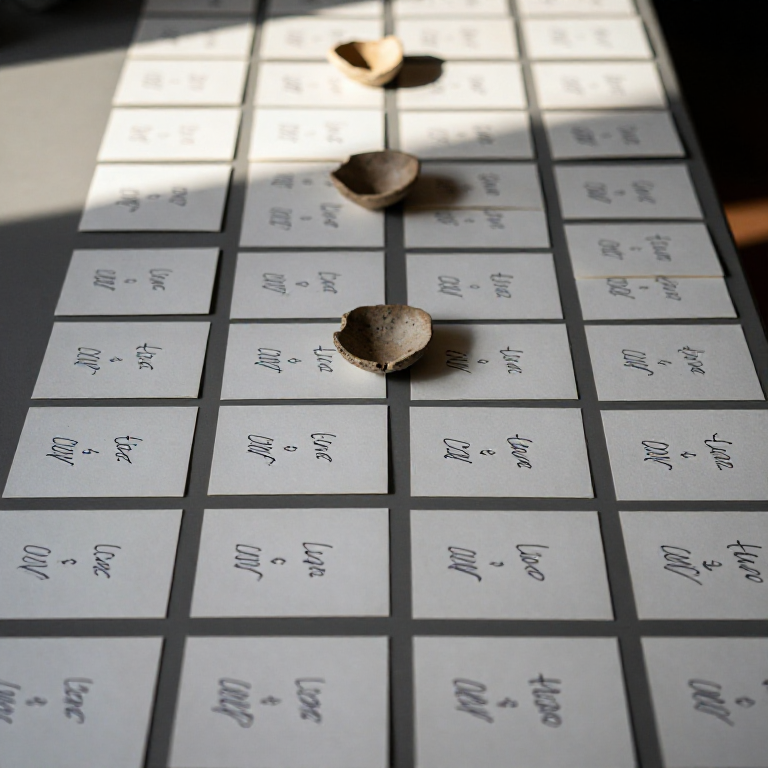
Write one slip per grave
Write one slip per grave
Write each grave on its own card: the grave number and the styles it contains. One physical card per assemblage — this is exactly Petrie's method and the physicality matters.
Материалы для этого шага:
 Картон1 лист
Shuffle the cards
Shuffle the cards
Shuffle thoroughly and lay them in a row in random order. This is the state a real excavation leaves you in.
Build a presence grid
Build a presence grid
Draw a grid with graves as rows in their current random order and styles as columns, and mark each cell where that style is present. The pattern will look like noise.
Необходимые инструменты:
 Линейка
State the rule you are optimising
State the rule you are optimising
Write the target at the top of the page: every style should occupy one unbroken run of consecutive rows. Every move from here is judged against that one sentence.
Start with the rarest style
Start with the rarest style
Find the style appearing in the fewest graves and move those graves next to each other. Rare styles have short runs and are the easiest constraints to satisfy first.
Move one card at a time
Move one card at a time
Slide a single grave card to a new position and redraw its row. Move one thing, check whether the total number of breaks went up or down, keep it or undo it.
Count the breaks as your score
Count the breaks as your score
Count every place where a style's run is interrupted by a gap. That count is your score, and the whole exercise is driving it to zero. Now you are doing optimisation, not intuition.
Work the ends inward
Work the ends inward
Graves sharing no styles with each other must sit far apart; graves sharing several must sit close. Fix the two extremes first, then fill the middle.
Accept a local minimum and shake it
Accept a local minimum and shake it
When single moves stop helping but breaks remain, swap two distant cards and rework. You are stuck in a local optimum, and this is exactly why seriation was later handed to computers.
Compare with the true order
Compare with the true order
Now reveal the answer. Count how many graves are in the right place, and whether your sequence is the true one or its exact reverse.
Notice that reversal is not an error
Notice that reversal is not an error
If you produced the mirror image, you have not failed. Seriation cannot tell early from late — it recovers an order, not a direction. Something external is always needed to orient it.
Orient the sequence with one outside fact
Orient the sequence with one outside fact
Have the setter reveal a single dated grave. That one fact flips the whole sequence the right way round. One external date turns a relative order into a chronology.
Redo it with counts instead of presence
Redo it with counts instead of presence
Now use how many pots of each style each grave holds rather than yes/no, and plot each style's counts down the sequence. Each style should rise, peak and fall — the lens shape called a battleship curve, and the basis of frequency seriation.
Compendium — what seriation is really claiming
Compendium — what seriation is really claiming
Petrie's problem. Excavating predynastic cemeteries in Egypt in the 1890s — Naqada and Ballas in 1894-95, Diospolis Parva in 1898-99 — Flinders Petrie faced hundreds of graves with no stratigraphic relationship to each other and nothing to date them by. He wrote the contents of each grave on a slip of paper and rearranged the slips until he had a sequence he was satisfied with, reasoning that the best order was the one in which each design style was concentrated over the shortest span. He published the resulting sequence dating in 1899 and the chart in 1901. It is now called seriation, and it was a genuine breakthrough for empirical archaeology.
The assumption underneath. Seriation works only if styles behave the way fashions do: introduced, adopted, popular, abandoned — a single continuous span of use. A style that is revived after a gap, or that persists as an heirloom, breaks the assumption. Archaeologists have to argue, not assume, that their material behaves this way.
Order, not date; and not direction. A seriation gives a relative sequence and nothing more. Reversed, it fits the data exactly as well. Dates and direction come from outside — stratigraphy at another site, a datable import, radiocarbon. Petrie's predynastic sequence has since been tied to absolute chronology by radiocarbon work, which is what converted his relative order into calendar time.
Contextual and frequency seriation. Petrie's method used presence and absence. Later workers used proportions instead, plotting how common each style is at each point, which produces the battleship-shaped curves that give frequency seriation its nickname. Same logic, finer resolution.
Why it is done by computer now. The number of possible orderings of n assemblages is n factorial — fifteen graves already gives more than a trillion arrangements. Hand-shuffling finds a good order, not provably the best one, and gets trapped in local optima exactly as you found. Algorithms search that space properly. What they do not do is decide whether the underlying assumption about style holds, which is still the archaeologist's judgement and still where the method actually lives or dies.
Связанные чертежи
Эти чертежи делятся знаниями — техники, материалы или принципы

CC0 Общественное достояние
Этот чертёж выпущен под лицензией CC0. Вы можете свободно копировать, изменять, распространять и использовать эту работу в любых целях без запроса разрешения.
Поддержите мейкера, покупая товары через его чертёж, где он получает Комиссию мейкера установленную продавцами, или создайте новую итерацию этого чертежа и включите его как связь в свой чертёж для распределения дохода.