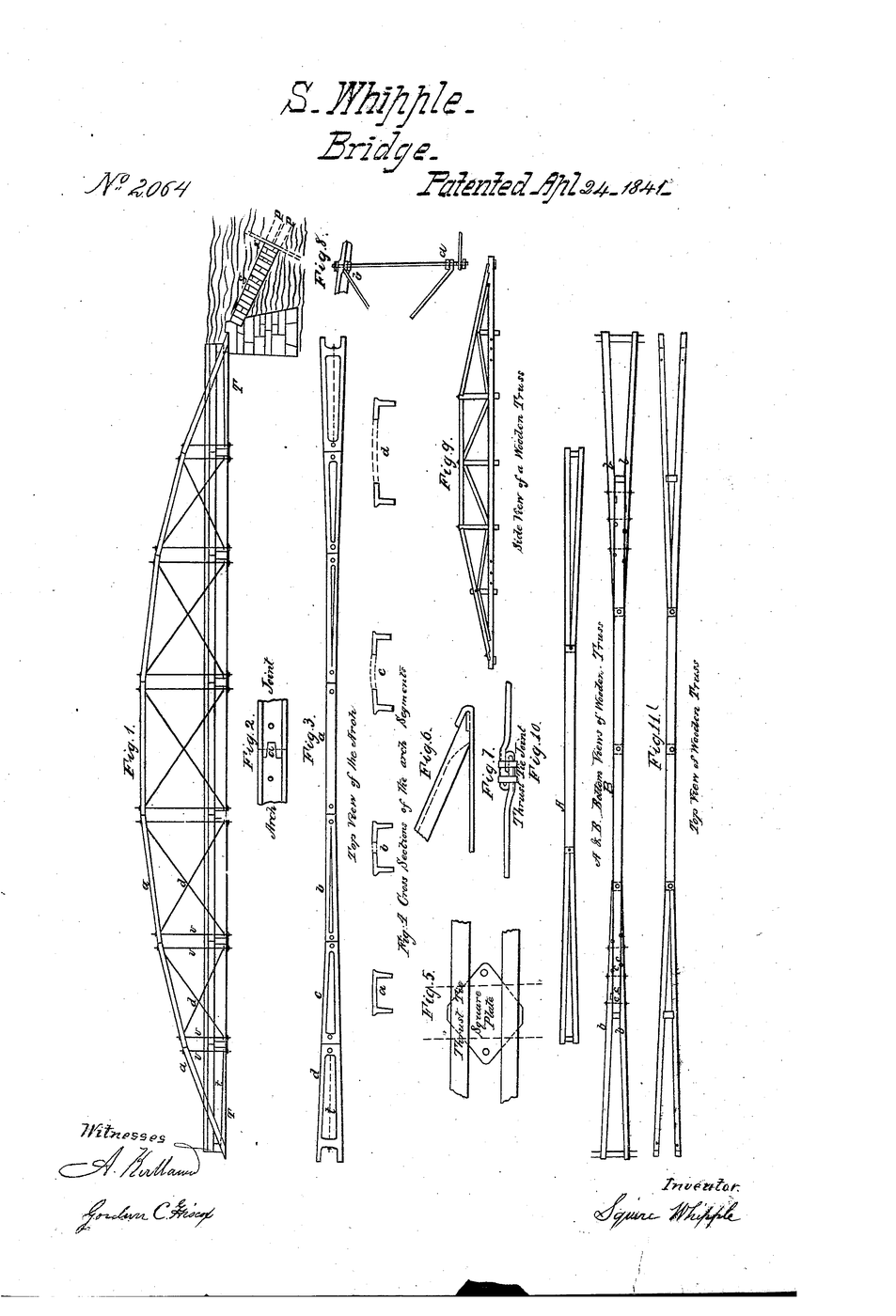


Whipple Bowstring Truss
Before Squire Whipple, bridges were built by rule of thumb and often fell down. Nobody could actually say how much force each member of a truss carried, so builders guessed, over-built where it did not matter and under-built where it did. Whipple changed that: he was the first person to calculate the stress in every member of a truss.
His bowstring design puts each material exactly where the maths says it belongs. A curved top chord — the "bow" — arches over the span and is squeezed, so it is made of cast iron, which is strong in compression. A straight bottom chord — the "string" — is stretched taut like a bowstring, so it is made of wrought iron, which is strong in tension. The verticals and diagonals carry the load between them.
It is the first truss designed by analysis rather than by feel — light, efficient, and, above all, calculable.
US Patent 2,064, granted 24 April 1841 to Squire Whipple of Utica, New York.
Инструкции
Read the claim and the deeper point
Read the claim and the deeper point
Whipple claims a bowstring iron truss — but the real breakthrough is that he could calculate the force in every member. Note both the shape and the analysis.
Curve a strip into an arch and press down
Curve a strip into an arch and press down
Bend a strip into an arch, feet apart, and press the crown. Feel the feet push outward — the arch is in compression and wants to spread. Note where the thrust goes.
Материалы для этого шага:
 Липовая дощечка1 лист
Необходимые инструменты:
 Макетный нож
Tie the feet with a string and press again
Tie the feet with a string and press again
Run a string between the arch's feet and press the crown. The string goes taut and stops the feet spreading. That is the bowstring: arch above, tie below.
Материалы для этого шага:
 Пеньковый шпагат1 метр
Build the bow (top chord)
Build the bow (top chord)
Make a curved top chord from stiff wood strips — the compression member. In Whipple's bridge this was cast iron, strong when squeezed.
Build the string (bottom chord)
Build the string (bottom chord)
Run a straight tension member along the bottom, foot to foot — the "string." Whipple used wrought iron, strong when stretched. Model it with wire.
Материалы для этого шага:
 Оцинкованная стальная проволока1 метр
Необходимые инструменты:
 Пассатижи
Add verticals and diagonals
Add verticals and diagonals
Connect the bow to the string with vertical hangers and diagonals so a load on the deck is carried up into the arch. Now it is a working truss.
Load it and identify each member's force
Load it and identify each member's force
Load the deck and check each member: the bow is squeezed (compression), the string is pulled (tension), hangers pulled, diagonals as the geometry dictates. Mark C or T on all of them.
Необходимые инструменты:
 Динамометр (пружинные весы)
Measure the tension in the string
Measure the tension in the string
Put the spring scale in line with the bottom string and load the deck. Read the pull. The heavier the load, the tighter the string — the number Whipple learned to predict.
Flatten the arch and watch the forces jump
Flatten the arch and watch the forces jump
Rebuild with a shallower arch and re-measure the string tension for the same load. A flatter bow pulls the string far harder. Rise controls force — this is the kind of relationship Whipple could calculate.
Put cast iron where compression is
Put cast iron where compression is
Cast iron is strong pushed, brittle pulled; wrought iron is tough pulled. Confirm your model has the stiff member in the bow and the tough one in the string — the wrong way round would snap.
Swap the materials and predict the failure
Swap the materials and predict the failure
Imagine cast iron in the string (tension). It would crack — cast iron is weak in tension. Matching material to force is the safety of the whole bridge.
Load to failure and see where it goes
Load to failure and see where it goes
Overload the truss and watch which member fails first. A well-designed truss fails at the member you predicted, at the load you predicted. Design by analysis means no surprises.
History & Context — the first truss designed by calculation
History & Context — the first truss designed by calculation
The patent. US 2,064, granted 24 April 1841 to Squire Whipple of Utica, New York. Whipple is often called the father of iron bridge engineering, and his bowstring truss is widely regarded as the first scientifically designed truss bridge — the first to be laid out from a correct analysis of the forces in every member rather than by tradition and guesswork.
Why "scientifically designed" is the whole point. Before Whipple, a truss was proportioned by experience and precedent, which is why bridges of the 1830s failed with grim regularity — nobody could say how hard any member was actually being pulled or pushed, so builders could not know which parts were dangerously weak. Whipple worked out the statics: he treated the truss as a system of members meeting at pin joints and calculated the tension or compression in each, publishing it in 1847 in A Work on Bridge Building, the first American engineering text to do so. Steps 8 and 9 hint at the power of this — once you can compute that a flatter arch multiplies the tie force, you can size every member to its actual load instead of guessing, which is both safer and lighter.
The bowstring resolves the load beautifully. A curved top chord carries the load as an arch — pure compression, thrusting outward at the ends (step 2) — and instead of needing massive abutments to resist that thrust, the straight bottom chord ties the two ends together and takes the thrust as tension, like the string of a bow (step 3). Whipple then made each chord of the right iron: cast iron for the compression bow (cheap, stiff, strong when squeezed, brittle when pulled) and wrought iron for the tension string and diagonals (tough, strong when stretched). Match the material to the force and every pound of iron does its proper job.
What it led to. Whipple's method — analyse the forces, size each member, choose the material to suit — is simply how structural engineering is done today; the arithmetic got more sophisticated, but the idea that you calculate a structure before you build it starts here. His bowstring trusses carried the Erie Canal and early railroads, and the broader family of iron and then steel trusses he made calculable went on to span the rivers and carry the railways of the industrial world. A number on a page, it turns out, is the strongest thing you can put in a bridge.
Материалы
3- 1 листЗаполнитель
- 1 метрЗаполнитель
- Заполнитель
Требуемые инструменты
3- Заполнитель
- Заполнитель
- Заполнитель
Связанные чертежи
Эти чертежи делятся знаниями — техники, материалы или принципы



CC0 Общественное достояние
Этот чертёж выпущен под лицензией CC0. Вы можете свободно копировать, изменять, распространять и использовать эту работу в любых целях без запроса разрешения.
Поддержите мейкера, покупая товары через его чертёж, где он получает Комиссию мейкера установленную продавцами, или создайте новую итерацию этого чертежа и включите его как связь в свой чертёж для распределения дохода.