Ubufatanye
UBUHANZI
UBWIZA N'UBUZIMA
UBUKORIKORI
UMUCO N'AMATEKA
IMYIDAGADURO
IBIDUKIKIJE
IBIRIBWA N'IBINYOBWA
UBWUBATSI BUSUBIRA INYUMA
UBUMENYI
SIPORO
IKORANABUHANGA
IBYAMBARWA
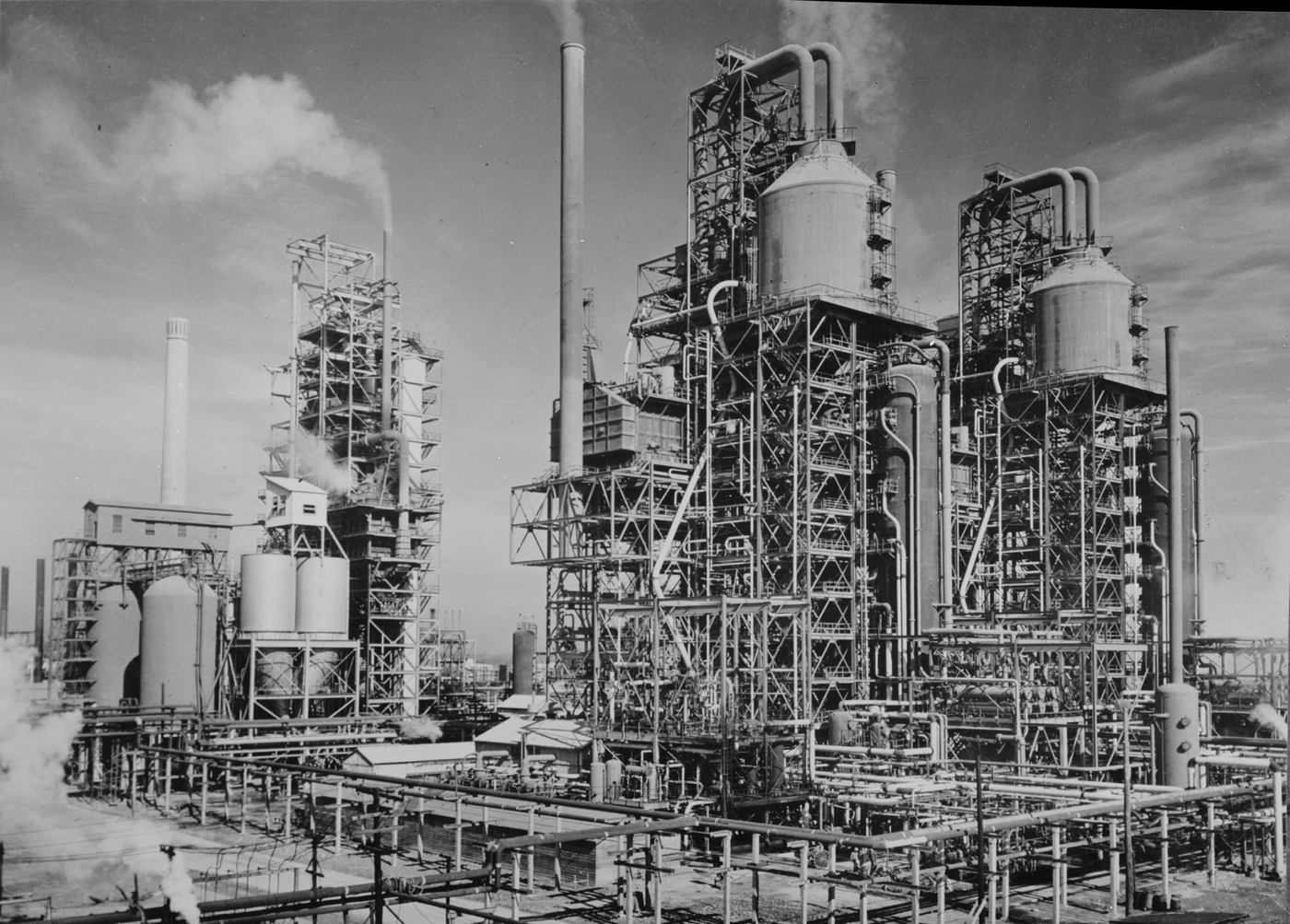


Aviation Gasoline by Catalytic Cracking over Silica-Alumina Gel at 750 °F (Voorhies, US 2,230,552)
Oil vapour passed over a hot silica-alumina gel cracks into gasoline of relatively high octane number. Voorhies (Standard Oil Development, 1941) showed that a light feed cracked at a low temperature, about 750 °F, gives aviation gasoline that needs little or no further refining.
Best result in the patent (Ex. 1, a light crude cut boiling 336-540 °F): 25.9 % of the feed as aviation gasoline (the table says 25.0 %), ASTM octane 81.0 clear and 91.7 with 3 cc of tetraethyl lead per gallon.
Variables: the feed, the temperature and the feed rate. Hotter and faster gives less gasoline and more unsaturates. Source: A. Voorhies Jr., US 2,230,552 (1941). Not given: reactor design, how the catalyst is regenerated, catalyst amounts. Highly flammable vapours. Picture: catalytic cracking units in Louisiana, about 1944 (FSA, public domain).
Impuguke
1 day
Amabwiriza
1
1
Fill the reactor with silica-alumina gel
Fill the reactor with silica-alumina gel
Pack the reaction zone with a synthetic gel of silica and alumina. Voorhies's gel was silica hydrogel soaked in aluminium nitrate solution, dried, and heated to break down the nitrate and activate it, with a silica to alumina molar ratio of about 12 to 1.
Ibikoresho bikenewe:
 Reyakitori y'imiyoboro ifite igitanda gihamye
 Umusemburo wa jeli ya silika-alumina
2
2
Choose a light feed
Choose a light feed
The feed should have a mid-boiling point below 600 °F and an aniline point below 155 °F, better below 150 °F; the heavier the feed, the lower its aniline point must be. Kerosene of aniline point 145 °F (Ex. 6) qualifies. A gas oil of aniline point 173 °F (Ex. 5) gave a gasoline of acid heat 34 °F, against 12.5 °F in Ex. 1.
Ibikoresho by'iyi ntambwe:
 Peteroli0.6 volume per volume of catalyst per hour
Ibikoresho bikenewe:
 Ikigega cyo kubika peteroli
3
3
Crack at 750 °F in half-hour runs
Crack at 750 °F in half-hour runs
Hold the reaction zone at 750 °F (range 700-800 °F). Pass 0.6 volume of liquid feed per volume of catalyst per hour, in half-hour cracking periods with a regeneration of the catalyst between them. Voorhies does not say how he regenerated it.
Ibikoresho bikenewe:
Reyakitori y'imiyoboro ifite igitanda gihamyeUmusemburo wa jeli ya silika-alumina Igipima Ubushyuhe
4
4
Fractionate the cracked product
Fractionate the cracked product
Condense and fractionate the cracked products. Take aviation gasoline up to an end point of about 290 to 310 °F. In Ex. 2 the rest split into 8.7 % gas, 37.5 % heavy naphtha boiling 300-400 °F (octane 75.8 clear, usable as a blending agent or solvent) and 25 % gas oil.
Ibikoresho bikenewe:
 Ikinyuza umwuka gitandukanya
 Umuzingo w'ikondanseri
 AmaziIkigega cyo kubika peteroli
5
5
Variables: feed, temperature, rate
Variables: feed, temperature, rate
Ex. 1 (336-540 °F crude cut, 750 °F, 0.6): 25.9 %, octane 81.0 clear. Ex. 2 (244-507 °F cut, 725 °F, 0.3): 30.8 %, 79.2 clear, 89.5 with 3 cc lead. Ex. 6 (kerosene, 750 °F, 0.6): 20.1 %, acid heat 16 °F. Ex. 7 (gas oil, 850 °F, 1.2): 20.6 %, acid heat 70 °F against 20+ °F at 750 °F (Ex. 4).
Ibikoresho bikenewe:
Reyakitori y'imiyoboro ifite igitanda gihamyeIbikoresho bikenewe
7- Umwanya
- Umwanya
- Umwanya
- Umwanya
- Umwanya
Iki gishushanyo gikora

Blueprint zijyanye
Izi blueprint zisangira ubumenyi — uburyo, ibikoresho cyangwa amahame
CC0 Umurenge rusange
Iyi blueprint yasohowe munsi ya CC0. Ushobora gukoporora, guhindura, gukwirakwiza no gukoresha nta kwemererwa.
Shyigikira Umuremyi ugura ibicuruzwa binyuze muri Blueprint ye Komisiyo y'Umuremyi byashyizweho n'Abacuruzi, cyangwa kora verisiyo nshya y'iyi Blueprint ukayinjiza nk'isano muri Blueprint yawe kugira ngo musangire inyungu.