Ubufatanye
UBUHANZI
UBWIZA N'UBUZIMA
UBUKORIKORI
UMUCO N'AMATEKA
IMYIDAGADURO
IBIDUKIKIJE
IBIRIBWA N'IBINYOBWA
UBWUBATSI BUSUBIRA INYUMA
UBUMENYI
SIPORO
IKORANABUHANGA
IBYAMBARWA
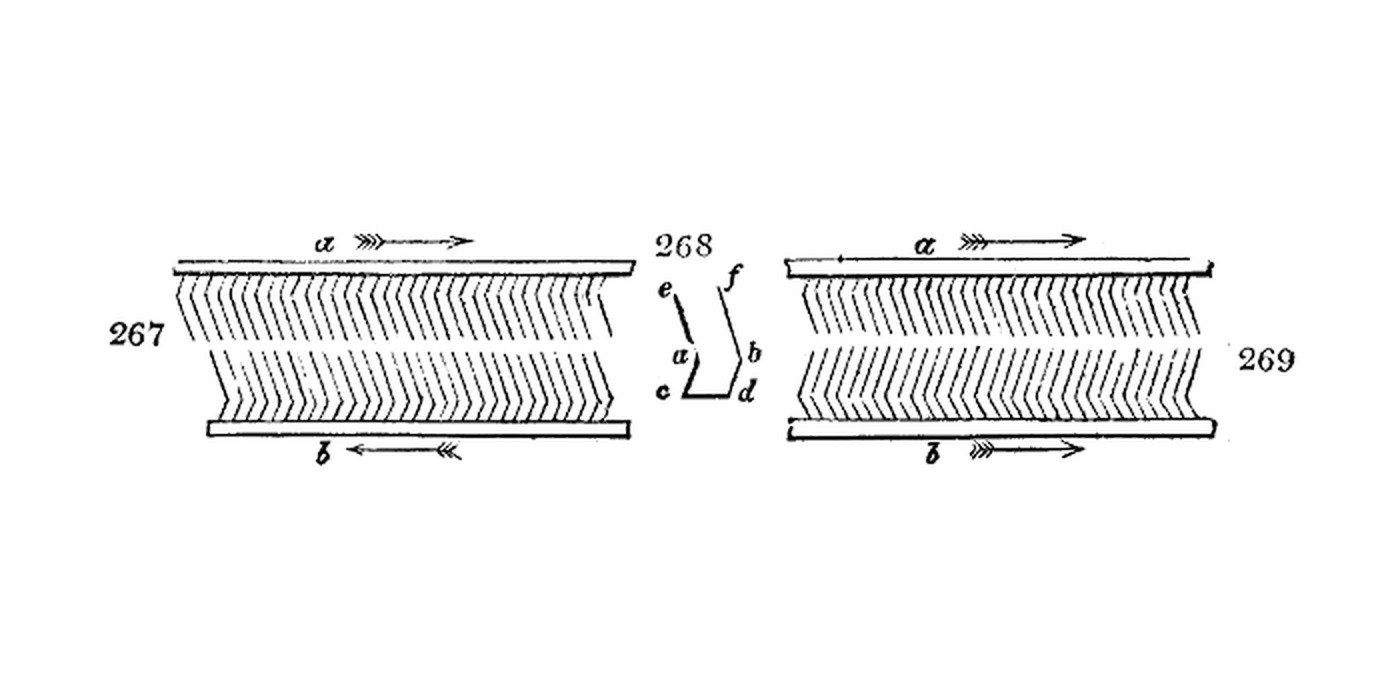


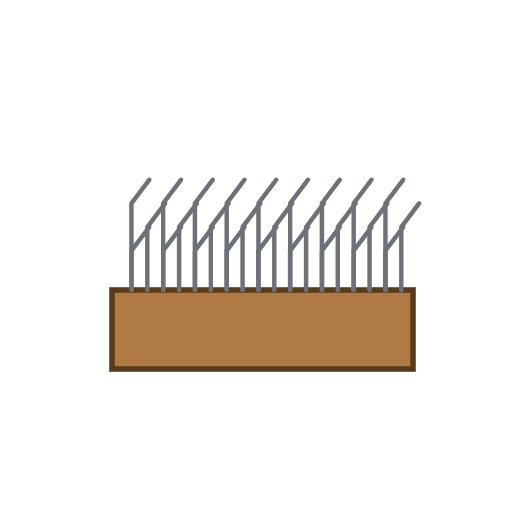
Card Clothing: Twin-Toothed Wire Staples Set in Shaved Leather (Ure, 1839)
Card clothing is the toothed face of a card: leather set with rows of bent wire staples. Andrew Ure's Dictionary of Arts (1839) explains why it is hard to make well. Every staple gives two teeth, and both teeth must be bent to exactly the same angle; the twin holes for each staple must slope at the same angle through the leather; and the leather must be the same thickness everywhere, or the teeth stand at different lengths and the card works unevenly. Factories shaved the leather to an even thickness, losing about half its weight, and gave the wire and leather out to be put together by hand.
Ure gives no wire metal, gauge, tooth length, angle or hole spacing; those are unknown here.
Source: Andrew Ure, A Dictionary of Arts, Manufactures and Mines (1839), CARDS. Picture: his figs. 267-269, card teeth and one staple.
Hagati
A day for a small sheet
Amabwiriza
1
1
Read Ure
Read Ure
"Cards are formed of a sheet or fillet of leather pierced with a multitude of small holes, in which are implanted small staples of wire with bent projecting ends called teeth. Thus every piece of wire is double toothed."
2
2
Shave the leather even
Shave the leather even
Shave the leather to the same thickness over its whole surface; in the factory about half its weight is lost in shaving and trimming. If the thickness varies, teeth of the same length stand at different heights. The thickness is not given (unknown).
Ibikoresho by'iyi ntambwe:
 Uruhu rwatunganyijwe n'ibimera1 urupapuro
Ibikoresho bikenewe:
 Icyuma cyo kunanura uruhu
 Ingano zitazwi
3
3
Bend the staples
Bend the staples
Cut the wire into equal lengths. Bend each length at right angles at two points (c and d in fig. 268) to make a staple, then bend each leg again at the same obtuse angle (a and b), so the two teeth lean the same way. Every staple must be bent alike. The metal and gauge of the wire, the tooth length and the angle are not given (unknown).
Ibikoresho by'iyi ntambwe:
 Icyuma kitazwi1 wire
Ibikoresho bikenewe:
 Koleyo yo guca insinga y'ukwerekeza
 Ipfundo Rifite Umunwa UringaniyeIngano zitazwi
4
4
Prick the twin holes
Prick the twin holes
Prick the leather with pairs of holes the width of a staple apart (c to d), in regular rows, every hole sloping at the same angle through the leather. The spacing is not given (unknown).
Ibikoresho bikenewe:
 Urushinge RutoboraIngano zitazwi
5
5
Set the staples
Set the staples
Push each staple through its two holes from the back, so the cross piece (c d) lies against the back of the leather and holds it, and the teeth stand out on the face all leaning one way.
Ibikoresho bikenewe:
Ipfundo Rifite Umunwa Uringaniye6
6
History and honest limits
History and honest limits
By 1839 machines at Halifax, Leeds, Glasgow and Lille shaved the leather, pierced it, cut and bent the wire and set the staples; Ure describes a machine that does all four in turn. Card clothing was then nailed to the flat or cylindrical wooden or metal surfaces of hand cards and carding engines.
The wire metal and gauge, tooth length, knee angle, hole spacing and leather thickness are not given; vegetable-tanned leather stands for the card leather.
Ibikoresho
2- 1 urupapuroUmwanya
- 1 wireUmwanya
Ibikoresho bikenewe
5- Umwanya
- Umwanya
- Umwanya
Iki gishushanyo gikora
CC0 Umurenge rusange
Iyi blueprint yasohowe munsi ya CC0. Ushobora gukoporora, guhindura, gukwirakwiza no gukoresha nta kwemererwa.
Shyigikira Umuremyi ugura ibicuruzwa binyuze muri Blueprint ye Komisiyo y'Umuremyi byashyizweho n'Abacuruzi, cyangwa kora verisiyo nshya y'iyi Blueprint ukayinjiza nk'isano muri Blueprint yawe kugira ngo musangire inyungu.