
Ubufatanye
UBUHANZI
UBWIZA N'UBUZIMA
UBUKORIKORI
UMUCO N'AMATEKA
IMYIDAGADURO
IBIDUKIKIJE
IBIRIBWA N'IBINYOBWA
UBWUBATSI BUSUBIRA INYUMA
UBUMENYI
SIPORO
IKORANABUHANGA
IBYAMBARWA
Cattleman's Broad-Brimmed Hat: A Felt Body Stiffened With Shellac, Blocked and Set by Hand (Ermatinger, 1919)
Tex

Yaremwe na

Tex

13. Ugushyingo 2026FO
2
0
0
0
0

Cattleman's Broad-Brimmed Hat: A Felt Body Stiffened With Shellac, Blocked and Set by Hand (Ermatinger, 1919)

A cowboy hat is a soft felt hat with a broad, stout brim. In 1919 the hatter Henry L. Ermatinger wrote that shellac stiffening "should only be applied to hats requiring extra stout brims, such as the broad brimmed hats used by cattlemen and military men." His book Scientific Hat Finishing and Renovating also tells how a small shop finishes new hats from bodies bought in the rough. This blueprint follows him: stiffen a felt body with shellac, block it with steam and a cord, iron and pounce it, pare the brim, set the brim's roll by hand over steam, and sew in the sweatband. The brim width, the block size and a few hand tools are ours.
Hejuru
About 3 days (mostly drying)

Amabwiriza

1

Body width and the mix

Gupakira ikaye ya Jupyter…
2

Read Ermatinger

"Shellac stiffening should only be applied to hats requiring extra stout brims, such as the broad brimmed hats used by cattlemen and military men. In the ordinary soft hat the thing desired is to turn out a hat that is soft and mellow." (Scientific Hat Finishing and Renovating, 1919, p. 47)
3

Make a notched board

Ermatinger rests the hat in a half circle cut in his bench while he works on the brim. Cut a half circle 20 cm across (our size: wide enough for the crown) in the edge of a plywood board and clamp the board to your table.

Ibikoresho by'iyi ntambwe:

Urupapuro rw'ibiti byometseUrupapuro rw'ibiti byometse1 igice

Ibikoresho bikenewe:
Umucumita w'ImigororwaUmucumita w'Imigororwa
Umurongo w'ipimaUmurongo w'ipima
4

Dissolve the shellac

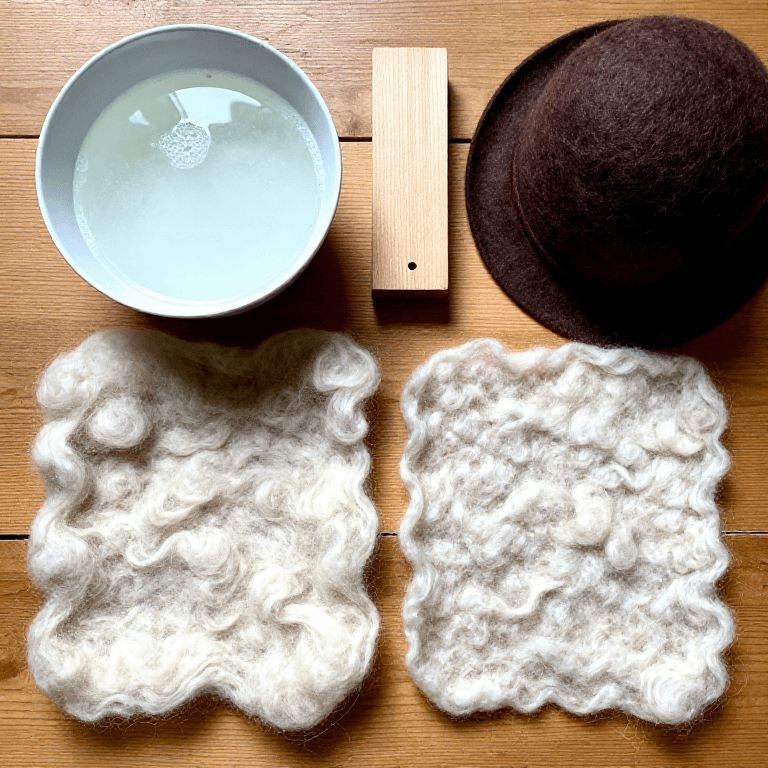
Put orange shellac in a jar, cover it with denatured alcohol, close the lid and shake it now and then through the day until it has all dissolved. Pour some into a bowl and add an equal part of denatured alcohol, so it is like rich milk. Keep a new sponge only for this, stored in a closed jar of alcohol so it does not harden.

Ibikoresho by'iyi ntambwe:

Uduce twa sherakeUduce twa sherake1 igice
Kileo cyangijweKileo cyangijwe1 igice

Ibikoresho bikenewe:

Icupa ry'Ikirahure Rifite UmufunikoIcupa ry'Ikirahure Rifite Umufuniko
IbakuliIbakuli
Isiponzi kamere y'inyanjaIsiponzi kamere y'inyanja
5

Stiffen the inside and upper brim

Ermatinger puts shellac on the inside and the upper brim only. Chalk the back of the body. Turn it inside out and pull it firmly onto the block. Soak the sponge in the mix. Starting at the bottom at the chalk mark, stroke it on with one long stroke, pressing gently and then harder, up to the centre of the crown. Work round the hat like this. Never go over the same spot twice, or it will come up stiffer there.

Ibikoresho by'iyi ntambwe:

Ingofero itarangiye y'ubwoya bwashongeshejweIngofero itarangiye y'ubwoya bwashongeshejwe1 igice

Ibikoresho bikenewe:

Ikigezo cy'ingofero - cy'ibiti, umutweIkigezo cy'ingofero - cy'ibiti, umutwe
Isiponzi kamere y'inyanjaIsiponzi kamere y'inyanja
Ingwa y'umudoziIngwa y'umudozi
6

Stiffen the underbrim

Turn the hat right side out and lay the brim over the notch. Stiffen the underbrim the same way: it should be a little stiffer than the crown. Then pat it and brush it from the band-mark out to the edge to stretch the nap. Hang it to dry overnight. If it is not stiff enough when dry, do it again. When dry, brush it hard with a dry sponge to clear the surface.

Ibikoresho bikenewe:

Isiponzi kamere y'inyanjaIsiponzi kamere y'inyanja
Uburoso bw'imyendaUburoso bw'imyenda
7

Block the crown

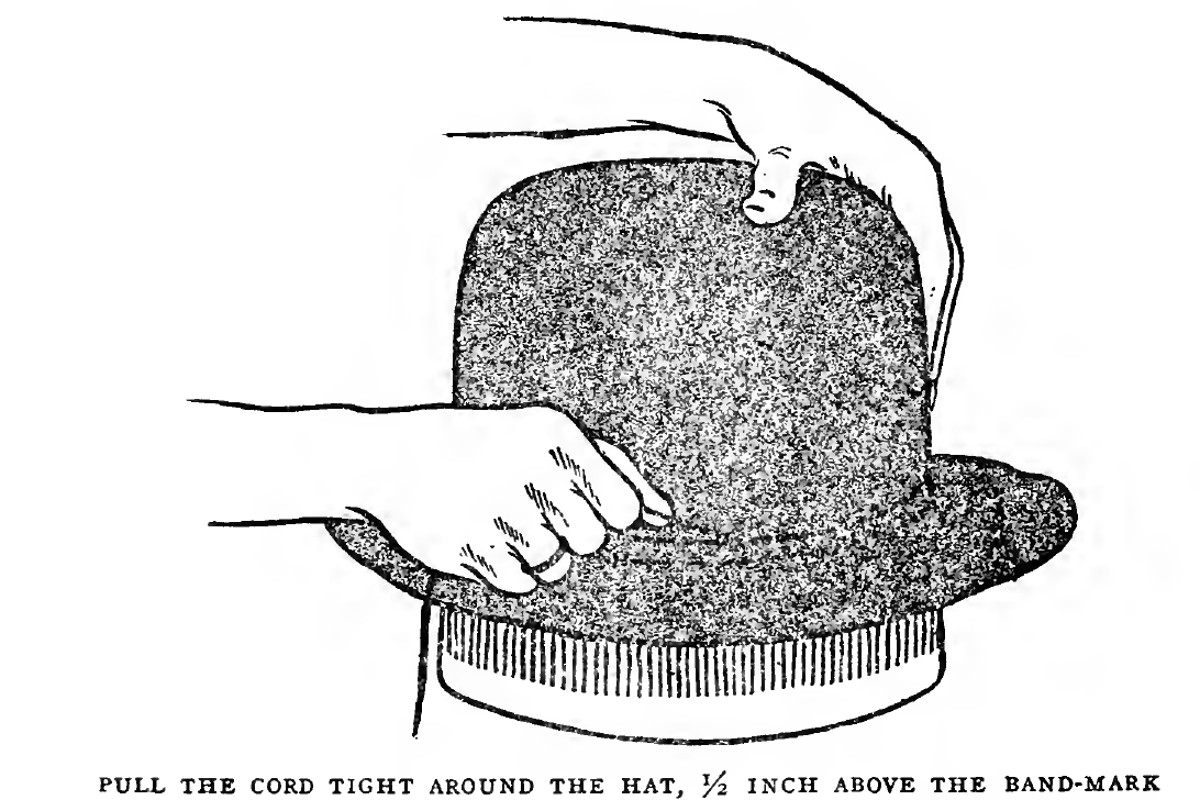
Put the dry hat on the block and work it down by hand. Tie the blocking cord round it with a tight slip-knot, half an inch (13 mm) above the band-mark (the line where crown meets brim), and wet the knot. Boil about two inches (5 cm) of water in the pot, lift the lid and hold the crown in the steam for 15 to 20 seconds, no longer: more makes the felt porous. Pull the brim down evenly until all wrinkles are gone, then push the cord down to the band-mark. For a full, flat-topped crown (his "Dakota"), palm the tip flat on the block and steam again, two or three times if needed.

Ibikoresho by'iyi ntambwe:

Umugozi wo guhindura imiterereUmugozi wo guhindura imiterere1 igice

Ibikoresho bikenewe:

Ikigezo cy'ingofero - cy'ibiti, umutweIkigezo cy'ingofero - cy'ibiti, umutwe
Inkono Nini y'UmutobeInkono Nini y'Umutobe
Urubaho rushyushyaUrubaho rushyushya
Umugozi wo GupimaUmugozi wo Gupima
8

Iron the underbrim

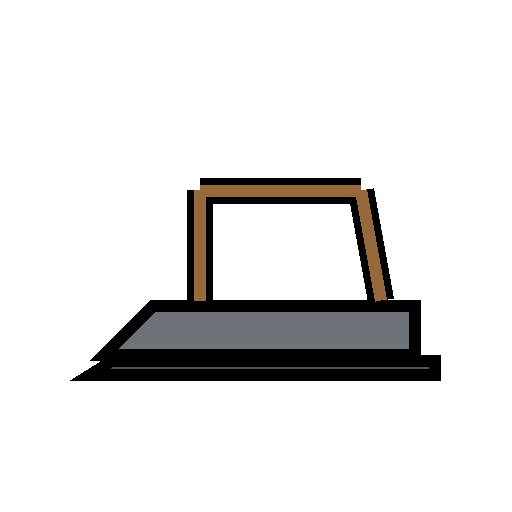
Pull the brim out flat by hand and smooth it. Rest the hat upside down in the notch. Heat the flat iron on the hot plate, wipe its face clean, and cool its nose in the water bowl so it cannot scorch. Wet the sponge, squeeze it out, rub it over a part of the underbrim with the nap, and iron that part dry, always with the nap. Work round the whole underbrim.

Ibikoresho bikenewe:

Ipasi y'icyumaIpasi y'icyuma
Urubaho rushyushyaUrubaho rushyushya
Isiponzi kamere y'inyanjaIsiponzi kamere y'inyanja
IbakuliIbakuli
9

Iron the crown

Stand the block up. Sponge one side of the crown and iron it dry with the nap until the water marks go and a gloss comes up. Do the other side, the front, the back and last the top, ironing in one direction to spin a neat centre. Pull on the brim's edge all the time: ironing narrows the brim and raises the crown. Lay a cotton cloth (he used duck or Canton flannel) over light-coloured felt so the iron cannot soil it.

Ibikoresho bikenewe:

Ipasi y'icyumaIpasi y'icyuma
Isiponzi kamere y'inyanjaIsiponzi kamere y'inyanja
Umwenda w'IpambaUmwenda w'Ipamba
10

Pounce

Fold emery paper strips about 3 x 4 inches into a pad of three or four layers, with a fresh sheet on top. Hold the pad in your curved palm and rub the crown with the nap only, the same amount everywhere, to cut out the short hairs. Use 7-0 to 8-0 paper on fine felt, 5-0 to 6-0 on coarse. Finish with an old, dull sheet. Pounce both sides of the brim the same way. A fine hat gets no powders or grease.

Ibikoresho by'iyi ntambwe:

Urupapuro rwo gukuba rwa emeriUrupapuro rwo gukuba rwa emeri2 impapuro
11

Iron the upper brim

Take the hat off the block, set it brim down on a flat board with the block back inside the crown, and iron the upper brim with short strokes. While it is still steaming, press firmly along the band-mark again and again; a tight twine round the band-mark helps keep it sharp. Pounce the upper brim.

Ibikoresho bikenewe:

Ipasi y'icyumaIpasi y'icyuma
Isiponzi kamere y'inyanjaIsiponzi kamere y'inyanja
Umugozi w'ipambaUmugozi w'ipamba
Urupapuro rw'ibiti byometseUrupapuro rw'ibiti byometse
12

Dry on the block

Put the hat back on the block, wipe the crown lightly with a damp (not wet) sponge, and leave it to dry slowly on the block. As it dries the felt tightens and the surface clears.

Ibikoresho bikenewe:

Ikigezo cy'ingofero - cy'ibiti, umutweIkigezo cy'ingofero - cy'ibiti, umutwe
Isiponzi kamere y'inyanjaIsiponzi kamere y'inyanja
13

Pare the brim

Mark the back of the underbrim exactly at the centre with chalk. Measure 4 inches (10 cm, our width) out from the band-mark all round and mark it. Cut the brim to the line with scissors. Take off the cord and the hat, and carry the chalk mark about one inch into the crown so the back can be found later.

Ibikoresho bikenewe:

Ingwa y'umudoziIngwa y'umudozi
Umugozi wo GupimaUmugozi wo Gupima
Umukasi w'imyendaUmukasi w'imyenda
14

Set the brim

A broad brim gets no curl at its edge. Boil the water, hold one side of the brim over the steam until it is soft, then roll it up slightly with your thumbs and fingers until it has the set you want. Rub your thumbs over the upper brim to shape it while it steams. Do the other side the same. Then steam the front and the back, dip them as you like, and let the brim cool in that shape.

Ibikoresho bikenewe:

Inkono Nini y'UmutobeInkono Nini y'Umutobe
Urubaho rushyushyaUrubaho rushyushya
15

Shape the crown

Leave the full crown open, or crease it: run the forefingers of both hands from the centre of the crown to the back and to the front, pressing until the crease is as deep as you want.
16

Sew in the sweatband and band

Buy the leather sweatband with its reed already attached, as Ermatinger did. Sew it inside the hat at the band-mark with neat, short stitches, hidden as well as you can. Sew a grosgrain band round the outside of the crown at the band-mark (ours).

Ibikoresho by'iyi ntambwe:

Agatambaro k'ibyuya k'ingoferoAgatambaro k'ibyuya k'ingofero1 igice
Umukandara wa grogreniUmukandara wa grogreni1 igice

Ibikoresho bikenewe:

Agatsiko k'urushinge n'umugozi by'ingoferoAgatsiko k'urushinge n'umugozi by'ingofero
17

Try it on

Put the hat on. It should sit snug at the sweatband, the brim should hold its roll when you take the hat off by the brim, and the crown should keep its shape.
18

Troubleshooting

Broad-brimmed felt hat troubleshooting.

Flow

Loading...
19

History and honest limits

**Henry L. Ermatinger**, *Scientific Hat Finishing and Renovating* (New York, Roberts, Cushman & Co., 1919), chapters VIII-XIII and XVIII-XIX. He wrote for small shops finishing hats bought "in the rough". He does not use the word "cowboy"; the broad brimmed hats of cattlemen are his. He says a shop finishing many rough bodies needs a flanging outfit (a hot sand bag on a flange); we use his hand method for setting the brim. We pull by hand instead of his puller-down and runner-down. A flat iron heated on a hot plate stands in for his gas-heated irons. The block size, the 4 inch brim, the wool capeline and the grosgrain band are ours. He gives no iron temperature: he cools the iron in water and learns by practice.

Ibikoresho

8

Ibikoresho bikenewe

17

Blueprint zijyanye

Izi blueprint zisangira ubumenyi — uburyo, ibikoresho cyangwa amahame

CC0 Umurenge rusange

Iyi blueprint yasohowe munsi ya CC0. Ushobora gukoporora, guhindura, gukwirakwiza no gukoresha nta kwemererwa.

Shyigikira Umuremyi ugura ibicuruzwa binyuze muri Blueprint ye Komisiyo y'Umuremyi byashyizweho n'Abacuruzi, cyangwa kora verisiyo nshya y'iyi Blueprint ukayinjiza nk'isano muri Blueprint yawe kugira ngo musangire inyungu.

Ibiganiro

(0)

Injira kugira ngo ujye mu biganiro

Gutegura ibitekerezo...