Ubufatanye
UBUHANZI
UBWIZA N'UBUZIMA
UBUKORIKORI
UMUCO N'AMATEKA
IMYIDAGADURO
IBIDUKIKIJE
IBIRIBWA N'IBINYOBWA
UBWUBATSI BUSUBIRA INYUMA
UBUMENYI
SIPORO
IKORANABUHANGA
IBYAMBARWA
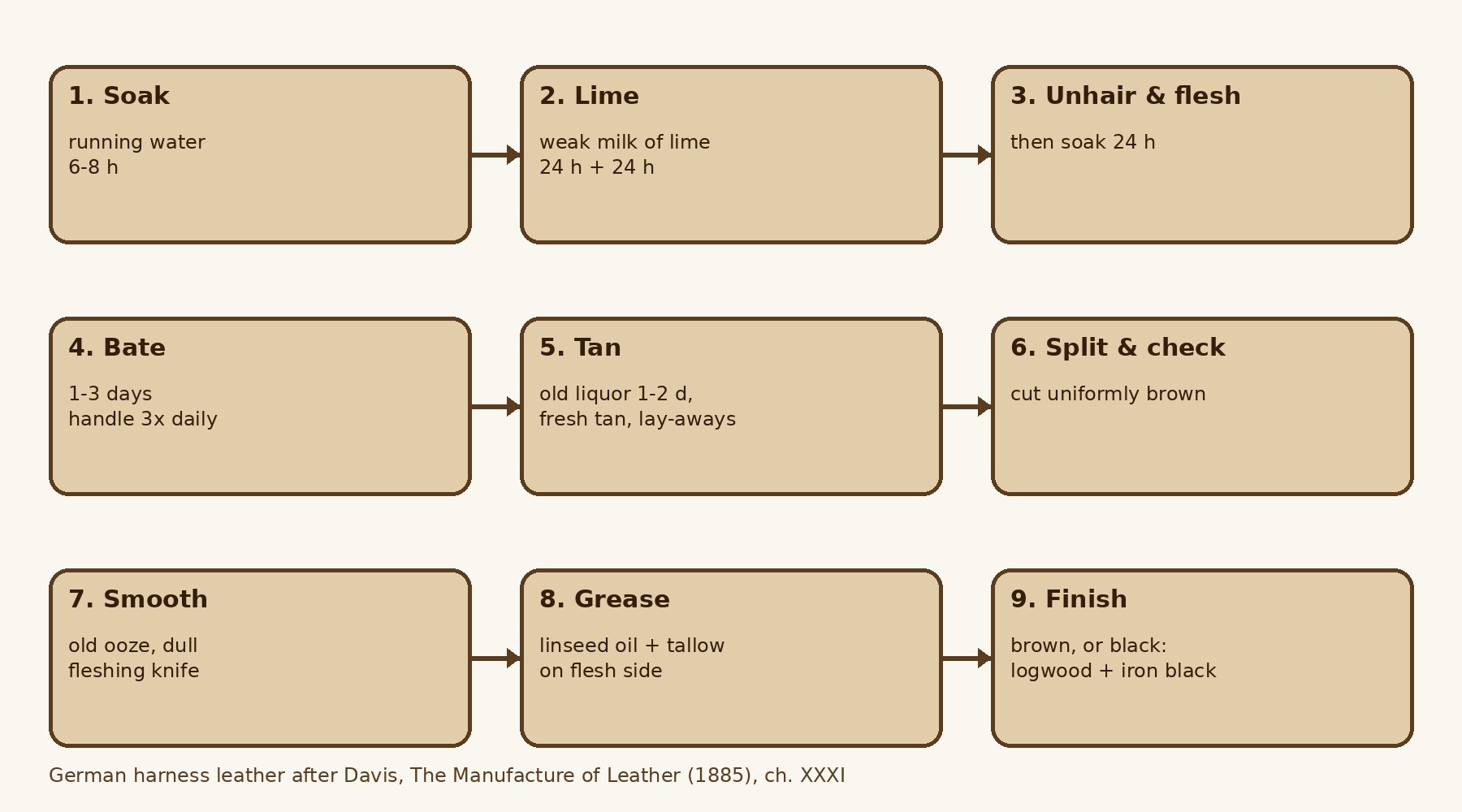


German Harness Leather: Limed, Bated and Bark-Tanned Hides Greased With Linseed Oil and Tallow (Davis, 1885)
How German tanners made harness leather, from C. T. Davis's The Manufacture of Leather (1885): green hides soaked, limed twice, unhaired, fleshed and bated, tanned in old liquor and fresh tan with lay-aways until the cut is brown through, split into sides, smoothed, and greased on the flesh side with linseed oil and tallow; then sold brown or blacked with logwood and iron black.
Hejuru
Several months
Amabwiriza
1
1
His schedule
His schedule
Gupakira ikaye ya Jupyter…
2
2
Read The Manufacture of Leather, ch. XXXI
Read The Manufacture of Leather, ch. XXXI
"Special attention should be paid to this process, as soft leather can only be produced by proper bating, while too much bating is injurious, as it destroys the skin fibres and the grain."
3
3
Soak and lime
Soak and lime
Use green hides if possible. Cut out the horns, soak in running water 6 to 8 hours with frequent rinsing (not longer, or water-stripes form), clean off dung, and lay in weak milk of lime for 24 hours; take out, make fresh lime and replace for 24 hours more, then handle regularly. Salted hides need 3 days' soaking to remove all salt; dried hides are soaked and stretched back to shape.
Ibikoresho by'iyi ntambwe:
 Uruhu rubisi1 igice
 Ishwagara yazimye1 igice
Ibikoresho bikenewe:
 Igikoni cyo Gutunganya Uruhu
 Icyuma cyo gukata uruhu
4
4
Unhair, flesh and bate
Unhair, flesh and bate
Unhair as soon as the hair pulls out easily, soak a few hours, flesh, soak 24 hours and smooth. Bate for 1 to 3 days by thickness and weather, handling three times a day; neither too little nor too much. Rinse, smooth again, soak several hours and work the flesh side thoroughly with a dull fleshing knife.
Ibikoresho bikenewe:
 Igiti cyo gukamuraho uruhu
 Icyuma cyo kuvana inyama ku ruhuIgikoni cyo Gutunganya Uruhu
5
5
Tan
Tan
Lay the hides in old liquor 1 or 2 days. Take them out, ladle out the old tan, add one third of a bushel of fresh tan and replace; the tan is spent in 4 to 8 days, so freshen the vat two or three times more. Then put them in the lay-aways, about as long as sole leather (stout harness leather may need longer). Split a hide after the second layer: uniformly brown through means tanned; pale yellow or white means not.
Ibikoresho by'iyi ntambwe:
 Igishishwa cy'umwaloni (cyamenaguwe)4 ibice
Ibikoresho bikenewe:
Igikoni cyo Gutunganya UruhuIcyuma cyo gukata uruhu6
6
Split, smooth and grease
Split, smooth and grease
Split into sides and number both halves alike. Rinse in old ooze and smooth with a dull fleshing knife on the beam. Choose the best hides for harness. Go over the leather with a fine-edged knife, grease the flesh side with linseed oil and tallow, and hang it up to dry.
Ibikoresho by'iyi ntambwe:
 Amavuta y'Ubudodo1 igice
 Ibinure by'Inyamaswa1 igice
Ibikoresho bikenewe:
Igiti cyo gukamuraho uruhuIcyuma cyo kuvana inyama ku ruhuIcyuma cyo gukata uruhu Uburoso bugari
7
7
Finish brown or black
Finish brown or black
Sort into brown and black. Brown is sold as it is or given lustre by glassing. Black is grounded with a decoction of logwood, blacked with iron black and, when nearly dry, pressed.
Ibikoresho by'iyi ntambwe:
 Ibisate by'igiti cya campeche1 igice
Ibikoresho bikenewe:
Uburoso bugari Inkono Nini
8
8
Troubleshooting
Troubleshooting
Harness leather troubleshooting.
Flow
Loading...
9
9
History and honest limits
History and honest limits
From Charles Thomas Davis, **The Manufacture of Leather** (Philadelphia, 1885), chapter XXXI (checked on the archive.org scan manufactureoflea01davi, pp. 518-521). He does not give the bate's composition, which tan, or the lime and oil-and-tallow quantities here; oak bark for the tan is our choice. The diagram hero and the tools are ours.
Ibikoresho
6- 1 igiceUmwanya
- 1 igiceUmwanya
- Umwanya
- 1 igiceUmwanya
- 1 igiceUmwanya
- Umwanya
Iki gishushanyo gikora

Blueprint zijyanye
Izi blueprint zisangira ubumenyi — uburyo, ibikoresho cyangwa amahame
CC0 Umurenge rusange
Iyi blueprint yasohowe munsi ya CC0. Ushobora gukoporora, guhindura, gukwirakwiza no gukoresha nta kwemererwa.
Shyigikira Umuremyi ugura ibicuruzwa binyuze muri Blueprint ye Komisiyo y'Umuremyi byashyizweho n'Abacuruzi, cyangwa kora verisiyo nshya y'iyi Blueprint ukayinjiza nk'isano muri Blueprint yawe kugira ngo musangire inyungu.