Ubufatanye
UBUHANZI
UBWIZA N'UBUZIMA
UBUKORIKORI
UMUCO N'AMATEKA
IMYIDAGADURO
IBIDUKIKIJE
IBIRIBWA N'IBINYOBWA
UBWUBATSI BUSUBIRA INYUMA
UBUMENYI
SIPORO
IKORANABUHANGA
IBYAMBARWA
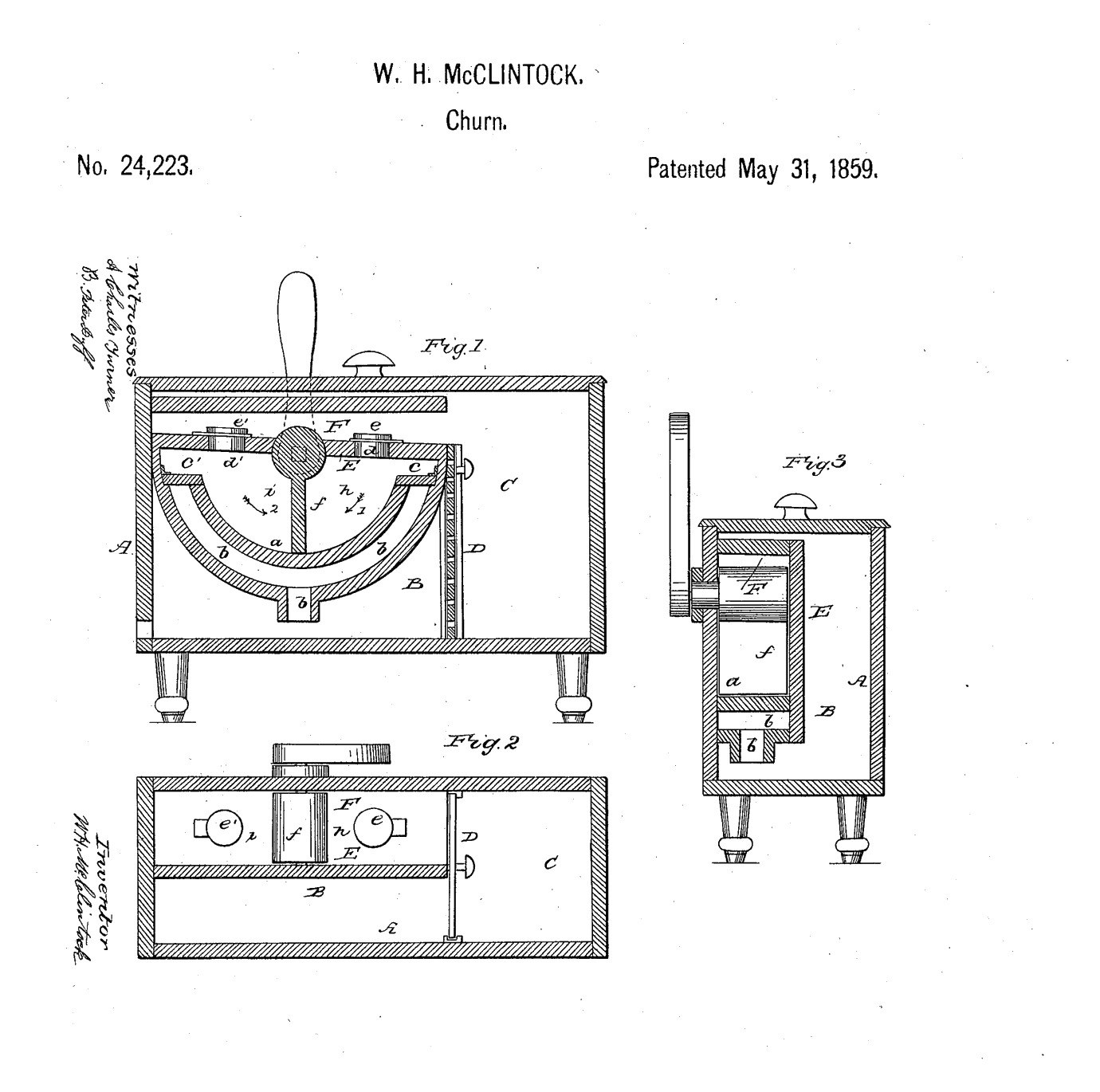


Oscillating-Pump Churn: A Half-Round Vane Pump Lifts the Cream Over and Strains It Back Through a Partition
W. H. McClintock of Frankfort, Ohio, received US 24,223, dated 31 May 1859, for a churn that is a pump. A box is divided by a perforated partition into a cream chamber and a butter chamber. In the cream chamber a half-round pump has a vane swung back and forth by a lever: each stroke sucks cream up through a passage round the pump and flap valves into one side, and forces the other side's cream up through valves on top into a channel that runs into the butter chamber. The cream strains back through the partition and goes round again, chafed at every pass, until the butter is left in the butter chamber. Pumping water round the same way rinses the churn and washes the butter.
This rung builds it in a pine box with a printed pump.
Hejuru
About 1 day, plus printing
Amabwiriza
1
1
What one stroke moves
What one stroke moves
Gupakira ikaye ya Jupyter…
2
2
Cream thrown over a partition, before it
Cream thrown over a partition, before it
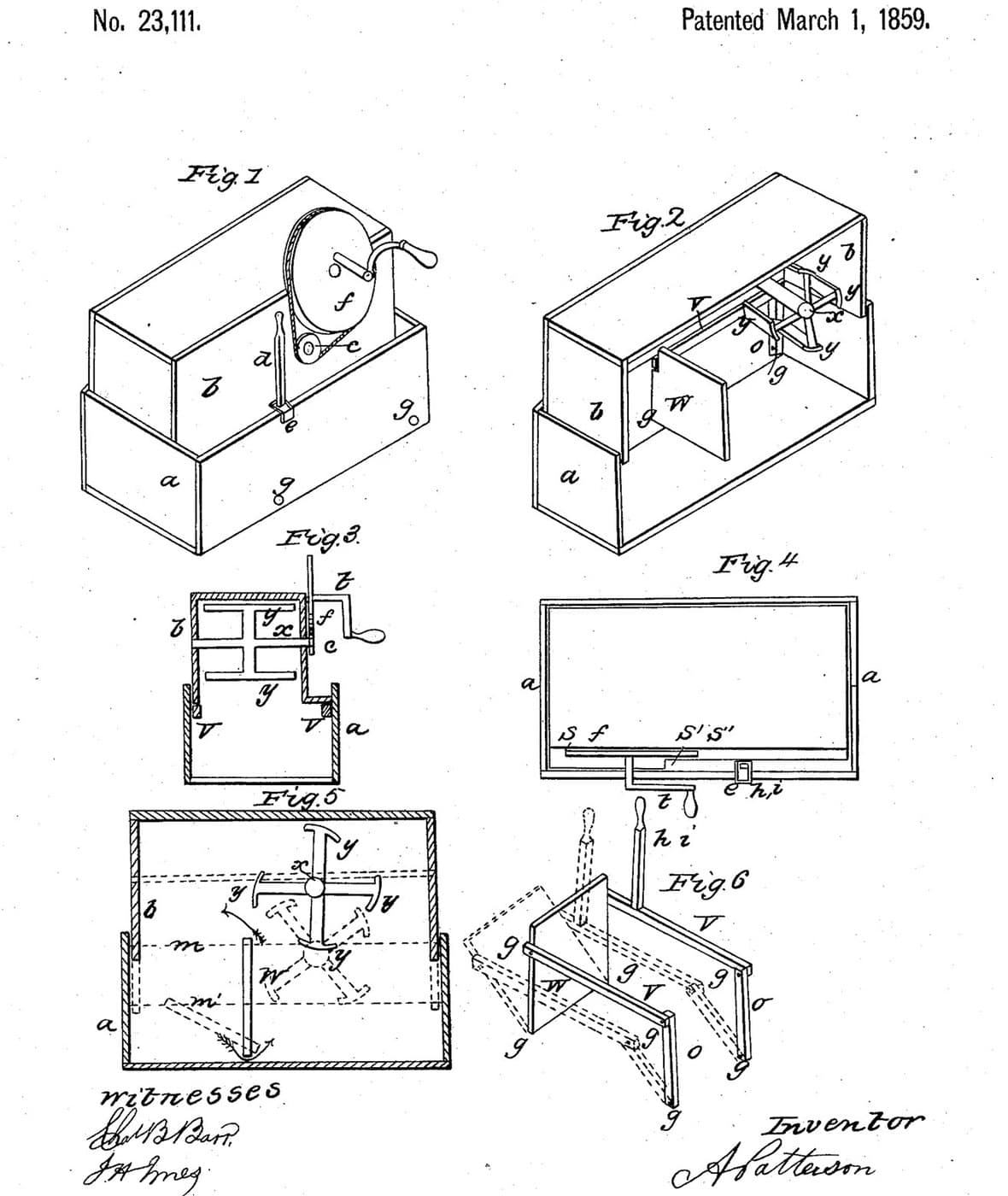
Patterson's fan threw cream over a partition to return under it. McClintock pumps it over and strains it back.
3
3
Read US 24,223
Read US 24,223
"The cream first expelled flows into the chamber C, and by reason of the continued suction of the piston is caused to strain through the perforated partition D, and enter the cream or milk chamber again ready to be again similarly circulated, minus a greater portion of its fatty matter, said fatty matter remaining in the chamber C."
4
4
Print the pump E
Print the pump E
The pump body: half-round chamber a, passage b round it with its inlet below, ports for valves c c'. Print it upside down on its flat top. PETG, 0.2 mm layers, 40 % infill, 4 walls; wash before first use.
5
5
Print the vane f
Print the vane f
The piston vane with its half-round hub. PETG, 0.2 mm layers, 40 % infill, 4 walls; wash before first use.
6
6
Box A and partition D
Box A and partition D
From 18 mm pine make a box 500 x 220 mm and 300 mm deep inside, with a lid and knob. Screw pairs of 10 mm strips down both side walls 300 mm from the left end as grooves, and slide in a 12 mm plywood partition D 212 mm high, drilled all over with 8 mm holes 20 mm apart, with a knob to lift it. Fit a PVC spigot low in the right end, in chamber C, as the opening j.
Ibikoresho by'iyi ntambwe:
 Ikibaho cy'igiti cya pinusi3 ibice
 Ikinyabutabire cy'Ibiti1 igice
 Imisumari y'ibiti40 ibice
 Ikibaho cy'Igiti Gikomeye1 igice
 Urupapuro rw'ibiti byometse1 igice
 Udukoni tw'ibiti bikomeye1 igice
 Igifuniko cya PVC1 igice
 Igifunga cya silikone1 igice
Ibikoresho bikenewe:
 Umucumita w'Intoki
 Umucumita wa Jigsaw
 Icyuma Cyivumbura Kidafite Insinga
 Ibyuma Byinshi byo Gucukura
 Ibyuma byo gucamo utwenge
 Ibifata
 Urupapuro rwo Gusya
 Ikusanyirizo ry'ibitorezi
 Umugozi wo Gupima
7
7
Pump E and top plate
Pump E and top plate
Cut a 12 mm plywood top plate 290 x 220 mm to fill chamber B from the left end to the partition. Cut a half-round groove across its underside for the vane's hub, 37 mm wide, centred 150 mm from the left end, and drill two 20 mm eduction holes d d' 50 mm each side of it. Glue rubber-sheet flaps e e' 32 mm square over them on top, hinged on one edge with a screw. Glue rubber flaps c c' over the two ports inside the pump's chamber, hinged at the top so they open inward. Screw the pump body under the plate, seal the joint with silicone, and rest the plate on cleats 200 mm above the floor so it closes chamber B.
Ibikoresho by'iyi ntambwe:
 Fibere ya PETG1 igiceUrupapuro rw'ibiti byometse1 igice
 Urupapuro rw'umupira1 igiceIgifunga cya silikone1 igiceImisumari y'ibiti12 ibiceIkibaho cy'igiti cya pinusi1 igice
Ibikoresho bikenewe:
 Imashini icapa 3D ikoresha umugozi (FDM)Umucumita wa JigsawIbyuma byo gucamo utwenge
 Icyuma gikata cy'akaziIcyuma Cyivumbura Kidafite InsingaIkusanyirizo ry'ibitorezi
8
8
Vane f, lever g and channel F
Vane f, lever g and channel F
Fix the vane on a 12 mm stainless rod with an M4 screw across, set it in the chamber with the hub in the plate's groove, and pass the rod out through the pump's end and the box's near wall. Fix a hardwood lever g 24 x 12 mm, 245 mm long, on the rod outside, standing up past the lid, with a 28 mm dowel handle on top. Fix a pine board above the top plate, sloping down from 258 mm high at the left end to 238 mm over the partition, to form channel F into C.
Ibikoresho by'iyi ntambwe:
 Agati k'icyuma kitagira ingese1 igice
 Ibitorezo by'imashini1 igice
 Ecrou ifunga ifite umuzingo wa nayiloni1 igiceIkibaho cy'Igiti Gikomeye1 igiceUdukoni tw'ibiti bikomeye1 igiceIkinyabutabire cy'Ibiti1 igiceIkibaho cy'igiti cya pinusi1 igiceImisumari y'ibiti8 ibice
Ibikoresho bikenewe:
 Umucumita w'IbyumaUmucumita w'IntokiIcyuma Cyivumbura Kidafite InsingaIbyuma Byinshi byo GucukuraIkusanyirizo ry'ibitorezi
9
9
The build in 3D
The build in 3D
FreeCAD model of this build, the near half cut away: box A with partition D in its grooves, the pump body with passage b and its inlet, the vane, the top plate with flaps e e', flaps c c' at the ports, channel F's board and the spigot. It was checked at five vane angles from -60 to +60 degrees.
10
10
Churn
Churn
Pour about 8 litres of heavy cream at about 15 °C into chamber B through C (it strains through the partition), checked with the thermometer, and put the lid on. Swing the lever steadily back and forth about 60 degrees each way and time it: cream spurts into channel F, runs into C and strains back. When the butter has gathered in C, draw off the buttermilk at the spigot, pour cold water in and pump it round to rinse the churn and wash the butter, then lift the butter out, work in a pinch of salt and weigh it.
Ibikoresho by'iyi ntambwe:
 Igice cy'ibinure cy'amata8 l
 Amazi1 igice
 Umunyu w'inyanja munini1 igice
Ibikoresho bikenewe:
 Igipima ubushyuhe gifite uruti rusigara mu kintu
 Isaha yo Guhagarika
 Iminzani ya Digitale yo mu Gikoni
 Ibakure rinini ryo kuvanga ry'icyuma kitagira ingese
11
11
Troubleshooting
Troubleshooting
Pump churn troubleshooting.
Flow
Loading...
12
12
History and honest limits
History and honest limits
**W. H. McClintock** of Frankfort, Ross County, Ohio, US 24,223, 31 May 1859, "Churn". He claimed the circularly vibrating suction and force pump with a churn having a perforated partition. He gave no sizes or materials: the box, the printed pump, the rubber flaps and every size are ours.
Ibikoresho
16- 3 ibiceUmwanya
- 2 ibiceUmwanya
- 60 ibiceUmwanya
- 1 igiceUmwanya
- 1 igiceUmwanya
- 1 igiceUmwanya
- 1 igiceUmwanya
- 2 ibiceUmwanya
- 1 igiceUmwanya
- 1 igiceUmwanya
- Umwanya
- 1 igiceUmwanya
- Umwanya
- Umwanya
- 1 igiceUmwanya
- 1 igiceUmwanya
Ibikoresho bikenewe
16- Umwanya
- 1 vendor sell this, none ship to you yetUmwanya
- 1 vendor sell this, none ship to you yetUmwanya
- Umwanya
- Umwanya
- Umwanya
- Umwanya
- Umwanya
- 1 vendor sell this, none ship to you yetUmwanya
- Umwanya
- Umwanya
- Umwanya
Dosiye z'igishushanyo
3Iki gishushanyo gikora


Blueprint zijyanye
Izi blueprint zisangira ubumenyi — uburyo, ibikoresho cyangwa amahame



CC0 Umurenge rusange
Iyi blueprint yasohowe munsi ya CC0. Ushobora gukoporora, guhindura, gukwirakwiza no gukoresha nta kwemererwa.
Shyigikira Umuremyi ugura ibicuruzwa binyuze muri Blueprint ye Komisiyo y'Umuremyi byashyizweho n'Abacuruzi, cyangwa kora verisiyo nshya y'iyi Blueprint ukayinjiza nk'isano muri Blueprint yawe kugira ngo musangire inyungu.