Ubufatanye
UBUHANZI
UBWIZA N'UBUZIMA
UBUKORIKORI
UMUCO N'AMATEKA
IMYIDAGADURO
IBIDUKIKIJE
IBIRIBWA N'IBINYOBWA
UBWUBATSI BUSUBIRA INYUMA
UBUMENYI
SIPORO
IKORANABUHANGA
IBYAMBARWA
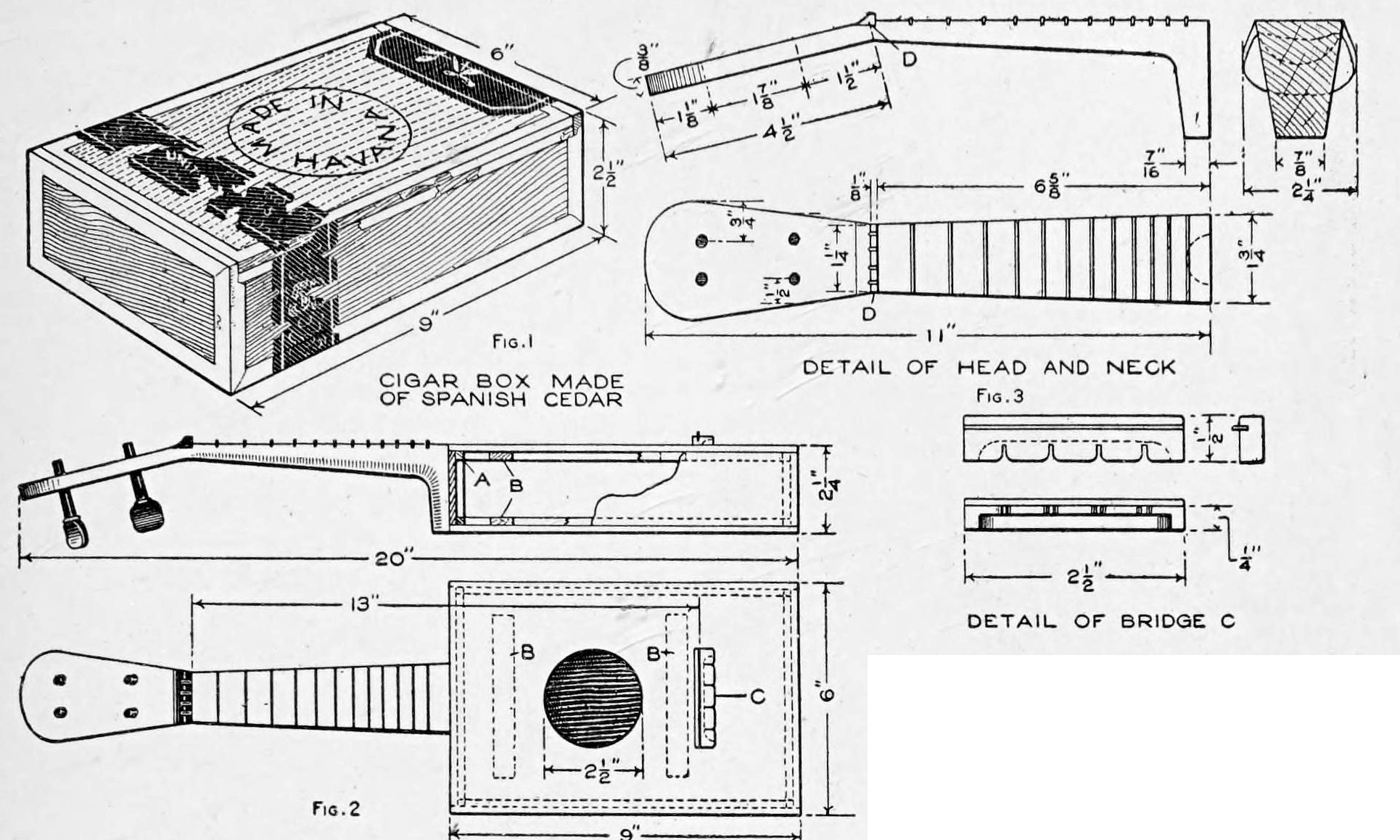


Cigar-Box Hawaiian Ukulele: Spanish-Cedar Body, 11 in Neck and Frets by the Rule of Eighteen (Boy Mechanic, 1919)
S. H. Samuels's ukulele from The Boy Mechanic, Book 3 (1919), made for 30 cents: a Spanish-cedar cigar box rebuilt as a 9 x 6 in body with a 2-1/2 in sound hole, an 11 in cedar or mahogany neck, a notched hardwood bridge, and aluminium frets set by the old rule of 1/18 on a 13 in string length.
Hagati
About 2 days
Amabwiriza
1
1
Fret table
Fret table
Gupakira ikaye ya Jupyter…
2
2
Read The Boy Mechanic, Book 3
Read The Boy Mechanic, Book 3
"The size of this instrument makes it especially suited to the cigar-box type of body construction."
3
3
Rebuild the box as the body
Rebuild the box as the body
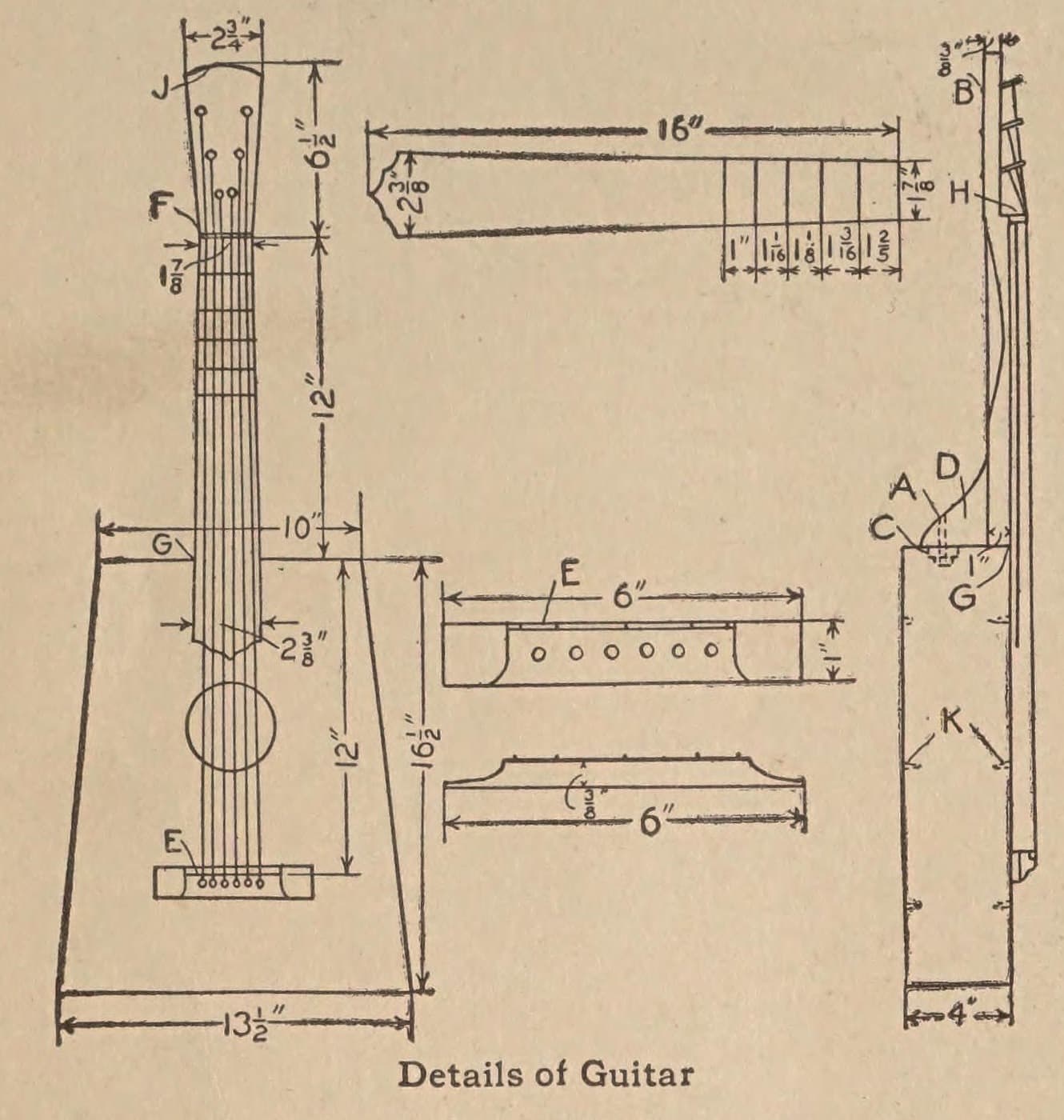
Take a good Spanish-cedar cigar box about 2-1/2 by 6 by 9 in, soak off the paper without marring the wood, take it apart and trim edges with too many or broken nail holes. Fit the parts so top and bottom rest against the sides and ends, the ends between the sides (Fig. 2; drawn 9 by 6 by 2-1/4 in). Cut a 2-1/2 in hole in the top 3-3/4 in from the neck end. Make corner strips A 1/4 in square and strips B 1/4 by 5/8 by 4-1/2 in for under the top and on the bottom.
Ibikoresho by'iyi ntambwe:
 Urubaho rwa sederi1 igice
Ibikoresho bikenewe:
 Umucumita w'Imigororwa
 Icyuma cyo gukata uruhu
 Ikoresho cyo gusiga ibiti
 Ikirangamurongo
 Umurongo w'ipima
4
4
Make the neck, nut and bridge
Make the neck, nut and bridge
Cut the neck from Spanish cedar or mahogany, 11 in long, best in one piece (or with the peg extension and the wide body end glued on and doweled): head 4-1/2 in, fingerboard 6-5/8 in from the 1/8 in nut, 1-1/4 in wide at the nut and 1-3/4 in at the body, heel 7/16 in, section 7/8 by 2-1/4 in as drawn (Fig. 3). Make the nut D of mahogany or walnut with the grain lengthwise, notched for the strings as spaced. Make the bridge C of hard wood, 2-1/2 in long and 1/2 in high, hollowed under the notched edge, with a metal string contact.
Ibikoresho by'iyi ntambwe:
 Ikibaho cy'Igiti Gikomeye1 igice
 Inkoni z'Ibiti1 igice
 Ifatanyo ry'inyamaswa1 igice
 Umurongo w'umuringa1 igice
Ibikoresho bikenewe:
 Umucumita w'IntokiUmucumita w'ImigororwaIcyuma cyo gukata uruhu
 Amakariso (Ikariso ry'Intoki)
 Igikoresho cyo gutobora gikoreshwa n'intoki
5
5
Fret the fingerboard
Fret the fingerboard
Measure the string length from the bridge contact to the nut (13 in here). Set the first fret 1/18 of that distance from the nut, the second 1/18 of the distance from the first fret to the bridge, and so on (notebook). Cut grooves 1/8 in deep and drive in frets of aluminium (or brass) 1/16 by 3/16 in, tight enough to need no fastening.
Ibikoresho by'iyi ntambwe:
Umurongo w'umuringa1 igiceIbikoresho bikenewe:
Umucumita w'Intoki Umucumita w'IbyumaAmakariso (Ikariso ry'Intoki)Umurongo w'ipima
 Ikaramu ya penisile
 Inyundo
6
6
Assemble and finish
Assemble and finish
Glue the body's end to the neck with animal glue, reinforced by screws, its upper edge parallel with the fingerboard and the fingerboard flush with the top. Glue the body (without the top) to that end; when dry, glue in the strips, bridge and finally the top. Clean, sandpaper, stain and shellac or varnish. Fit tuning pegs (bought or made) and a set of strings.
Ibikoresho by'iyi ntambwe:
Ifatanyo ry'inyamaswa1 igice Imisumari y'ibiti1 igice
 Urupapuro rwo Gusya1 igice
 Varinishi ya sherake1 igice
 Utubaho two guhindura amajwi4 ibice
 Ukulele Strings1 igice
Ibikoresho bikenewe:
 Igifashe cy'inkoni
 Agafuni k'urwasaya rugororotse
 Uburoso bugari
7
7
Troubleshooting
Troubleshooting
Ukulele troubleshooting.
Flow
Loading...
8
8
History and honest limits
History and honest limits
From "A Homemade Hawaiian Ukulele" by S. H. Samuels, in **The Boy Mechanic, Book 3**, Popular Mechanics, 1919 (Project Gutenberg 71856; checked on the archive.org scan boymechanic0003unse, pp. 358-359). He gives the box as about 2-1/2 in deep; his drawing shows 2-1/4 in. He names no stain and no string type. The fret table, its equal-temperament comparison and the metric figures are ours.
Ibikoresho
10- 1 igiceUmwanya
- 1 igiceUmwanya
- 1 igiceUmwanya
- 1 igiceUmwanya
- 1 igiceUmwanya
- 1 igiceUmwanya
- 1 igiceUmwanya
- 1 igiceUmwanya
- 4 ibiceUmwanya
- 1 igiceUmwanya
Ibikoresho bikenewe
14- Umwanya
- Umwanya
- Umwanya
- Umwanya
- Umwanya
- Umwanya
- Umwanya
- 1 vendor sell this, none ship to you yetUmwanya
- Umwanya
- Umwanya
- Umwanya
Iki gishushanyo gikora
Blueprint zijyanye
Izi blueprint zisangira ubumenyi — uburyo, ibikoresho cyangwa amahame
CC0 Umurenge rusange
Iyi blueprint yasohowe munsi ya CC0. Ushobora gukoporora, guhindura, gukwirakwiza no gukoresha nta kwemererwa.
Shyigikira Umuremyi ugura ibicuruzwa binyuze muri Blueprint ye Komisiyo y'Umuremyi byashyizweho n'Abacuruzi, cyangwa kora verisiyo nshya y'iyi Blueprint ukayinjiza nk'isano muri Blueprint yawe kugira ngo musangire inyungu.