UBUHANZI
UBWIZA N'UBUZIMA
UBUKORIKORI
UMUCO N'AMATEKA
IMYIDAGADURO
IBIDUKIKIJE
IBIRIBWA N'IBINYOBWA
UBWUBATSI BUSUBIRA INYUMA
UBUMENYI
SIPORO
IKORANABUHANGA
IBYAMBARWA
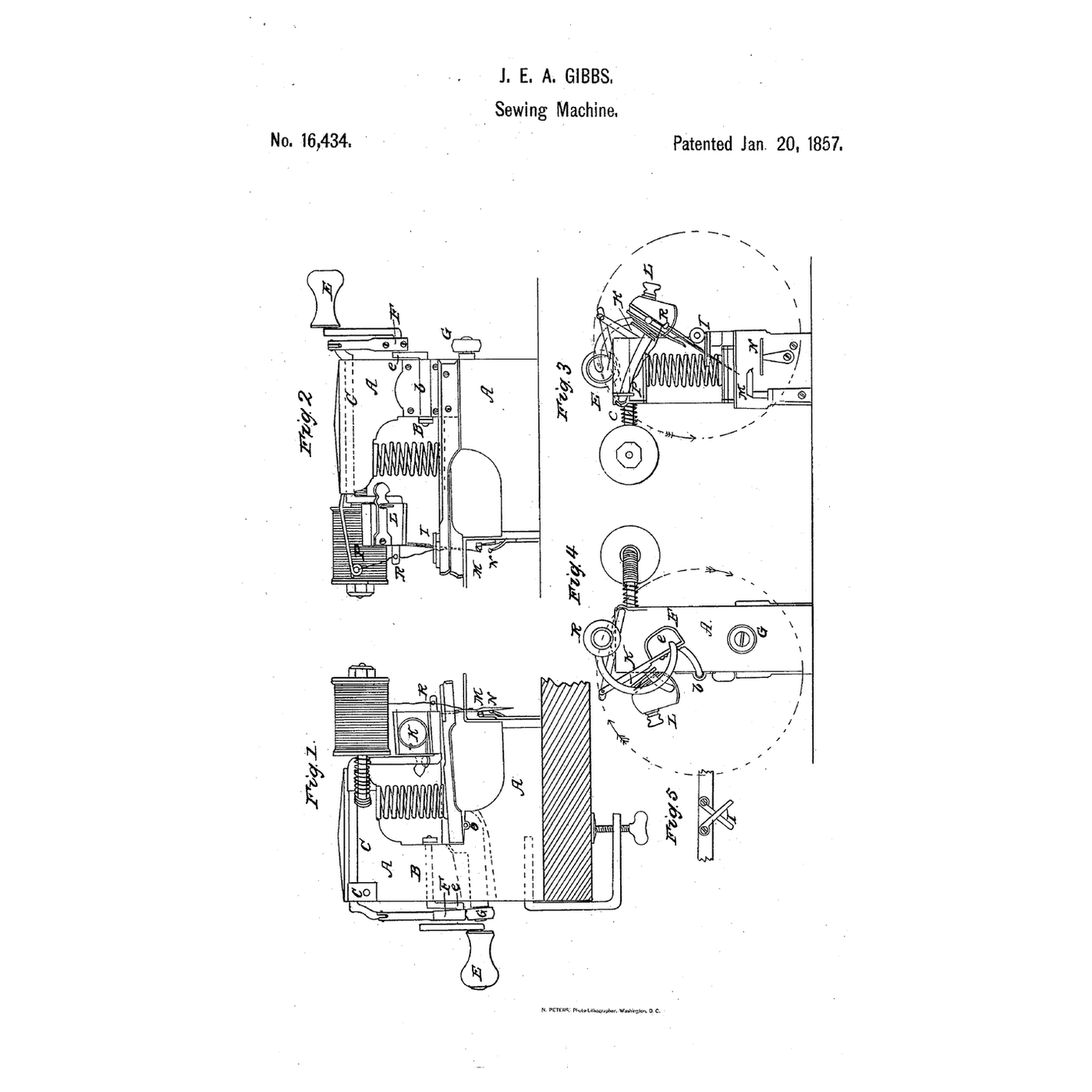


The Stationary-Hook Chain Stitcher: A Vibrating Needle Lays Its Loop Over a Fixed Hook
The sewing machines of the 1850s were costly, with a moving shuttle or a revolving looper under the cloth, too dear for a household.
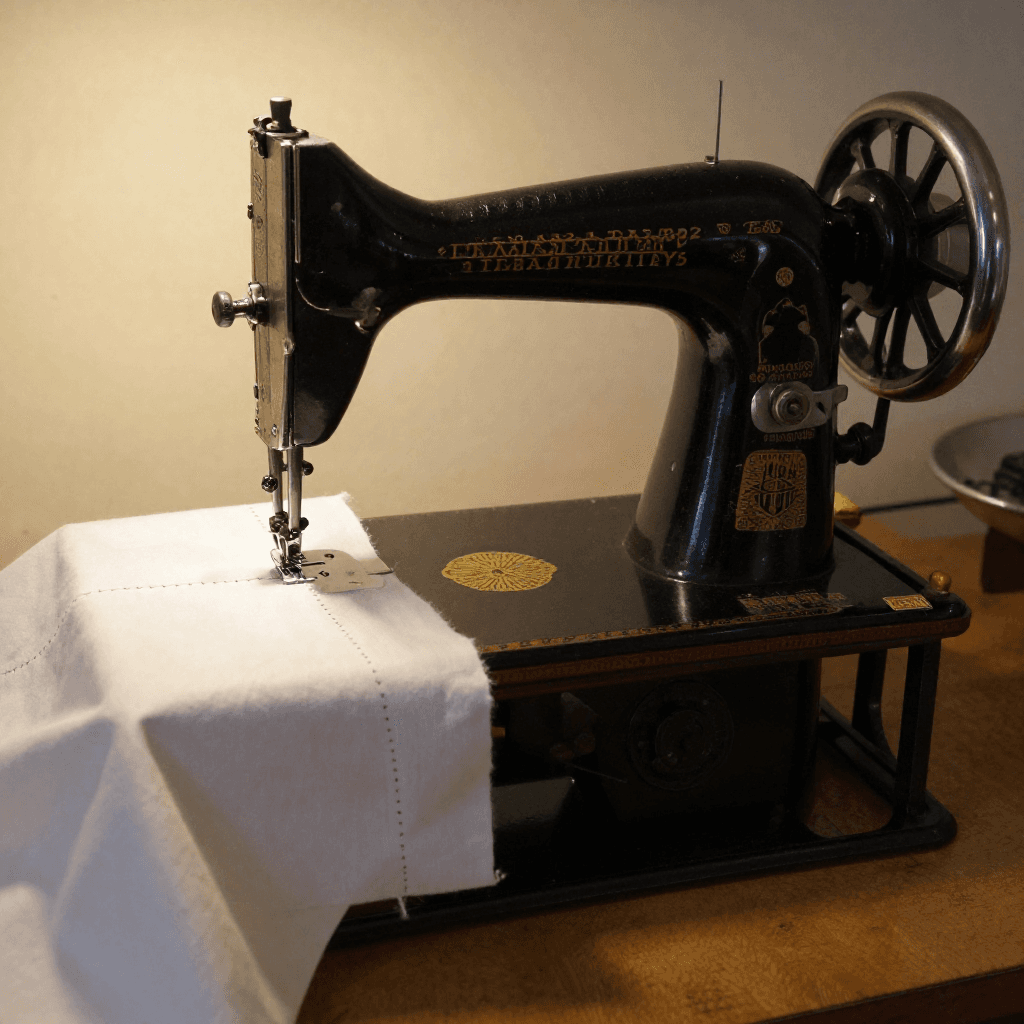
James E. A. Gibbs of Mill Point, Virginia, received US 16,434, dated 20 January 1857, for "so arranging and constructing the machine as to form the chain-stitch on a stationary hook for the purpose of simplifying the mechanism of the whole machine." A crank rocks a shaft that carries the needle-head; guided by cross-bars, the needle passes through the cloth and then slides on an inclined plane of a fixed crochet-hook, which catches the thread; on the next descent the needle passes through that loop and draws it off the hook, and a feeding hook moves the cloth one step each turn.
This rung works out how much thread a chain stitch uses, then builds a hand-cranked demonstrator with a rocking needle and a fixed hook under a slotted table, and stitches a chain seam.
Hejuru
About 2 days
Amabwiriza
1
1
Thread in a chain stitch
Thread in a chain stitch
Gupakira ikaye ya Jupyter…
2
2
A sewing machine before it
A sewing machine before it
The embedded blueprint makes the lock stitch with two threads and a moving shuttle. Gibbs makes a one-thread chain stitch on a hook that does not move.
3
3
Read US 16,434
Read US 16,434
"The pedestal of the frame bears in front the cloth-table, which is slotted, so as to allow a free passage and play of the needle, and is furnished with a stationary hook, M, screwed or otherwise permanently attached in such a position as to catch the thread from the needle when the latter is guided thereto by a projecting guide, N, for the purpose of forming the loop in the manner hereinafter described."
"The loop is formed by the needle passing the thread over the crochet-point, where it remains until the needle, in its next downward motion, passes through the loop and draws it off the hook."
4
4
Build the demonstrator and stitch a seam
Build the demonstrator and stitch a seam
**Frame.** Screw a hardwood upright to a baseboard, clamp the baseboard to a table's edge as Gibbs did, and fix a hardwood cloth table across the front with a slot for the needle.
**Rocking shaft and needle-head.** Run a steel rod through the upright as the rocking shaft, bent at its front end, and pivot a hardwood needle-head on it. Bend a crank on the rod's back end and fit a handle. Set a sewing machine needle, or a stout sewing needle with its eye near the point, in the head.
**Hook.** Under the table beside the slot, screw a crochet hook with its point toward the needle's path and file a small inclined plane in front of it that guides the needle's thread over the point.
**Feed and clamp.** Hold the cloth under a spring clamp and move it one stitch by hand each turn, in place of Gibbs's feeding hook.
**Test.** Thread the needle, turn the crank slowly and watch each loop catch on the hook and the next pass through it. Sew 10 cm of chain seam in cotton fabric, then pull its end and see it unravel, as a chain stitch does.
Ibikoresho by'iyi ntambwe:
 Ikibaho cy'Igiti Gikomeye2 ibice
 Igihimba cy'Igiti Gikomeye1 igice
 Imisumari y'ibiti10 ibice
 Umurongo Uzengurutse w'Icyuma Cyoroshye0.4 metero
 Ubudodo bw'Ipamba1 igice
 Igitambaro cy'ipamba (cyoroheje)1 igice
 Umurongo w'icyuma cya sipringi0.1 metero
Ibikoresho bikenewe:
 Umucumita w'Intoki
 Ibikoresho by'amasuka y'igiti
 Icyuma Cyivumbura Kidafite Insinga
 Ibyuma Byinshi byo Gucukura
 Ifatiro ry'Ameza
 Umucumita w'Ibyuma
 Itara rya Propane
 Ikusanyirizo ry'Amakariso Mato
 Utuma two gukora imyenda
 Ibifata
 Ikusanyirizo ry'ibitorezi
 Ibikoresho by'inshinge zo kudoda
5
5
A stitcher that skips, tangles or breaks thread
A stitcher that skips, tangles or breaks thread
Stationary-hook chain stitcher troubleshooting.
Flow
Loading...
6
6
History and honest limits
History and honest limits
**James E. A. Gibbs** of Mill Point, Pocahontas County, Virginia, received US 16,434, dated 20 January 1857. His cam F on the crank struck a roller G to raise the cloth clamp, a spring K kept the needle-head against its guides, a screw L limited the needle's swing to set the stitch length, and a bobbin with a spiral spring gave the thread its tension. His claim is making the chain stitch with a vibrating needle in combination with a stationary hook.
**Honest limits.** A hand-built wooden demonstrator with hand feed stands in for his machine, and it is slow. The notebook's thread length is a rough rule; its values are examples. Your seam is the result.
Ibikoresho
7- 2 ibiceUmwanya
- 1 igiceUmwanya
- 10 ibiceUmwanya
- 0.4 meteroUmwanya
- 1 igiceUmwanya
- Umwanya
- 0.1 meteroUmwanya
Ibikoresho bikenewe
12- Umwanya
- 1 vendor sell this, none ship to you yetUmwanya
- Umwanya
- Umwanya
- Umwanya
- Umwanya
- Umwanya
- Umwanya
- Umwanya
Blueprint zijyanye
Izi blueprint zisangira ubumenyi — uburyo, ibikoresho cyangwa amahame
CC0 Umurenge rusange
Iyi blueprint yasohowe munsi ya CC0. Ushobora gukoporora, guhindura, gukwirakwiza no gukoresha nta kwemererwa.
Shyigikira Umuremyi ugura ibicuruzwa binyuze muri Blueprint ye Komisiyo y'Umuremyi byashyizweho n'Abacuruzi, cyangwa kora verisiyo nshya y'iyi Blueprint ukayinjiza nk'isano muri Blueprint yawe kugira ngo musangire inyungu.