Ubufatanye
UBUHANZI
UBWIZA N'UBUZIMA
UBUKORIKORI
UMUCO N'AMATEKA
IMYIDAGADURO
IBIDUKIKIJE
IBIRIBWA N'IBINYOBWA
UBWUBATSI BUSUBIRA INYUMA
UBUMENYI
SIPORO
IKORANABUHANGA
IBYAMBARWA
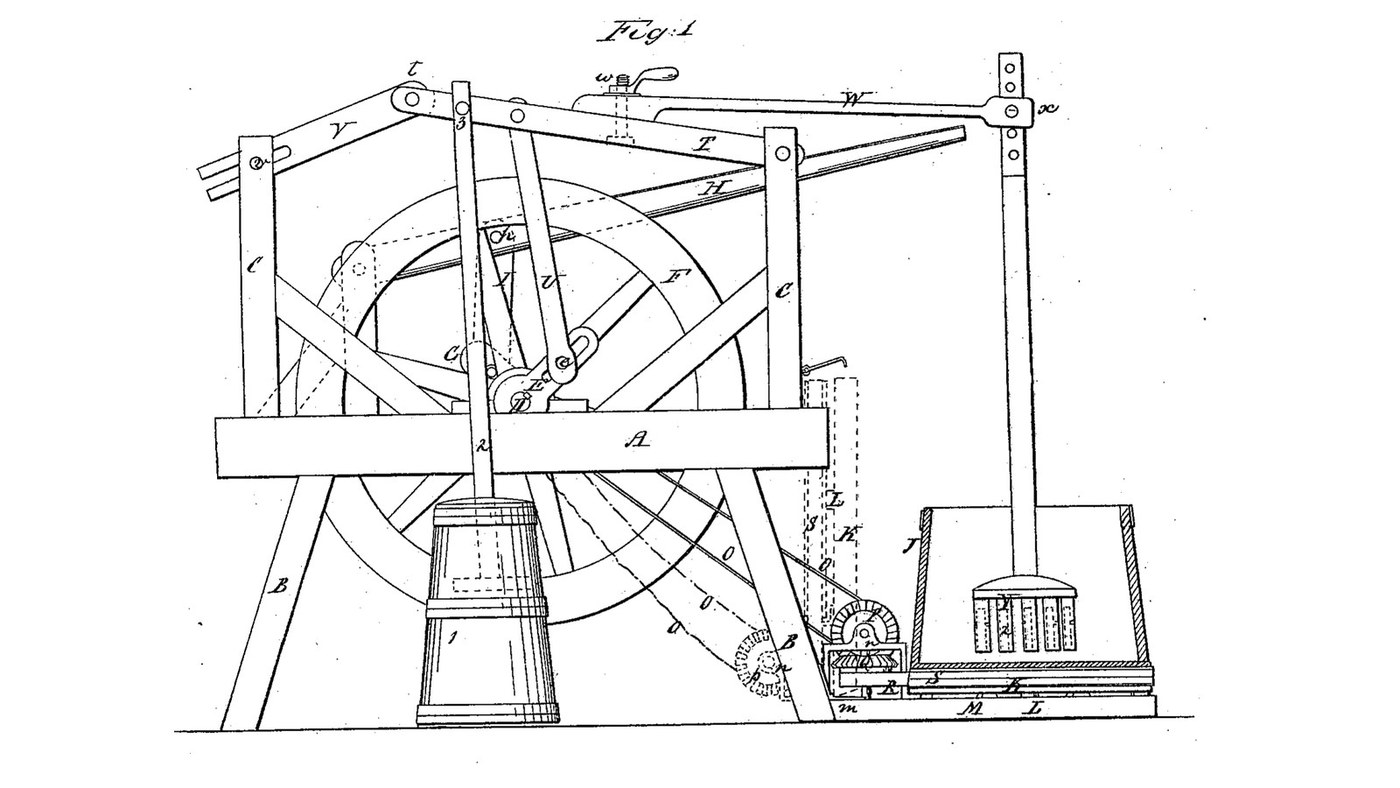


Washing Machine with Churn: One Crank Pounds the Wash, Turns the Tub and Works a Dash Churn (Wagoner & Severson, 1859)
John Wagoner and Abram Severson Jr. of Guilderland Center, New York, received US 25,152, dated 16 August 1859, for a washing machine. A crank shaft with a heavy balance wheel rocks a long lever. A springy beam on the lever carries a pounder into the tub, and a belt and a pair of bevel wheels turn the tub slowly under it. The tub stands on a hinged platform: folded up it slackens the belt, and let down the tub's weight tightens it. A pin on the lever also works the dash of a churn standing beside the machine, with or without the washing.
The patent gives no sizes; every size here is ours.
Hejuru
About 5 days, plus printing
Amabwiriza
1
1
Crank pin, strokes and tub speed
Crank pin, strokes and tub speed
Gupakira ikaye ya Jupyter…
2
2
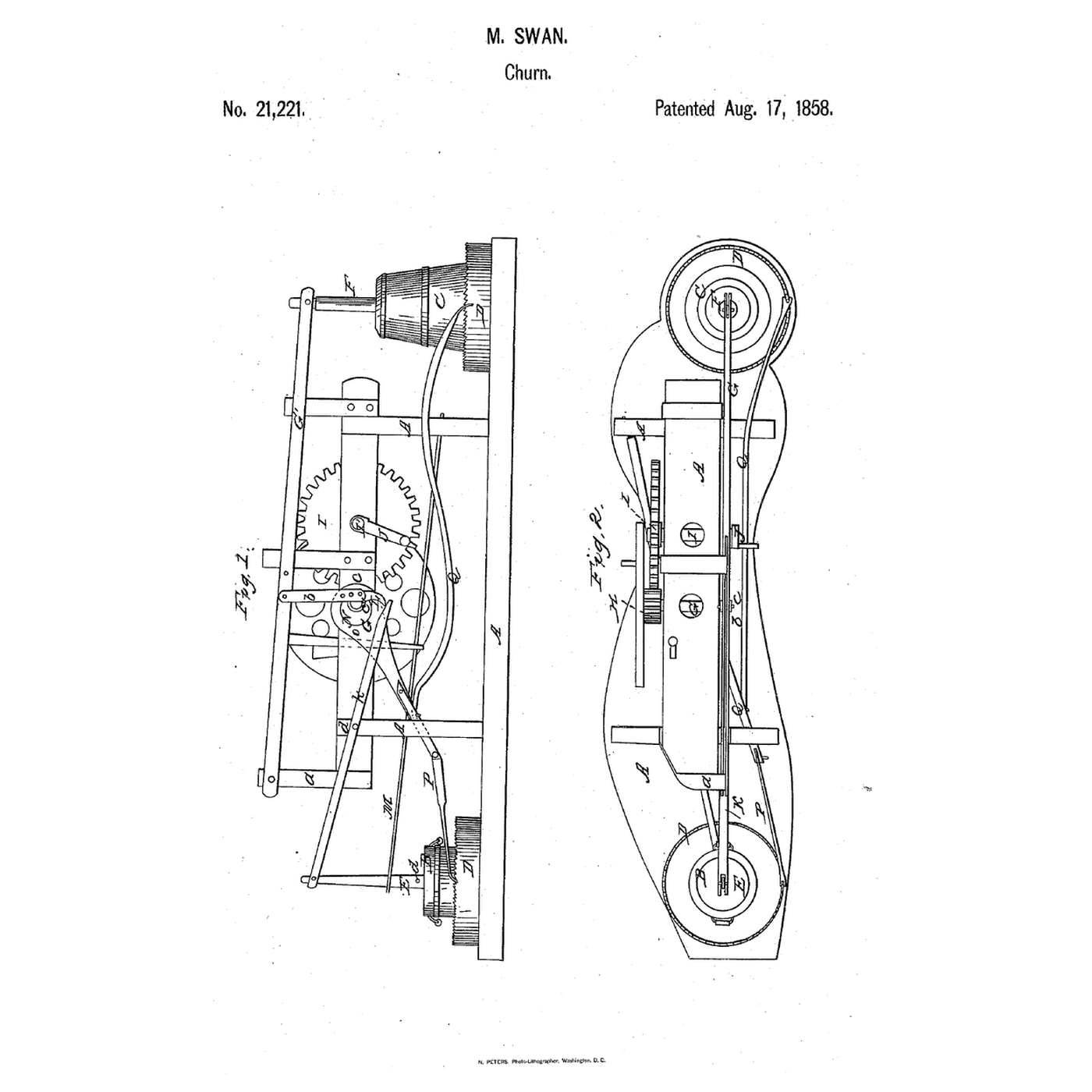
One crank working a churn and a washtub, a year before
One crank working a churn and a washtub, a year before
Swan's machine lifted a plunger by a cam. Here a springy beam carries the pounder, and the tub's own weight tightens the belt that turns it.
3
3
Read US 25,152
Read US 25,152
"In addition to what has now been described our machine is adapted to operate a churn very effectively either alone or simultaneously with the washing operation."
"We place the center of our tube J out of the plane of the motion of the levers T and V. Our pounder therefore inclines to strike on one side of J and not in the center thereby increasing the uniformity of the effect on the contents."
4
4
Print the pulley for shaft D
Print the pulley for shaft D
Flat-faced pulley 120 mm across and 40 mm wide, bored 31 mm for shaft D. PETG, 0.2 mm layers, 40 % infill, 4 walls.
5
5
Print pulley R
Print pulley R
Flat-faced pulley 100 mm across and 40 mm wide, bored 21 mm for the lower bevel wheel's shaft. PETG, 0.2 mm layers, 40 % infill, 4 walls.
6
6
Frame A, legs B and uprights C
Frame A, legs B and uprights C
From 70 x 70 mm timber cut three stringers 1500 mm, two cross pieces 630 mm, four legs 700 mm, an upright 830 mm and an upright 720 mm. Bolt the cross pieces across the tops of the legs and the stringers on the cross pieces, 210 mm apart, so the frame's top is 840 mm from the floor. Bolt the long upright to the outside of the front stringer 100 mm from the left end and the short one 100 mm from the right end. Chisel an opening 50 x 260 mm through the left upright, from 440 to 700 mm above the stringer, and bore it across 560 mm up for pin v (a 16 mm bolt).
Ibikoresho by'iyi ntambwe:
 Ibiti byoroshye bya 70x70 mm11 m
 Bulo ifite umutwe uzengurutse16 ibice
 Uruziga Rurambuye16 ibice
 Ecrou ifunga ifite umuzingo wa nayiloni16 ibice
Ibikoresho bikenewe:
 Umucumita w'Intoki
 Icyuma Cyivumbura Kidafite Insinga
 Ibyuma Byinshi byo Gucukura
 Agasanduku k'ibinyo bipfunyitse
 Icyuma cyo kubaza umwobo w'ihuzo
 Inyundo y'Igiti
 Igipimo cy'inguni ya dogere mirongo cyenda
 Umugozi wo Gupima
 Isupana ihindurwa
 Igifashe cy'inkoni
7
7
Shaft D, balance wheel F and crank E
Shaft D, balance wheel F and crank E
Bolt three bearing blocks on the stringers' tops 650 mm from the left end and pass a 30 mm steel shaft D through them, 710 mm long. Build the balance wheel from three layers of 20 mm hardwood segments glued crossways: 840 mm across, a 100 mm rim and four spokes, 50 mm thick in all. Fit it on D between the front and middle stringers, the printed pulley between the middle and back stringers, and a hand crank 240 mm long on the back end. On the front end fit crank E, a hardwood arm 20 mm thick with a slot from 50 to 125 mm out, and a 20 mm bolt in the slot for the crank pin e.
Ibikoresho by'iyi ntambwe:
 Agati k'icyuma kitagira ingese1 igice
 Igifata-nyunganizi3 ibice
 Ikibaho cy'Igiti Gikomeye3 ibice
 Ikinyabutabire cy'Ibiti1 igice
 Icyegeranyo cy'inyuzi z'impande esheshatu13 ibiceEcrou ifunga ifite umuzingo wa nayiloni13 ibice
 Shaft Collar2 ibice
Ibikoresho bikenewe:
 Umucumita wa Jigsaw
 Ikirangamurongo
 Ikimasa cyo ku mezaIcyuma Cyivumbura Kidafite InsingaAgasanduku k'ibinyo bipfunyitse
 Imashini ibaza inkombeIgifashe cy'inkoni
 Umucumita w'IbyumaIsupana ihindurwa
8
8
Lever T, link U and rod V
Lever T, link U and rod V
Cut lever T from hardwood 40 x 70 mm, 1195 mm long. Bolt it to the front of the right upright, 610 mm above the stringer, free to rock. Join it to the crank pin by link U, hardwood 20 x 40 mm with its pin holes 560 mm apart, 715 mm from T's pivot. At T's left end join rod V, hardwood 30 x 40 mm, slotted 22 mm wide for 220 mm, and pass it through the left upright's opening astride pin v. Fix a steel pin 3, 24 mm and 370 mm long, through T 1015 mm from its pivot, sticking out at the front for the churn.
Ibikoresho by'iyi ntambwe:
Ikibaho cy'Igiti Gikomeye2 ibiceIcyegeranyo cy'inyuzi z'impande esheshatu4 ibiceUruziga Rurambuye8 ibiceEcrou ifunga ifite umuzingo wa nayiloni4 ibiceAgati k'icyuma kitagira ingese1 igiceIbikoresho bikenewe:
Ikimasa cyo ku mezaImashini ibaza inkombeIcyuma Cyivumbura Kidafite InsingaIbyuma Byinshi byo GucukuraAgasanduku k'ibinyo bipfunyitseUmucumita w'Ibyuma Urupapuro rwo GusyaIsupana ihindurwaUmugozi wo Gupima
9
9
Spring beam W and the pounder
Spring beam W and the pounder
Cut the spring beam W from ash 30 x 40 mm, 1210 mm long. Lay it on T's top, its left end against a block glued on T, bolt it through T 415 mm left of the pivot with a wing nut (the hand nut w), and let it run past the upright to overhang the frame by 510 mm. Make rod X from hardwood 40 x 40 mm, 1090 mm long, with four holes at its top for height. Under it glue a hardwood head 200 x 120 mm with five legs 30 x 36 mm, 160 mm long, each slotted (Z) and bored across (z). Hang X from W's end on a bolt so it swings freely, in front of W.
Ibikoresho by'iyi ntambwe:
 Urubaho rw'igiti cya ash1 igiceIkibaho cy'Igiti Gikomeye1 igiceIkinyabutabire cy'Ibiti1 igiceIcyegeranyo cy'inyuzi z'impande esheshatu2 ibice
 Inoti y'amababa1 igiceUruziga Rurambuye4 ibice
Ibikoresho bikenewe:
Ikimasa cyo ku mezaImashini ibaza inkombeIcyuma Cyivumbura Kidafite InsingaIbyuma Byinshi byo GucukuraIcyuma cyo kubaza umwobo w'ihuzoInyundo y'IgitiUrupapuro rwo GusyaIgifashe cy'inkoni10
10
Hinged platform M, bevel wheels and platform K
Hinged platform M, bevel wheels and platform K
Make platform M from 40 mm hardwood, 860 x 860 mm, and hang it on two strap hinges (the butts m) at the feet of the right-hand legs. On M, 100 mm from the hinges, fit a 20 mm vertical shaft in a flange bearing with pulley R and the lower bevel wheel on it. In a hardwood post fit a 20 mm cross shaft with the upper bevel wheel and a 240 mm hardwood pulley P in line with the pulley on D. 480 mm from the hinges, 340 mm towards the front, set a 24 mm shaft L in a hardwood block that slides in a slot along M, with a compression spring pushing it away from R. Glue platform K, 660 mm across and 40 mm thick, bore it for L, and set four 40 mm hardwood wheels l under its edge.
Ibikoresho by'iyi ntambwe:
Ikibaho cy'Igiti Gikomeye4 ibiceIkinyabutabire cy'Ibiti1 igice Ifatanya ry'umurongo w'icyuma2 ibice
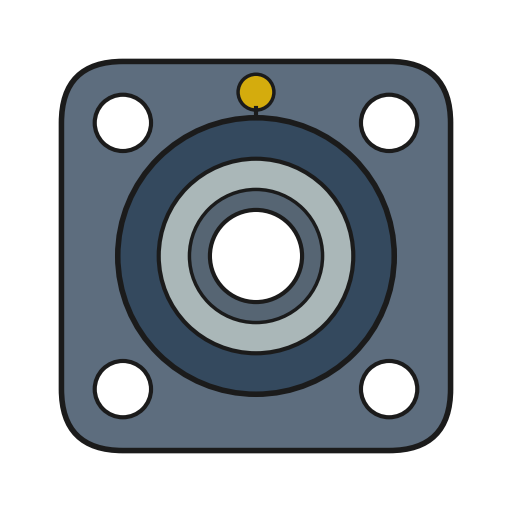 Beringi ifite flanje3 ibice
 Iseti y'amapine y'inkoni (icyuma, 1:1)1 igiceAgati k'icyuma kitagira ingese1 igiceShaft Collar3 ibice
 Ikusanyirizo ry'imisemburo yikanyiza1 igice
 Udukoni tw'ibiti bikomeye1 igice
 Imisumari y'ibiti40 ibiceIcyegeranyo cy'inyuzi z'impande esheshatu4 ibiceEcrou ifunga ifite umuzingo wa nayiloni4 ibice
 Fibere ya PETG1 igice
Ibikoresho bikenewe:
 Imashini icapa 3D ikoresha umugozi (FDM)Umucumita wa JigsawIkirangamurongoImashini ibaza inkombeIcyuma Cyivumbura Kidafite InsingaIbyuma Byinshi byo GucukuraAgasanduku k'ibinyo bipfunyitseUmucumita w'IbyumaIgifashe cy'inkoniIsupana ihindurwa
11
11
Belts O and S, and the fold
Belts O and S, and the fold
Put belt S round pulley R and platform K's rim. Fold M up against the frame, run a string round the pulley on D and pulley P, and choose belt O just short enough that, with M let down and empty, it holds M at a slight angle; "The belt O is sufficiently short to hold the platform M at a slight angle until the weight of J is added thereto." Set the wooden tub J on K: its weight should pull M flat and the belt tight. Oil the wood.
Ibikoresho by'iyi ntambwe:
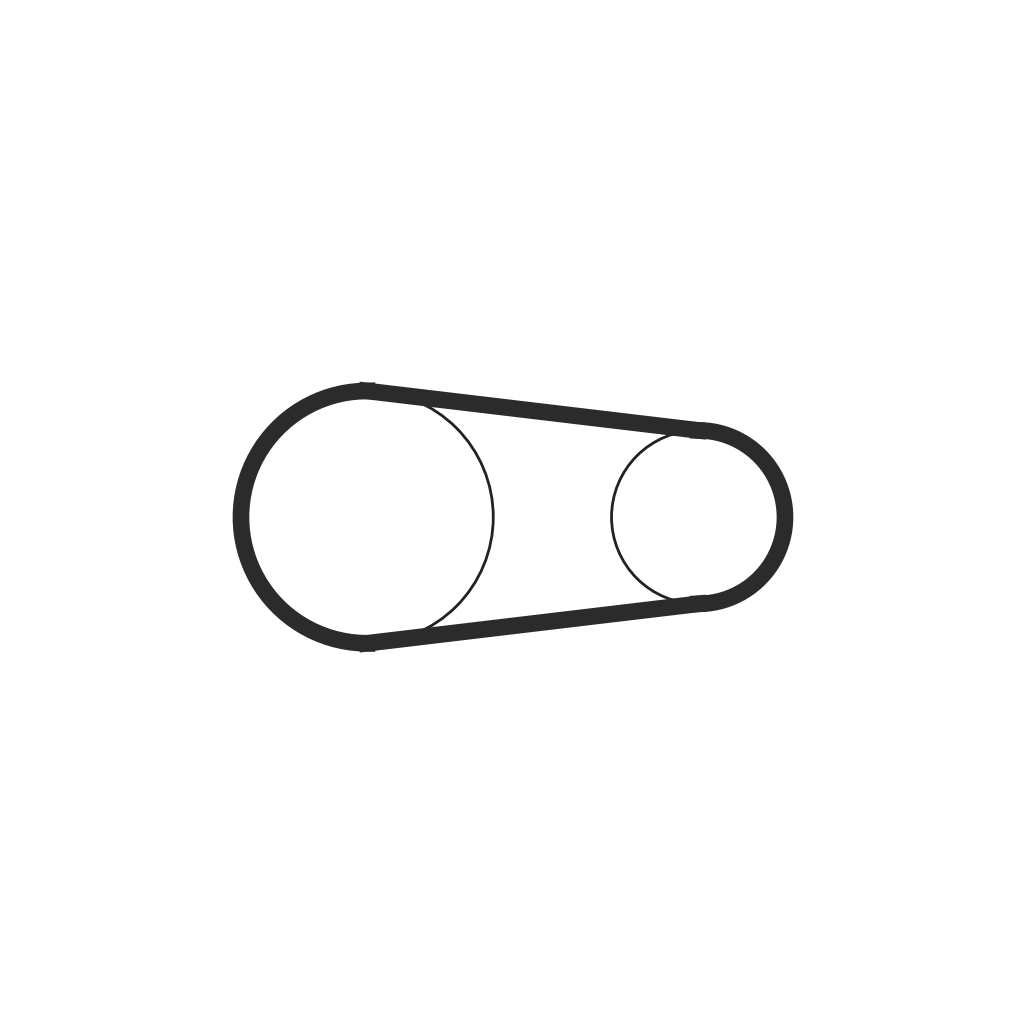 Umukandara utwara2 ibice
 Ikibindi cy'imbaho1 igice
 Amavuta y'Ubudodo Yatetse1 igice
Ibikoresho bikenewe:
Umugozi wo Gupima12
12
The build in 3D
The build in 3D
FreeCAD model of this build: the frame, shaft D with the balance wheel and crank E, lever T with link U and rod V, the spring beam W and the pounder in the tub (front of the tub cut away), the hinged platform M with the bevel wheels, pulleys and belts, and the churn on pin 3. The crank was turned through 18 positions.
13
13
Wash
Wash
Put warm water, soap and the clothes in the tub, and set the pounder's height so its feet clear the tub's bottom by the clothes. Turn the hand crank steadily. The pounder rises and falls on one side of the tub while the tub turns under it, so every part of the wash comes under it in turn. Move the crank pin out in its slot for a longer stroke, in for a shorter one. Lift the clothes out to rinse and wring.
Ibikoresho bikenewe:
 Amazi
 Isabuni y'urubaho
14
14
Churn on pin 3
Churn on pin 3
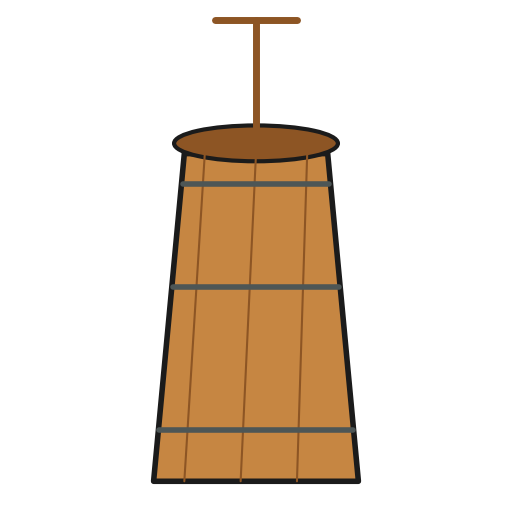
Make the dash 2: a hardwood rod 35 mm across, 1250 mm long, bored at the top to hang on pin 3, with two crossed blades 220 x 30 x 20 mm at the bottom. Stand the churn under pin 3, beside the machine, pour in about 10 litres of cream at about 15 °C (checked with the thermometer), a third of its height, pass the dash through the lid and hang it on pin 3. Turn the crank, with or without the wash, timing it. When the butter comes, lift the dash off the pin, drain the buttermilk, wash the butter in cold water, salt and weigh it.
Ibikoresho by'iyi ntambwe:
 Igice cy'ibinure cy'amata10 l
 Umunyu w'inyanja munini1 igiceIkibaho cy'Igiti Gikomeye1 igiceUdukoni tw'ibiti bikomeye1 igice
Ibikoresho bikenewe:
 Igisabo cyo gucunda amavuta
 Igipima ubushyuhe gifite uruti rusigara mu kintu
 Isaha yo Guhagarika
 Iminzani ya Digitale yo mu Gikoni
 Ibakure rinini ryo kuvanga ry'icyuma kitagira ingeseAmaziIcyuma Cyivumbura Kidafite InsingaAgasanduku k'ibinyo bipfunyitseUmucumita w'Intoki
15
15
Troubleshooting
Troubleshooting
Washing machine troubleshooting.
Flow
Loading...
16
16
History and honest limits
History and honest limits
**John Wagoner and Abram Severson, Jr.** of Guilderland Center, New York, US 25,152, 16 August 1859, "Washing-Machine". They claimed mounting the platform K and the pulleys and gearing P Q R on the hinged platform M, so turning M up slackens belt O and turning it down lets the tub's weight tighten it. The patent gives no sizes; every size here is ours. Their hand lever H and rod I, a second way to turn D, are not built: we turn D by a crank, which the patent allows. The spring that urges K's centre against belt S is "not represented" in their drawing; ours is a compression spring in a slot.
Ibikoresho
24- Umwanya
- 16 ibiceUmwanya
- 28 ibiceUmwanya
- Umwanya
- Umwanya
- 3 ibiceUmwanya
- 4 ibiceUmwanya
- 3 ibiceUmwanya
- Umwanya
- 3 ibiceUmwanya
- 1 igiceUmwanya
- 1 igiceUmwanya
- Umwanya
- 3 ibiceUmwanya
- Umwanya
- Umwanya
- 1 igiceUmwanya
- 40 ibiceUmwanya
- 1 igiceUmwanya
- 2 ibiceUmwanya
- 1 igiceUmwanya
- 1 igiceUmwanya
- Umwanya
- 1 igiceUmwanya
Ibikoresho bikenewe
24- Umwanya
- 1 vendor sell this, none ship to you yetUmwanya
- Umwanya
- Umwanya
- 1 vendor sell this, none ship to you yetUmwanya
- Umwanya
- Umwanya
- 1 vendor sell this, none ship to you yetUmwanya
- Umwanya
- 1 vendor sell this, none ship to you yetUmwanya
- Umwanya
- Umwanya
- Umwanya
- Umwanya
- Umwanya
- Umwanya
- Umwanya
Dosiye z'igishushanyo
3Iki gishushanyo gikora



Blueprint zijyanye
Izi blueprint zisangira ubumenyi — uburyo, ibikoresho cyangwa amahame




CC0 Umurenge rusange
Iyi blueprint yasohowe munsi ya CC0. Ushobora gukoporora, guhindura, gukwirakwiza no gukoresha nta kwemererwa.
Shyigikira Umuremyi ugura ibicuruzwa binyuze muri Blueprint ye Komisiyo y'Umuremyi byashyizweho n'Abacuruzi, cyangwa kora verisiyo nshya y'iyi Blueprint ukayinjiza nk'isano muri Blueprint yawe kugira ngo musangire inyungu.