
The Cooling Tower
A power station's fundamental problem is not making heat but getting rid of it. A thermal plant converts perhaps a third of its fuel energy into electricity and must dump the other two-thirds somewhere, continuously, at a rate of hundreds of megawatts.
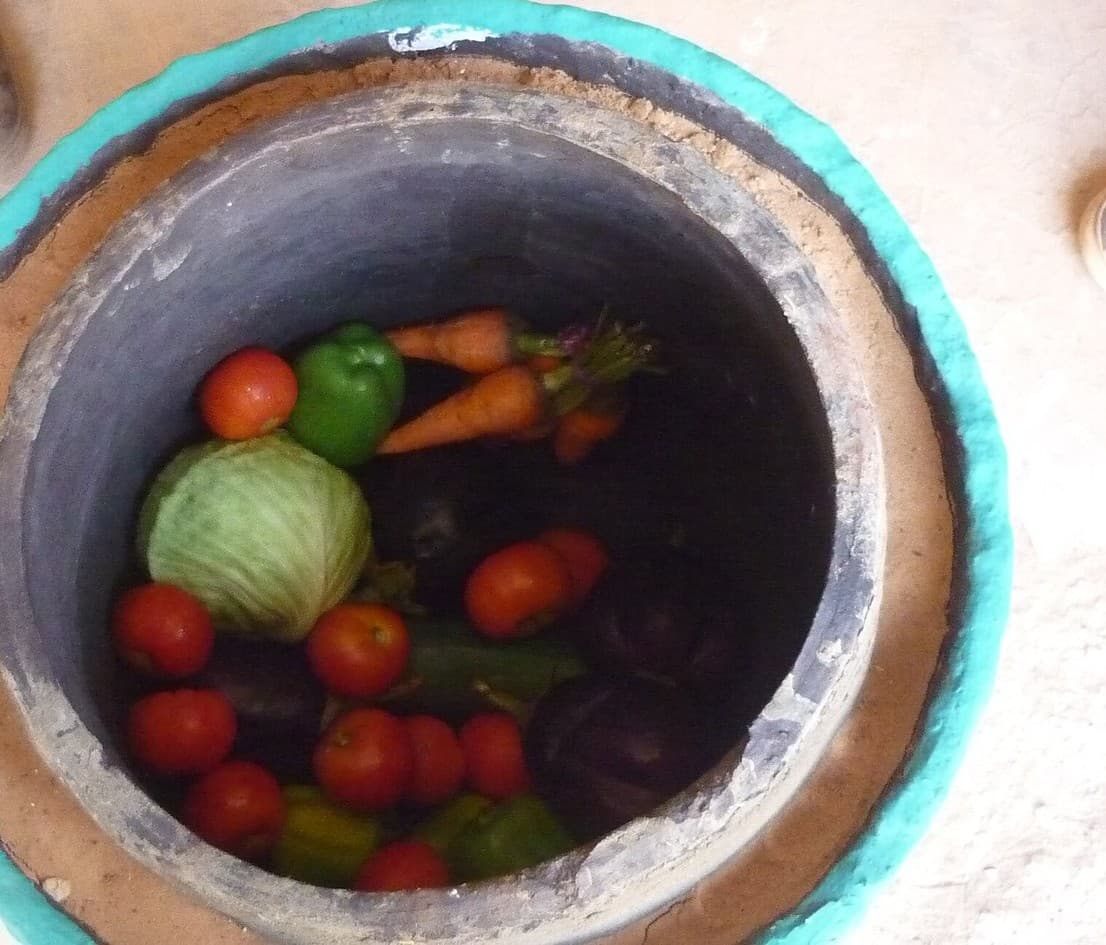
A river can take it — until the river runs low or its fish cannot. So the cooling tower does the job with the atmosphere, using the same mechanism as the zeer pot at a scale five orders of magnitude larger.
Hot water is sprayed over fill — a stack of surfaces that breaks it into films and droplets — while air moves up through it. A small fraction of the water evaporates, and because evaporation costs about 2,260 kJ per kilogram, that small fraction carries away an enormous amount of heat. Roughly 1 % evaporated cools the remainder by about 6 °C.
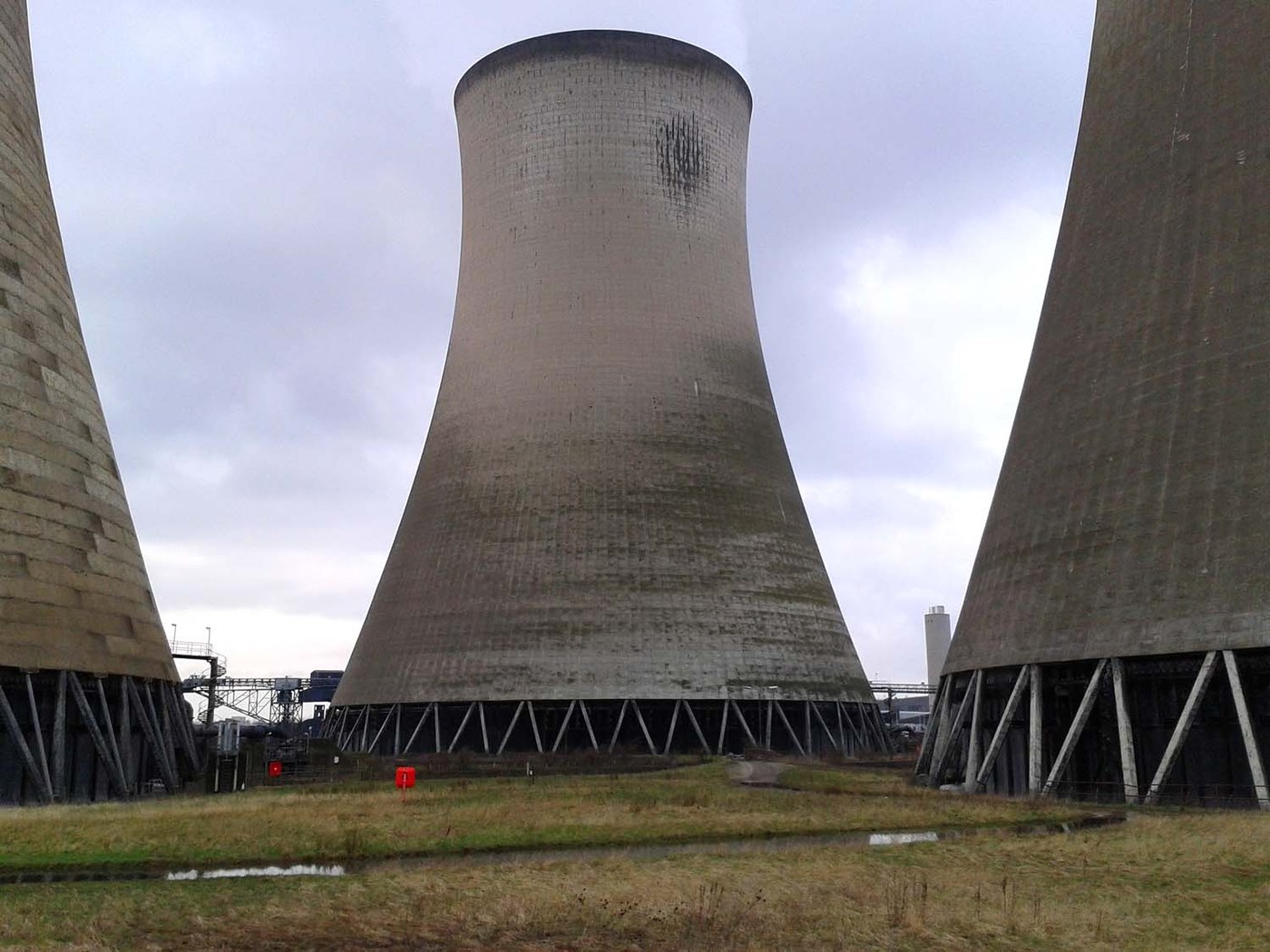
The elegant part is that the tower needs no fan. Its hyperboloid shape is a chimney: warm moist air inside is less dense than the outside air, so the column rises and pulls fresh air in at the base. The curve is structural — a doubly-ruled surface built from straight members, strong and thin — and aerodynamic at once.
The plume is not smoke. It is condensing water vapour, and saying so out loud is half of what this blueprint is for.
التعليمات
Weigh how much heat a little evaporation removes
Weigh how much heat a little evaporation removes
Take a known mass of warm water in an open dish, blow air across it, and measure both the temperature drop and the mass lost.
Compute the heat removed by evaporation from the mass lost, and compare with the heat implied by the temperature drop of what remains.
Expect the two to roughly agree, and expect the fraction evaporated to be startlingly small for the cooling achieved.
Write down the ratio. That single number — about 1 % evaporated per 6 °C — is why every large heat rejection system on Earth is evaporative rather than air-cooled.
المواد لهذه الخطوة:
 ماء1 قطعة
الأدوات المطلوبة:
 ميزان مطبخ رقمي
 ميزان حرارة
Make surface area out of nothing
Make surface area out of nothing
Pour the same warm water through three arrangements at the same flow: a bare tube, a tube packed with gravel, and a stack of corrugated sheets or mesh. Measure the outlet temperature of each.
Expect the arrangements that spread the water into thin films to cool it far more.
Evaporation happens only at a surface, so the design problem is manufacturing surface area cheaply and then holding the water on it for as long as possible.
That is all the 'fill' is — and the same reasoning shapes a radiator's fins, a dialyser's fibres and a scrubber's packing.
المواد لهذه الخطوة:
 حصى1 قطعة
Let the tower pull its own draught
Let the tower pull its own draught
Build a model: a chimney over a tray of warm water, with openings at the base. Test it short, then tall, and with the water hot and lukewarm.
Measure airflow at the base with a streamer.
Expect draught to increase with height and with temperature difference.
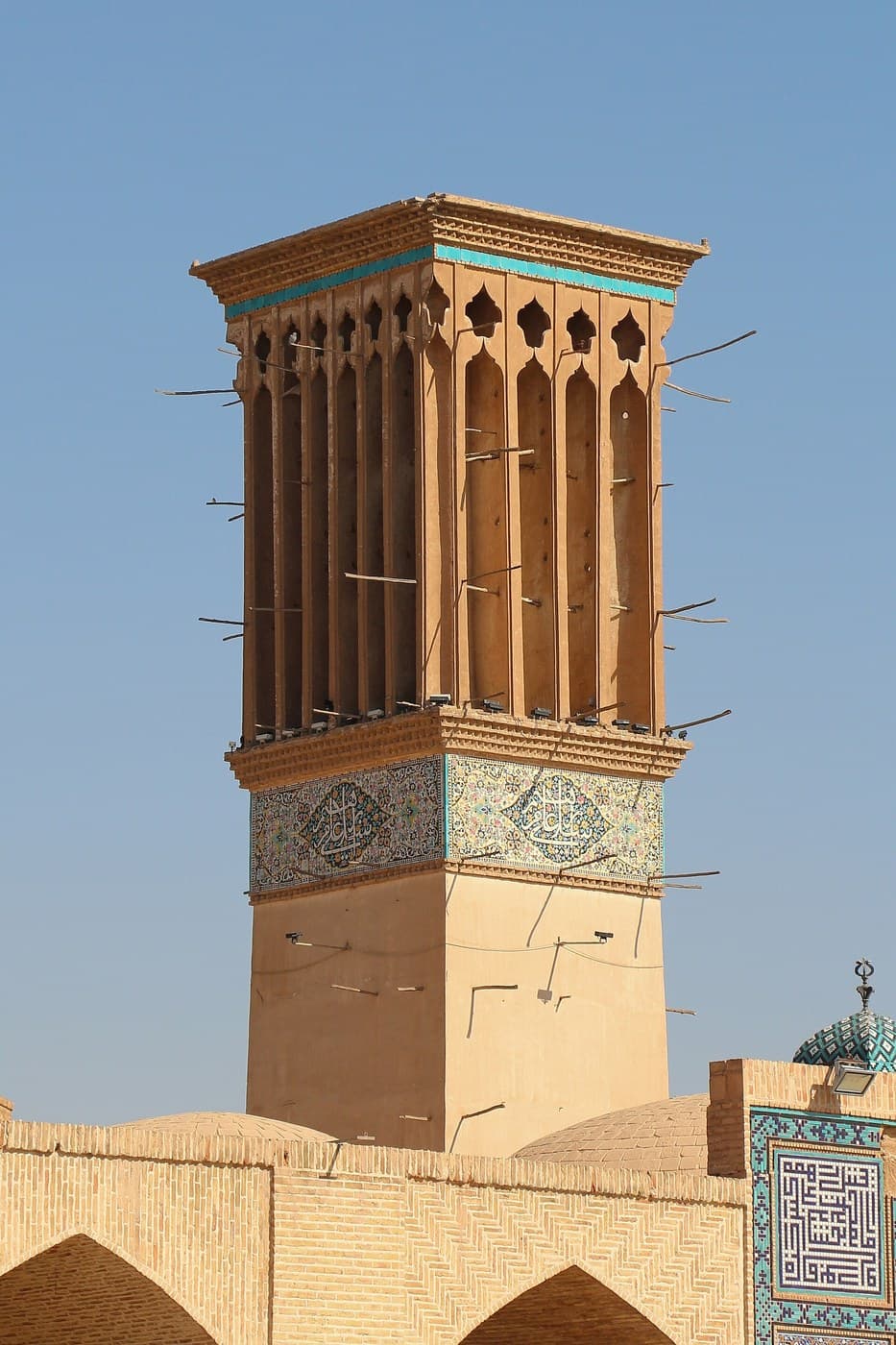
This is the same buoyancy that drives the windcatcher, run in reverse and on purpose.
The tower is 150 metres tall because it is a chimney, not because the equipment inside is large — the equipment sits in the bottom few metres, and everything above is pump.
Find the wall you cannot pass
Find the wall you cannot pass
Measure the wet-bulb temperature of your air, then run the model until the water stops getting colder.
Expect it to approach the wet-bulb temperature and stop, never reaching it.
The gap that remains is the approach, and closing it costs disproportionately more fill, more airflow and more height.
Then repeat on a humid day.
Expect worse performance with no change to the machine.
A cooling tower's output is set by the weather, not by its size — which is why power stations lose capacity in a heatwave, exactly when the electricity is most wanted.
الأدوات المطلوبة:
ميزان حرارةAccount for the water you are losing
Account for the water you are losing
Run the model on a closed loop for a long period, topping up and recording what you add, and taste or measure the conductivity of the circulating water over time.
Expect a continuous water loss and the remaining water to become progressively more concentrated in dissolved solids.
Evaporation removes pure water and leaves everything else behind, so salts accumulate until they scale the fill.
The remedy is blowdown — deliberately discarding some concentrated water and replacing it. An evaporative cooler is not a closed system; it consumes water permanently, and at power-station scale that consumption is the main environmental argument against it.
History & Context
History & Context
The hyperboloid tower is Dutch, and it is a structural idea before it is a thermal one. The reinforced-concrete hyperboloid form was patented by Frederik van Iterson and Gerard Kuypers in 1918, and the first such towers were built at the Dutch State Mines around 1918. The shape is a doubly-ruled surface — every point lies on two straight lines — so a curved, stiff shell can be built from straight formwork and straight reinforcement. It is thin, strong, cheap to form and a good chimney, which is an unusually lucky coincidence of requirements.
The plume is steam, and the confusion is politically consequential. Photographs of nuclear and coal stations almost always show the cooling towers, because that is where the visible white cloud is — condensed water vapour, which evaporates again as it mixes. The actual combustion exhaust leaves from a much less photogenic stack. The most-photographed part of a power station emits water, and a great deal of public argument has been conducted against a picture of a cloud.
The same device sits on ordinary buildings. Any large air-conditioning plant rejects its heat through a cooling tower on the roof, which is where this batch's last blueprint connects: Carrier's machine makes cold inside by moving heat outside, and this is how the outside part is done. Every refrigeration system is a heat PUMP, and the tower is where the heat finally lands.
Its real hazard is biological, not thermal. Warm nutrient-rich water and a fine aerosol are ideal for Legionella, and cooling towers have caused fatal outbreaks. Modern practice — biocide dosing, drift eliminators, inspection regimes and registration of towers — exists because of that history. The engineering risk in this device is microbiological, which almost nobody guesses.
Honest limits. It cannot cool below the wet-bulb temperature, so it fails hardest in hot humid weather. It consumes water continuously, which is a serious constraint where water is scarce. It requires blowdown and water treatment, producing a waste stream. It demands a very large structure and a considerable capital cost. It creates a visible plume that can cause fog and icing nearby. And it needs disciplined maintenance for public-health reasons, not merely for performance.
الأدوات المطلوبة
3- عنصر نائب
- عنصر نائب
- عنصر نائب
مواد المخططات المرتبطة

المخططات ذات الصلة
هذه المخططات تشارك المعرفة مع هذا — التقنيات والمواد والمبادئ

CC0 ملكية عامة
هذا المخطط مُصدر بموجب CC0. يحق لك نسخه وتعديله وتوزيعه واستخدامه لأي غرض، دون طلب إذن.
ادعم الصانع بشراء منتجات عبر مخططه حيث يكسب عمولة الصانع يحددها البائعون، أو أنشئ نسخة جديدة من هذا المخطط وضمّنه كرابط في مخططك لمشاركة الإيرادات.