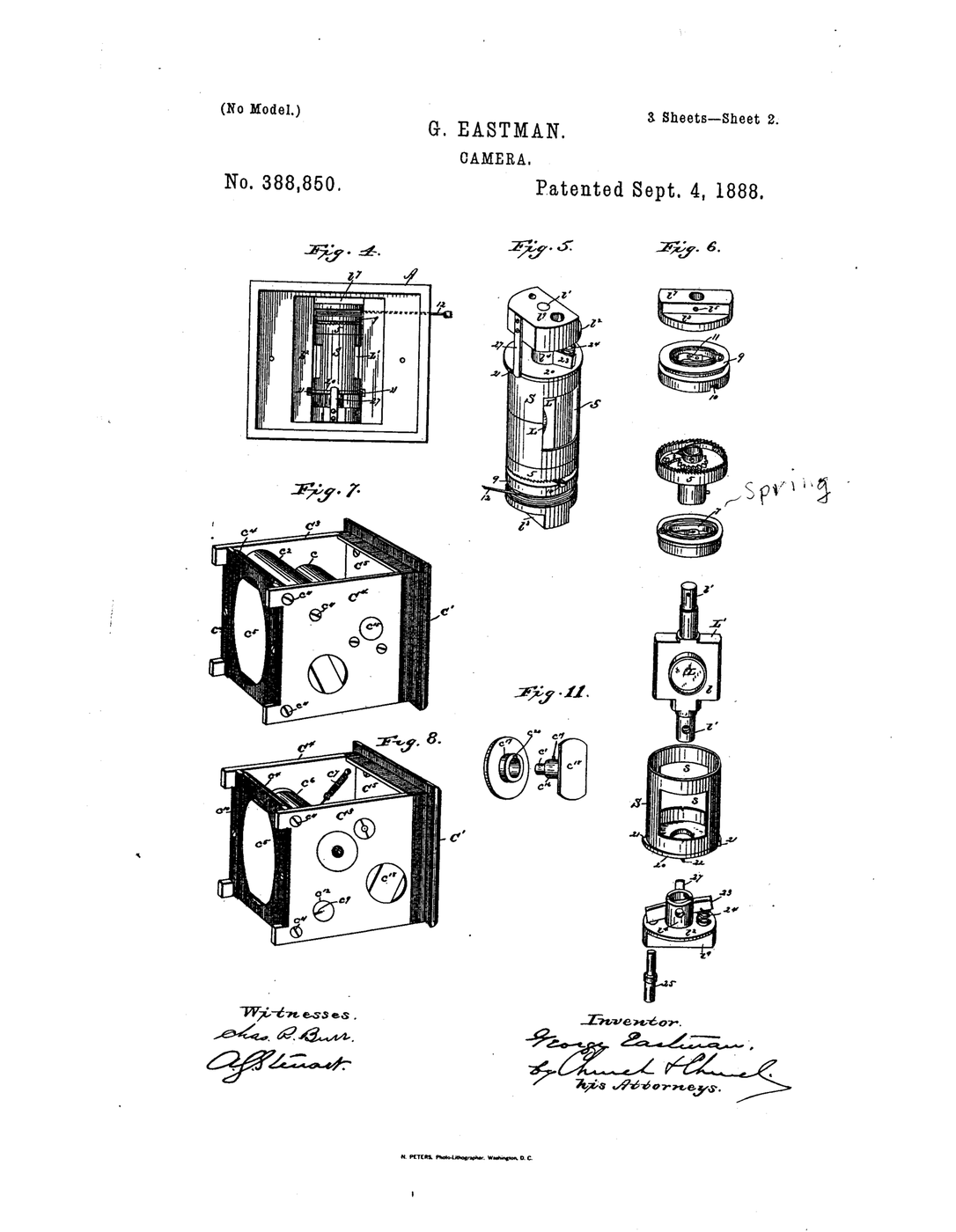


Eastman Kodak Camera
Photography in 1880 meant coating a glass plate with wet collodion, exposing it while still wet, and developing it immediately — so the darkroom had to travel with the camera. Photographers carried tents, chemicals and crates of glass. It was a craft with a laboratory attached.
George Eastman's camera removes the laboratory from the user entirely. A long roll of flexible film inside a fixed-focus box, no plates, no chemistry, no focusing and one control. When the roll is finished the whole camera is posted back to Rochester, where the film is developed, prints are returned and the camera comes back reloaded.
The patent is titled simply "Camera" — US Patent 388,850, granted 4 September 1888. The slogan was "You press the button, we do the rest", and that sentence is a business model, not an advertisement.
التعليمات
Read US 388,850 and note what it is titled
Read US 388,850 and note what it is titled
It is called simply "Camera". The claims cover the shutter and lens support and the film-handling mechanism — the roll film chemistry is separate work.
List everything a wet-plate photographer carried
List everything a wet-plate photographer carried
Write it out: plates, collodion, silver bath, developer, fixer, water, a dark tent. That inventory is the problem being solved, and it is not an optical one.
Build a light-tight box
Build a light-tight box
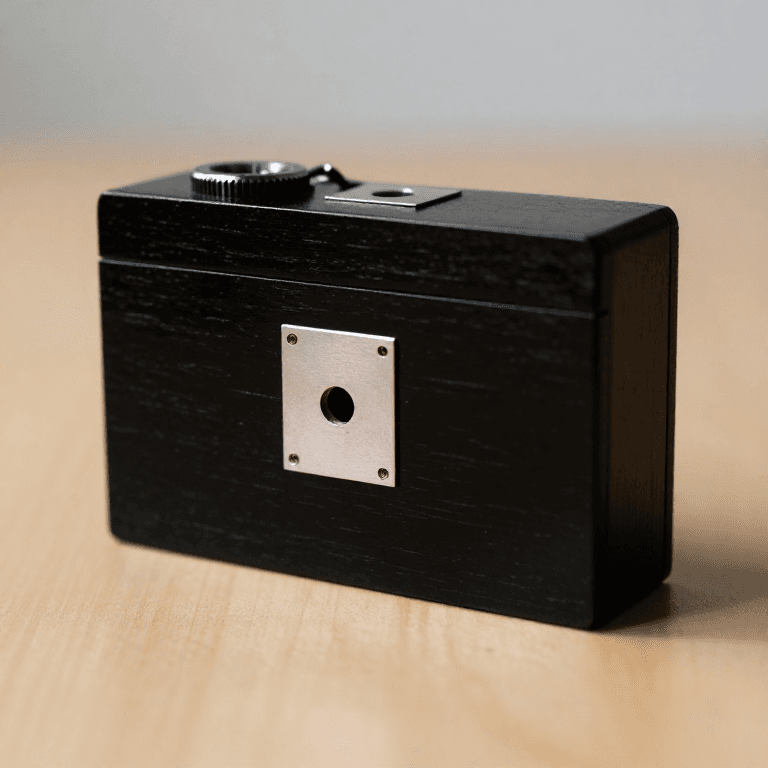
Make a simple wooden box with a lens aperture at one end and a film plane at the other. Every joint must be light-tight; test it in sunlight with film-free paper inside.
المواد لهذه الخطوة:
 خشب رقائقي من البتولا البلطيقي1 ورقة
الأدوات المطلوبة:
 منشار يدوي
Fix the focus instead of adjusting it
Fix the focus instead of adjusting it
Set the lens at the hyperfocal distance and glue it there. With a small aperture, everything from a couple of metres to infinity is acceptably sharp — and there is nothing for the user to get wrong.
الأدوات المطلوبة:
 مسطرة
مسطرةUnderstand why a small aperture is the enabling choice
Understand why a small aperture is the enabling choice
Depth of field grows as the aperture shrinks. A small stop buys you a camera with no focusing control at the price of needing brighter light and faster film.
Build a single-speed rotary shutter
Build a single-speed rotary shutter
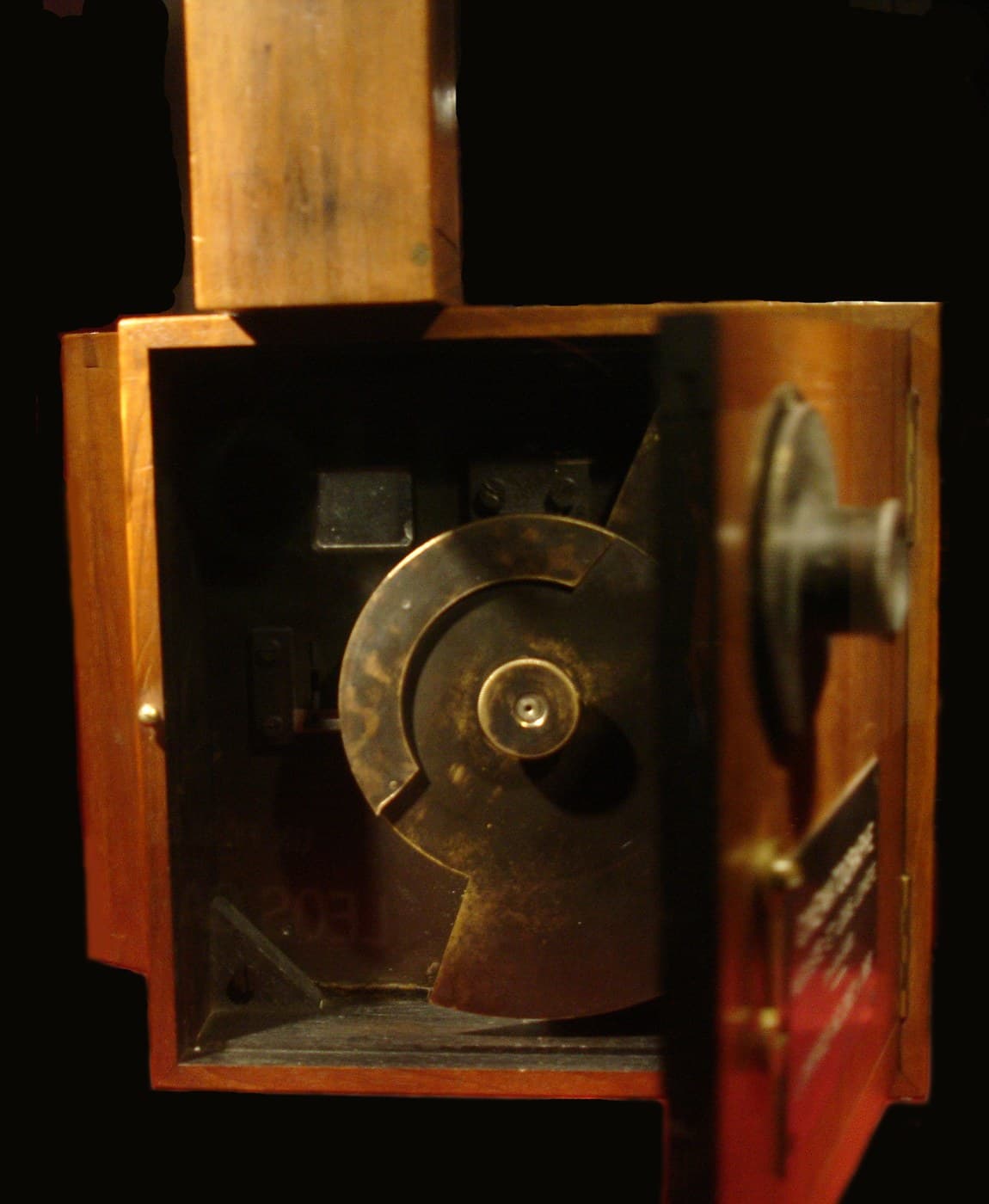
Make a spring-driven disc with a slot that sweeps past the aperture once. One speed, one control — no exposure decisions are delegated to the customer.
المواد لهذه الخطوة:
 لوح نحاس أصفر 260 مقاس 241 ورقة
 طقم نوابض ضغط1 قطعة
Fit spools for a long roll and a winding key
Fit spools for a long roll and a winding key
Mount a supply spool and a take-up spool with a key. The original held a hundred exposures — enough that reloading is somebody else's job.
Add a frame counter and a wind stop
Add a frame counter and a wind stop
Fit a mechanism that advances one frame and stops. Without it users double-expose, and a double exposure is a complaint the company must answer.
Interlock the wind against the shutter
Interlock the wind against the shutter
Make it impossible to fire twice without winding. Design out the error rather than instructing against it — that principle is the whole product philosophy.
Coat a test strip with gelatin emulsion
Coat a test strip with gelatin emulsion
Prepare a silver halide gelatin emulsion on a flexible base. Gelatin dry plates, unlike wet collodion, can be coated in advance and stored — that is what makes roll film possible at all.
المواد لهذه الخطوة:
 مسحوق جيلاتين50 غ
Work out why flexibility matters more than image quality
Work out why flexibility matters more than image quality
Glass gives a better negative and cannot be rolled. Roll film is optically worse and enables a hundred exposures in a pocket — the worse technology wins on system grounds.
Shoot a roll with no adjustments at all
Shoot a roll with no adjustments at all
Point and press, a dozen times, in daylight. No focus, no aperture, no speed. Note how many decisions have been removed from you.
Develop the strip and inspect the failures
Develop the strip and inspect the failures
Process it and look at what went wrong: motion blur, subjects too close, dim interiors. Those are the residual limits of a one-control camera, and they are predictable.
Count the steps the customer never performs
Count the steps the customer never performs
Tally what Rochester did instead: develop, print, reload, return. The camera is one component of a service, and the service is the actual invention.
Compendium — removing decisions, not adding features
Compendium — removing decisions, not adding features
The patent. US 388,850, "Camera", granted 4 September 1888 to George Eastman of Rochester, New York. The Kodak sold that year for 25 dollars loaded with a roll of a hundred exposures. When the roll was finished the entire camera went back to Rochester; ten dollars bought developing, printing and a reloaded camera returned. Eastman coined the name Kodak himself, wanting a short, strong word that meant nothing in any language and could not be mispronounced.
The chemistry came first and is the real foundation. Wet collodion plates had to be coated, exposed and developed within about fifteen minutes, so a darkroom travelled with the camera. Richard Leach Maddox's gelatin dry plate of 1871 broke that constraint: a gelatin silver halide emulsion could be coated, dried, stored and developed later. Eastman began by manufacturing dry plates in 1880, then put the emulsion on flexible roll material. Without the dry emulsion there is no roll film, and without roll film there is no snapshot.
Every design choice removes a decision. Fixed focus at the hyperfocal distance with a small aperture means nothing to focus. A single shutter speed means nothing to set. A hundred-exposure roll means nothing to reload. An interlock between wind and shutter means double exposure is impossible rather than merely discouraged. Each of these makes the camera optically worse than a contemporary plate camera and makes it usable by someone with no training — and the wind-shutter interlock is a small classic of designing the error out instead of writing a warning about it.
The film was also worse, and that was fine. A glass plate gives a sharper, flatter negative than early roll film, which was thinner, curled and less stable. Roll film won because a hundred exposures fit in a pocket and glass does not, which is a recurring pattern: the component that is worse in isolation wins because it makes the SYSTEM possible. Kodak went on to dominate photography for a century, and the same company's difficulty in abandoning film for digital a hundred years later is a well-documented sequel to this patent.
المواد
4- عنصر نائب
- عنصر نائب
- 1 قطعةعنصر نائب
- 50 غعنصر نائب
هذا المخطط يصنع

المخططات ذات الصلة
هذه المخططات تشارك المعرفة مع هذا — التقنيات والمواد والمبادئ


CC0 ملكية عامة
هذا المخطط مُصدر بموجب CC0. يحق لك نسخه وتعديله وتوزيعه واستخدامه لأي غرض، دون طلب إذن.
ادعم الصانع بشراء منتجات عبر مخططه حيث يكسب عمولة الصانع يحددها البائعون، أو أنشئ نسخة جديدة من هذا المخطط وضمّنه كرابط في مخططك لمشاركة الإيرادات.