Building a Pole Lathe for Green Wood Turning — Spring-Pole Reciprocating Lathe
التعليمات
Select a Spring Pole
Choose a straight ash or birch sapling approximately 3 to 4 metres long and 40 millimetres in diameter at the base. The pole must flex freely without cracking — ash is the traditional first choice because it bends predictably and springs back with consistent force. Avoid dead or seasoned wood, which is brittle and will snap under repeated flexing. A live-cut sapling retains the moisture that makes the fibres elastic.
المواد لهذه الخطوة:
Ash Wood Log Section1 قطعةFell and Trim the Sapling
Fell and Trim the Sapling
Cut the sapling at the base with an axe. Trim all side branches flush with the trunk using a hatchet, working from base to tip so the blade follows the grain direction. Leave the bark on — it protects the wood fibres and slows drying, which preserves the pole's springiness for months of use.
الأدوات المطلوبة:
Axe
HatchetTest the Pole Flexibility
Test the Pole Flexibility
Rest the thick end of the pole on a support at chest height and press down on the thin tip. The pole should flex at least 300 millimetres and spring back smartly when released. If it stays bent, creaks, or shows longitudinal cracks, discard it and select another. A good spring pole will endure tens of thousands of cycles before needing replacement.
Rive Two Bed Rails from Oak
Split a green oak log lengthwise using wedges and a mallet to produce two rails approximately 1500 millimetres long, 100 millimetres wide, and 75 millimetres thick. Riving (splitting along the grain) produces stronger rails than sawing because the split follows the natural fibre direction without severing fibres. Oak is chosen for the bed because it resists wear from the sliding poppets and holds peg holes without crumbling.
المواد لهذه الخطوة:
Hardwood Logs (Oak, Maple, Beech)1 قطعةالأدوات المطلوبة:
Splitting Axe
Wooden MalletFlatten the Bed Rail Surfaces
Flatten the Bed Rail Surfaces
Clamp each rail and use a drawknife to shave the top face and the inner face (the side facing the other rail) flat and smooth. The poppets must slide along these surfaces without catching. Work with the grain to avoid tearing the fibres. Functional flatness is sufficient — the surface does not need to be polished.
الأدوات المطلوبة:
DrawknifeBore Poppet-Peg Holes Along the Bed Rails
Bore Poppet-Peg Holes Along the Bed Rails
Using a hand auger, bore a row of holes 20 millimetres in diameter along the top face of each bed rail, spaced approximately 75 millimetres apart and centred on the width. These holes accept the locking pegs that hold the poppets at the required spacing for each workpiece length. Bore cleanly through the full thickness so pegs can be driven from above and tapped out from below.
الأدوات المطلوبة:
Earth AugerShape Two Poppets from Oak
Shape Two Poppets from Oak
From two blocks of oak approximately 300 millimetres tall and 100 millimetres square, shape each poppet into a flat-based upright with two downward tenons at the base. The tenons must fit snugly into the bed rail peg holes (20 millimetres diameter). The poppets are the headstock and tailstock of the lathe — they hold the workpiece between them. Keep the top of each poppet at least 50 millimetres wide to provide a solid mounting surface for the centre spike.
المواد لهذه الخطوة:
Hardwood Logs (Oak, Maple, Beech)2 قطعالأدوات المطلوبة:
Axe
Drawknife
Chisel Set
Wooden MalletDrive Centre Spikes into the Poppets
Drive Centre Spikes into the Poppets
Hammer a large iron nail or spike into the exact centre of each poppet top, leaving approximately 25 millimetres of point protruding. These centre points engage the ends of the workpiece and define the axis of rotation. The points must be precisely centred — any offset causes the workpiece to wobble and the turning to be uneven. File the spike tips to a clean conical point if they are not already sharp.
المواد لهذه الخطوة:
Nails2 قطعالأدوات المطلوبة:
Wooden Mallet
Metal FilePrepare Four Frame Legs
Prepare Four Frame Legs
Hew four legs from green oak or ash, each approximately 750 millimetres long and 75 millimetres square. These support the bed rails at working height. The bed should sit at approximately 800 to 900 millimetres from the ground — roughly waist height for a standing operator. Splay the legs outward by 5 to 10 degrees for lateral stability so the frame does not tip during vigorous turning.
المواد لهذه الخطوة:
Hardwood Logs (Oak, Maple, Beech)4 قطعالأدوات المطلوبة:
Axe
DrawknifeCut Mortises in the Leg Tops
Cut Mortises in the Leg Tops
At the top of each leg, cut a rectangular mortise approximately 100 millimetres long, 75 millimetres wide, and 50 millimetres deep to receive the end of a bed rail. Use a chisel and mallet to chop the mortise, clearing waste with the chisel bevel-down. First bore out most of the waste with an auger, then clean the walls with a chisel for a tight fit.
الأدوات المطلوبة:
Chisel Set
Wooden Mallet
Earth AugerAssemble Bed Rails onto the Legs
Assemble Bed Rails onto the Legs
Insert each bed rail end into its leg mortise. The two rails should be parallel, spaced approximately 130 millimetres apart — wide enough for the poppet bases to sit between them with their tenons dropping into the peg holes. Drive hardwood wedges through the joints from the outside to lock the rails permanently. Sight along the rails to confirm they are parallel and level.
المواد لهذه الخطوة:
Wooden Felling Wedge8 قطعالأدوات المطلوبة:
Wooden MalletAdd Stretcher Rails Between the Legs
Add Stretcher Rails Between the Legs
Connect each pair of legs (front pair and rear pair) with a horizontal stretcher rail mortised into the legs at approximately 200 millimetres from the ground. The stretchers prevent the frame from racking sideways under the repeated lateral forces of turning. Use the same mortise-and-wedge construction as the bed rail joints.
المواد لهذه الخطوة:
Ash Wood Log Section2 قطعالأدوات المطلوبة:
Chisel Set
Wooden Mallet
Earth AugerShape the Treadle Board
Shape the Treadle Board
From a plank of ash approximately 600 millimetres long, 100 millimetres wide, and 25 millimetres thick, shape the treadle board. Round the top edges with a drawknife for comfort underfoot. Ash is chosen for the treadle because it withstands repeated impact loading without splitting — the same property that makes it the first choice for tool handles and sports equipment.
المواد لهذه الخطوة:
Ash Board (1x4x24 inches)1 قطعةالأدوات المطلوبة:
Drawknife
Crosscut SawHinge the Treadle to the Frame
Hinge the Treadle to the Frame
Bore a hole through one end of the treadle and a matching hole through the front stretcher rail. Insert a hardwood dowel as a pivot pin. The treadle should swing freely up and down with no binding. Position the pivot so the free end of the treadle hangs directly below the workpiece position — this is where the drive cord attaches.
المواد لهذه الخطوة:
Dowel Rod1 قطعةالأدوات المطلوبة:
Earth AugerPrepare the Drive Cord
Prepare the Drive Cord
Cut approximately 3 metres of strong hemp cord. The cord must grip the workpiece without slipping, yet be flexible enough to wrap tightly around it. Avoid synthetic cord — it stretches under tension and slips on smooth wood. Traditional bodgers used hand-twisted flax or hemp, which grips bark and green wood surfaces naturally through its rough fibre texture.
المواد لهذه الخطوة:
Hemp Cord3 metreالأدوات المطلوبة:
KnifeMount the Spring Pole Overhead
Mount the Spring Pole Overhead
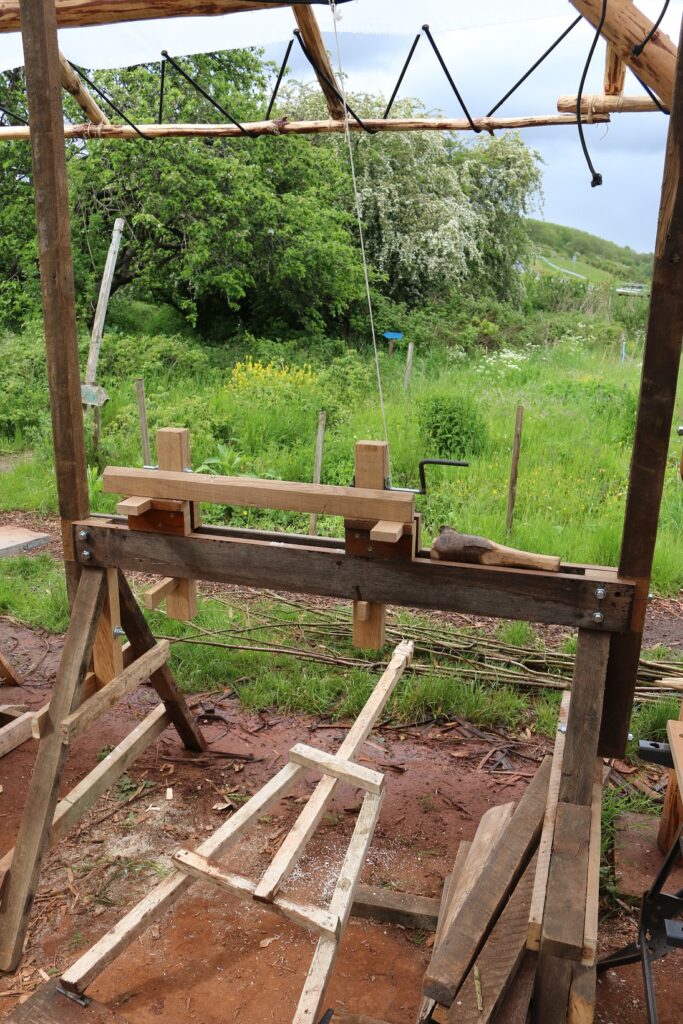
Secure the thick end of the spring pole to a rafter, ceiling beam, or stout overhead timber directly above the lathe. The pole should extend forward so that its thin, flexible tip hangs directly above the workpiece position. Lash the thick end firmly with rope. In woodland workshops, bodgers traditionally lashed the pole to a living tree overhead — any sturdy anchor that allows the pole to flex freely will work.
المواد لهذه الخطوة:
Binding Rope2 metreالأدوات المطلوبة:
Wooden MalletConnect the Drive Cord from Pole to Treadle
Connect the Drive Cord from Pole to Treadle
Tie one end of the hemp cord to the thin tip of the spring pole using a clove hitch secured with two half-hitches. Run the cord straight down, leaving a generous loop of slack in the middle (this slack wraps around the workpiece). Tie the other end to the free end of the treadle through a small hole bored near the tip. The cord should hang vertically when the pole is at rest — any lateral angle wastes energy.
الأدوات المطلوبة:
Earth AugerMount a Test Workpiece Between the Poppets
Mount a Test Workpiece Between the Poppets
Select a green wood blank of ash, birch, or sycamore, approximately 200 millimetres long and 75 millimetres in diameter. Mark the centre of each end with a punch or knife point. Set the poppets in the bed rails so the centre spikes engage both end marks, then lock with pegs driven into the bed rail holes. The blank must spin freely between the points without wobble.
الأدوات المطلوبة:
Wooden Mallet
KnifeWrap the Drive Cord Around the Workpiece
Wrap the Drive Cord Around the Workpiece
Take the slack loop of the drive cord and wrap it once around the workpiece. One full wrap is usually sufficient for green wood — the natural grip of hemp on bark or rough-cut surfaces provides enough friction. If the cord slips, add a second wrap. The wrapping direction matters: when you press the treadle down, the workpiece must spin toward you so that cutting happens on the downstroke.
Adjust the Spring Pole Tension
Press the treadle down with your foot. The cord should spin the workpiece toward you. When you release, the spring pole should pull the cord back, spinning the workpiece in reverse and lifting the treadle to its rest position. If the return is sluggish, move the cord attachment point closer to the flexible tip of the pole. If too violent, move it toward the stiffer base section.
Test-Turn with a Gouge
Hold a turning gouge firmly with both hands. Press the treadle to spin the workpiece toward you and apply the gouge edge to the wood on the downstroke only — lift the tool clear on the return stroke, as cutting against the reverse rotation would dig in and wreck the workpiece. In green wood, long curling shavings should peel away cleanly. The reciprocating action becomes rhythmic with practice: press, cut, release, pause, repeat.
الأدوات المطلوبة:
Gougeالمواد
8- 1 sapling 3-4m + 1 log for stretchers قطعةعنصر نائب
- 2-3 logs for rails, poppets, legs قطعةعنصر نائب
- 2-3 wedges قطعةعنصر نائب
- 1 plank for treadle قطعةعنصر نائب
- 2-3 metres for pole mounting قطعةعنصر نائب
الأدوات المطلوبة
11- عنصر نائب
- عنصر نائب
- عنصر نائب
- عنصر نائب
- عنصر نائب
- عنصر نائب
CC0 ملكية عامة
هذا المخطط مُصدر بموجب CC0. يحق لك نسخه وتعديله وتوزيعه واستخدامه لأي غرض، دون طلب إذن.
ادعم الصانع بشراء منتجات عبر مخططه حيث يكسب عمولة الصانع يحددها البائعون، أو أنشئ نسخة جديدة من هذا المخطط وضمّنه كرابط في مخططك لمشاركة الإيرادات.