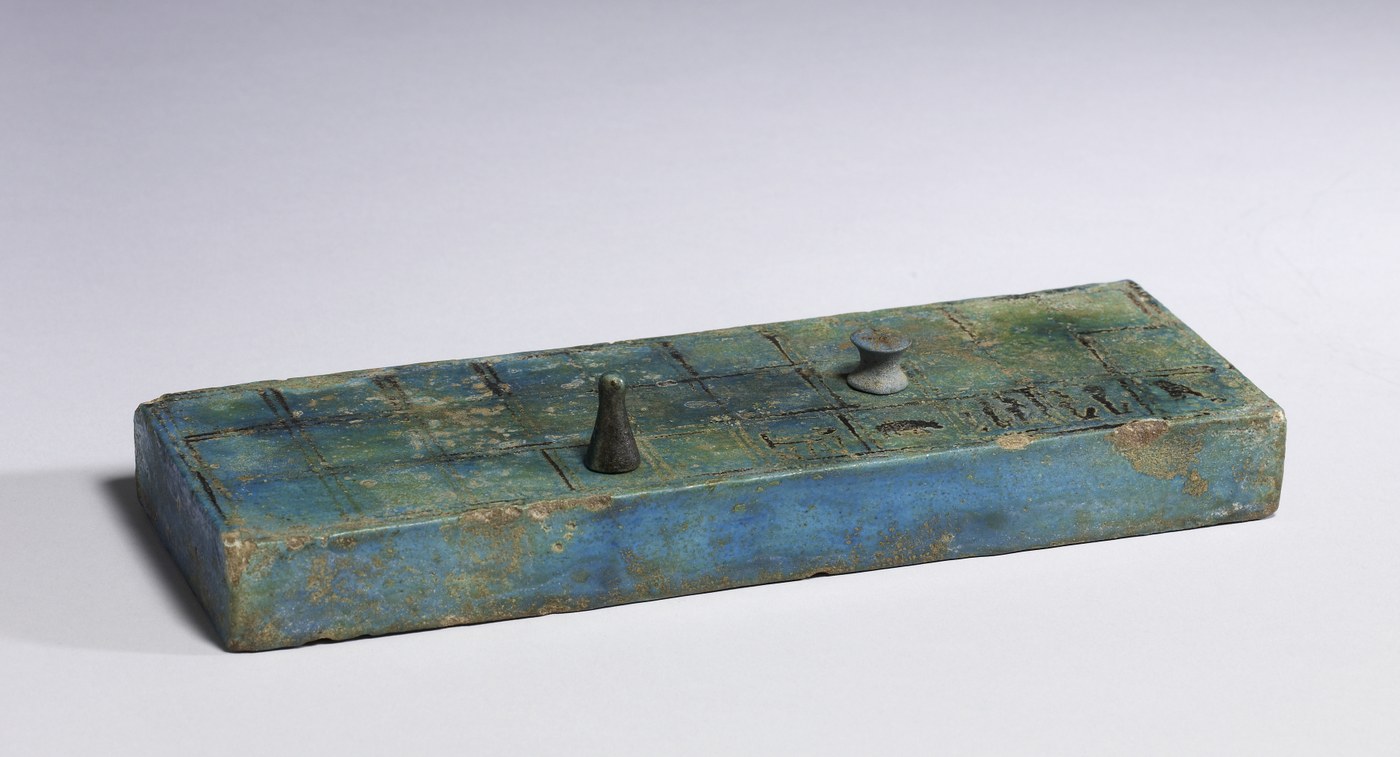


Senet Board
Senet is one of the oldest board games we have physical evidence for. Egyptians played it for something like two thousand years, and boards turn up everywhere from workmen's villages to royal tombs — Tutankhamun was buried with four of them. The board is always the same: thirty squares in three rows of ten, played in a boustrophedon path that runs down one row and back along the next, like an ox ploughing a field.
Over its long life the game acquired a second meaning. The last few squares carry names — the House of Beauty, the House of Water, the House of the Three Truths — and late in Egyptian history senet came to represent the soul's journey through the underworld, with the board itself appearing in funerary art. A game became a map of the afterlife.
This blueprint builds the board, the throw sticks and the pawns. What it will not do is tell you the rules with confidence — see the final step, because that honesty is part of the object.
التعليمات
Cut the board blank
Cut the board blank
Cut a hardwood board to 330 x 120 x 20 mm. That gives thirty 30 mm squares in a 3 x 10 grid with a 15 mm margin all round.
المواد لهذه الخطوة:
 Black Walnut Board1 قطعة
الأدوات المطلوبة:
 Hand Saw
Plane and sand the playing face
Plane and sand the playing face
Plane the top face flat and sand through 120 then 220 grit. Carve the grid into a surface that is already finished — sanding afterwards rounds over your crisp edges.
المواد لهذه الخطوة:
 Sandpaper (120 Grit)1 ورقةSandpaper (220 Grit)1 ورقة
Mark the 3 x 10 grid
Mark the 3 x 10 grid
Mark out three rows of ten 30 mm squares with the marking gauge and a square. Thirty squares exactly — the number is fixed across the whole two-thousand-year history of the game.
الأدوات المطلوبة:
 Marking Gauge
Carve the grid lines
Carve the grid lines
Cut each grid line 2 mm deep with a V-gouge, working with the grain where possible. Cut every line in the same direction for a consistent look.
الأدوات المطلوبة:
 Gouge
Gouge Carving Mallet
Mark the path direction
Mark the path direction
Carve a small arrow at each end of the three rows showing the boustrophedon path — along row one, back along row two, along row three. The path reverses each row; without the arrows a new player will read it as three parallel lanes.
الأدوات المطلوبة:
GougeCarve the marked squares
Carve the marked squares
Carve symbols into the five special squares near the end of the path — squares 26 to 30 in play order. These are the named houses that every surviving decorated board marks in some form.
الأدوات المطلوبة:
GougeMake the four throw sticks
Make the four throw sticks
Split four sticks 120 x 12 x 5 mm, each rounded on one face and flat on the other. Sand them smooth. Four sticks with two distinguishable faces is the Egyptian randomiser — dice as we know them came much later.
المواد لهذه الخطوة:
 Hardwood Dowel Rods 1/4"1 عبوة
Darken one face of each stick
Darken one face of each stick
Darken the rounded face of each stick so the two sides read instantly from across a table. A throw is scored by counting how many light faces land up.
Turn ten pawns
Turn ten pawns
Make ten pawns 25 mm tall — five of one shape, five of another, one set light and one dark. Five per player is the common configuration, though surviving sets vary between five and seven.
المواد لهذه الخطوة:
Hardwood Dowel Rods 1/4"1 عبوةOil the board and pieces
Oil the board and pieces
Wipe on boiled linseed oil, leave 20 minutes, wipe off the surplus. Two coats. Oil sinks into the carved lines and makes the grid read darker than the field.
المواد لهذه الخطوة:
 Linseed Oil (Boiled)50 مل
Play a game with a written rule sheet
Play a game with a written rule sheet
Pick one published reconstruction, write its rules on a card, and keep the card with the board. Because the rules are reconstructed rather than known, a set without a stated rule sheet will be played differently every time it comes out of the box.
History & Context
History & Context
We have the board. We do not have the rules. This is the honest and important part. No Egyptian text sets out how to play senet. The rule sets circulating today — including the ones in most museum shops — are 20th-century reconstructions, principally by Timothy Kendall (1978) and Peter Piccione (1980), with an earlier attempt by R. C. Bell. They are built by inference from scattered depictions and textual fragments spanning more than a thousand years, over which the game itself almost certainly changed. Anyone who tells you "the rules of senet" without that caveat is overselling.
What we do know. The board is thirty squares in three rows of ten. Movement was decided by throwing sticks or knucklebones, not dice, with the score read from how many faces landed one way up. Two players moved a set of pawns — five to seven each — along a path that reverses direction each row. The final squares carry names: the House of Beauty, the House of Water, the House of the Three Truths. The House of Water was evidently bad to land on.
From pastime to funerary text. Senet is attested from the Predynastic and Early Dynastic periods and stayed in play for roughly two millennia. Over that span it acquired religious weight: by the New Kingdom the journey across the board was read as the soul's passage through the underworld, and scenes of the deceased playing senet against an unseen opponent appear in tomb painting and in the Book of the Dead. Four boards were buried with Tutankhamun. A game had become equipment for the afterlife.
Boustrophedon. The back-and-forth path is named from the Greek for "as the ox turns in ploughing", and the same pattern appears in early Greek inscriptions, where lines of text alternate direction. It is an efficient way to fill a rectangle without lifting and returning, whether you are ploughing, writing, or moving a pawn.
Why reconstruct at all. An unplayable board is an object; a played board is a practice. Reconstruction is a legitimate scholarly exercise as long as it is labelled — which is why the rule card in step 11 matters. Write down which reconstruction you are using, and you are being straight about what is known and what is inferred.
المواد
5- 1 قطعةعنصر نائب
- 1 ورقةعنصر نائب
- 1 ورقةعنصر نائب
- 1 عبوةعنصر نائب
- 50 ملعنصر نائب
CC0 ملكية عامة
هذا المخطط مُصدر بموجب CC0. يحق لك نسخه وتعديله وتوزيعه واستخدامه لأي غرض، دون طلب إذن.
ادعم الصانع بشراء منتجات عبر مخططه حيث يكسب عمولة الصانع يحددها البائعون، أو أنشئ نسخة جديدة من هذا المخطط وضمّنه كرابط في مخططك لمشاركة الإيرادات.