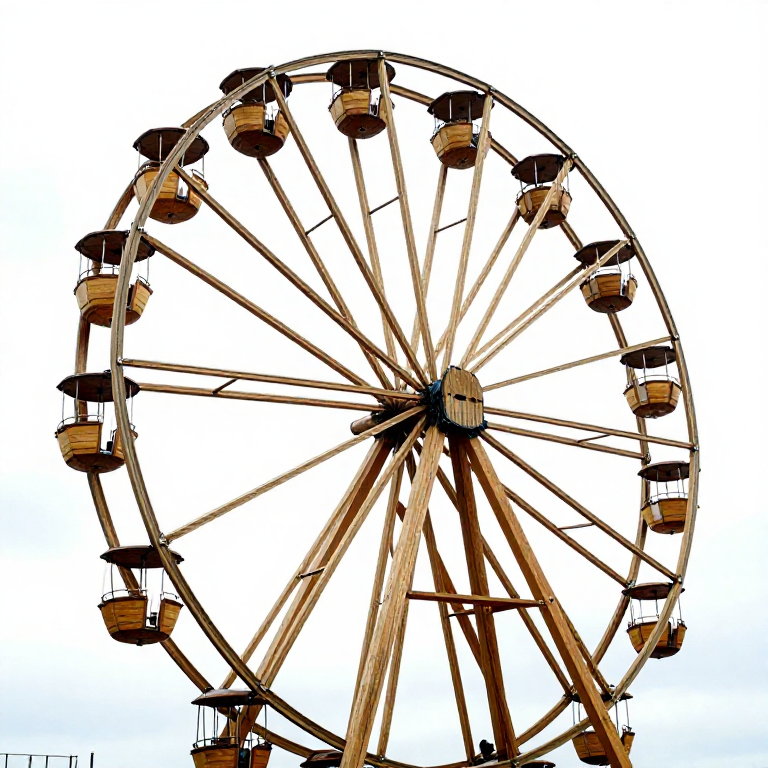


Somers Roundabout
A vertical wheel carrying people has one requirement above all others: the seats must stay level while everything around them turns upside down. Bolt a bench to a rotating rim and it will tip its passengers out at the top.
The answer is to hang the carriages, not fix them. Each car swings from a pivot on the rim, so gravity keeps it upright at every angle without any mechanism, control or adjustment. The wheel rotates; the seats simply hang.
William Somers built his in timber. US Patent 489,238, "Roundabout", granted 3 January 1893, specifies reinforced wooden rims and a pair of driving cables so that if one fails the other keeps the wheel turning. Somers had wheels running at Asbury Park, Atlantic City and Coney Island before Chicago's 1893 Exposition — and he sued George Ferris for infringement.
التعليمات
Build a model, not a ride
Build a model, not a ride
This is a bench model. A passenger-carrying wheel is regulated engineering requiring certified design and inspection — nothing here is a basis for building one.
Read US 489,238 and find the two cables
Read US 489,238 and find the two cables
Somers specifies a pair of parallel driving cables in grooves on the rims, explicitly so that one can fail without stopping the wheel. Designed redundancy, in 1893.
Prove the problem with a fixed seat
Prove the problem with a fixed seat
Glue a little bench rigidly to a disc and turn it. At the top it is inverted. This is why the carriages cannot be fixed.
Cut rim segments and lap the joints
Cut rim segments and lap the joints
Cut curved segments and overlap the joints so no two land in the same place. A wooden wheel is strong only if its joints are staggered.
المواد لهذه الخطوة:
 خشب رقائقي من البتولا البلطيقي1 ورقة
الأدوات المطلوبة:
 منشار يدوي
Build two parallel rims, not one
Build two parallel rims, not one
Make a pair of identical wheels on a common axle. Carriages hang between them, and the pair resists the sideways loads a single rim cannot.
Groove each rim for its driving cable
Groove each rim for its driving cable
Cut a rounded groove around the outer face of each rim. The cable sits in the groove and drives by friction — there are no gear teeth anywhere.
Tension the spokes rather than compressing them
Tension the spokes rather than compressing them
Use radial members in tension where you can. A wheel loaded at the rim carries far more as a tension structure than as a set of compression struts.
Hang each carriage from a free pivot
Hang each carriage from a free pivot
Suspend cars on pins between the rims so they swing. Gravity levels them at every position with no mechanism at all — this is the elegant part.
المواد لهذه الخطوة:
 قضيب فولاذ طري1 قطعة
Hang the pivot ABOVE the centre of mass
Hang the pivot ABOVE the centre of mass
The pivot must sit above the loaded car's centre of gravity or it will hang inverted. Check it loaded, not empty — passengers move the centre.
Space the carriages evenly around the rim
Space the carriages evenly around the rim
Place them at equal intervals. Uneven spacing makes the wheel unbalanced, so it accelerates through part of each turn and drags through the rest.
الأدوات المطلوبة:
 مسطرة
مسطرةFit both cables and check they share the load
Fit both cables and check they share the load
Run two cables at equal tension. If one carries everything, the redundancy is decorative — and that is a dangerous kind of decoration.
المواد لهذه الخطوة:
 سلك فولاذي5 أمتار
Cut one cable deliberately and observe
Cut one cable deliberately and observe
Release one cable while the model turns. The wheel should keep going on the other. Testing the failure case is the only way to know the redundancy is real.
Load one carriage heavily and watch the balance
Load one carriage heavily and watch the balance
Weight a single car and turn the wheel. It now wants to rest with that car at the bottom — which is why real wheels are loaded and unloaded in a set order.
Check the carriages swing but do not oscillate
Check the carriages swing but do not oscillate
Run it and watch for a car that keeps swinging. A pendulum near resonance with the rotation is deeply unpleasant — damp it or change the pivot height.
Compendium — the wheel that came before the Ferris Wheel
Compendium — the wheel that came before the Ferris Wheel
The patent. US 489,238, "Roundabout", granted 3 January 1893 to William Somers of Atlantic City, New Jersey. The specification describes a rotating vertical frame with suspended passenger carriages, driven by a pair of parallel cables running in grooves in the outer rims, and it makes a point of the dual-cable arrangement so that failure of one leaves the other driving. Somers built fifty-foot wooden wheels at Asbury Park, Atlantic City and Coney Island in 1892 — before the Chicago World's Columbian Exposition opened.
The dispute with Ferris. George Washington Gale Ferris Jr. rode Somers' Atlantic City wheel and went on to build the 264-foot steel wheel that was the centrepiece of the 1893 Exposition in Chicago. Somers sued for infringement. Ferris's defence was in essence that his machine was a different thing — a vastly larger steel structure, engineered as a bridge-builder would engineer it, rather than a scaled-up timber ride — and he prevailed. Both claims have some force: the suspended-carriage principle is Somers', while the structural engineering that made a 264-foot wheel possible is genuinely Ferris's. What is not in dispute is the order of events, and it is worth stating that the patent for the ride predates the wheel that gave it its name.
Gravity as the mechanism. Hanging each carriage from a pivot above its loaded centre of mass means the car is a pendulum, and a pendulum's rest position is directly below its pivot regardless of where that pivot has been carried. No linkage, no gearing, no control system, no power. It is one of the cleanest examples in mechanical design of using a physical law instead of a mechanism, and the same reasoning appears in gimballed compasses and ship's lamps. The failure mode is equally instructive: get the pivot BELOW the centre of mass and the stable position inverts.
Timber, and why it was replaced. Somers built in wood because it was cheap, workable and familiar, and he compensated for its weakness with laminated and staggered rim joints and generous section. Wood's problem in this application is not strength but consistency — it changes dimension with moisture, creeps under sustained load, and fails at knots and joints unpredictably. Ferris's steel allowed calculable strength and far larger spans, and every observation wheel since is steel. Somers' contribution survives as the arrangement, not the material.
المواد
3- عنصر نائب
- 1 قطعةعنصر نائب
- 5 أمتارعنصر نائب
المخططات ذات الصلة
هذه المخططات تشارك المعرفة مع هذا — التقنيات والمواد والمبادئ

CC0 ملكية عامة
هذا المخطط مُصدر بموجب CC0. يحق لك نسخه وتعديله وتوزيعه واستخدامه لأي غرض، دون طلب إذن.
ادعم الصانع بشراء منتجات عبر مخططه حيث يكسب عمولة الصانع يحددها البائعون، أو أنشئ نسخة جديدة من هذا المخطط وضمّنه كرابط في مخططك لمشاركة الإيرادات.