فنون
الجمال والعناية
حِرَف
الثقافة والتاريخ
ترفيه
البيئة
الطعام والمشروبات
الهندسة العكسية
العلوم
رياضة
التقنية
الأجهزة القابلة للارتداء
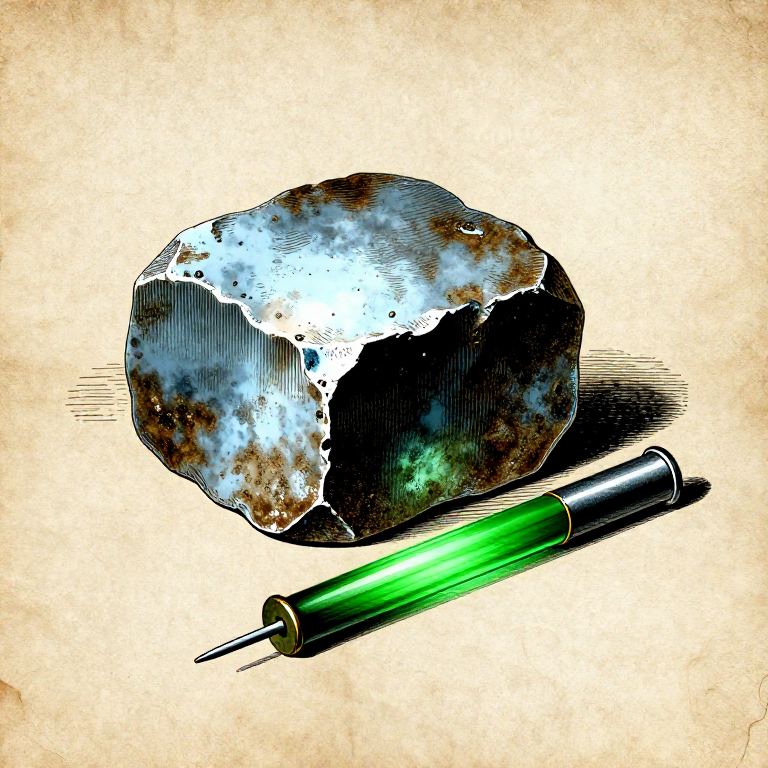
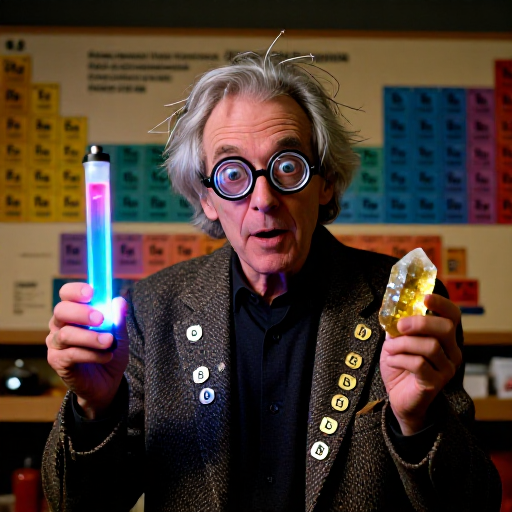
Understanding Thallium from Pyrite Smelting — The Poisoner's Element
متوسط
التعليمات
1
1
Understand Thallium's Discovery
Understand Thallium's Discovery
William Crookes discovered thallium in 1861 using the newly developed technique of flame spectroscopy. While examining selenium residues from a sulfuric acid plant, he observed a brilliant green spectral line at 535 nm that belonged to no known element. He named it thallium from the Greek 'thallos' (green shoot) for this vivid color. Claude-Auguste Lamy independently isolated the metal and exhibited it at the 1862 London International Exhibition.
2
2
Identify Thallium Sources
Identify Thallium Sources
Thallium occurs at 0.85 ppm in Earth's crust — moderately rare. It never forms its own ore minerals in commercially useful concentrations. Instead, thallium substitutes for potassium in potassium-bearing minerals and concentrates in sulfide ores of zinc, lead, and copper. It is recovered from flue dust during the roasting of pyrite and zinc concentrates for sulfuric acid production. Global production is approximately 10 tonnes per year, mostly from China and Kazakhstan.
الأدوات المطلوبة:
 عدسة يدوية 10x
3
3
Examine Thallium's Extreme Toxicity
Examine Thallium's Extreme Toxicity
Thallium compounds are among the most toxic substances known — the lethal dose of thallium sulfate is just 10-15 mg per kilogram of body weight. Thallium mimics potassium and enters cells through potassium ion channels, disrupting every potassium-dependent enzyme in the body. Symptoms appear 2-5 days after exposure: severe gastrointestinal pain, peripheral neuropathy, and characteristic hair loss. Thallium was banned as a rat poison in most countries by the 1970s.
4
4
Understand Thallium's Criminal History
Understand Thallium's Criminal History
Thallium was called 'the poisoner's poison' because thallium sulfate is odorless, tasteless, and soluble in water — it could be added to food or drink without detection. Symptoms mimic many natural diseases. Notable cases include Graham Young in England (1971) who poisoned coworkers, and multiple cases documented by Agatha Christie in her novels. The development of atomic absorption spectroscopy in the 1960s made thallium poisoning detectable and reduced criminal use.
5
5
Discover Semiconductor Detector Applications
Discover Semiconductor Detector Applications
Thallium bromide-iodide (TlBr-TlI, known as KRS-5) is transparent to infrared radiation from 0.6 to 40 μm — one of the widest infrared transmission ranges of any crystal. It is used for infrared spectroscopy windows, lenses, and prisms. Thallium-doped sodium iodide crystals (NaI:Tl) are the most widely used scintillator material for gamma ray detection in nuclear medicine cameras, radiation monitoring, and high-energy physics experiments.
6
6
Explore Superconductor Applications
Explore Superconductor Applications
Thallium barium calcium copper oxide (TlBa₂Ca₂Cu₃O₉) holds one of the highest critical temperatures among cuprate superconductors — 125 K, achievable with liquid nitrogen cooling. The thallium-based TBCCO family was discovered in 1988 and initially generated excitement for potential applications. However, thallium's extreme toxicity has limited practical development — most research shifted to the less toxic YBCO and bismuth-based superconductors for commercial applications.
7
7
Examine Thallium in Medical Imaging
Examine Thallium in Medical Imaging
Thallium-201 (half-life 73 hours) was the standard radiotracer for myocardial perfusion imaging (cardiac stress tests) from the 1970s to 2000s. Injected intravenously, Tl-201 is taken up by heart muscle in proportion to blood flow — areas of reduced uptake indicate blocked coronary arteries. Although largely replaced by technetium-99m-based agents, thallium-201 remains useful for assessing myocardial viability and certain specialized cardiac imaging protocols.
8
8
Survey Metal Properties
Survey Metal Properties
Thallium is a soft, bluish-white metal that tarnishes to a dark gray-blue oxide layer in air. Melting point is 304°C, density 11.85 g/cm³. It is soft enough to cut with a knife and can be bent by hand. Thallium exists in two oxidation states: Tl⁺ (thallous, more stable) and Tl³⁺ (thallic). The Tl⁺ ion has a similar ionic radius to K⁺ (1.50 vs 1.38 Å), explaining its ability to substitute for potassium in biological systems.
9
9
Understand Environmental and Safety Concerns
Understand Environmental and Safety Concerns
Thallium contamination is a significant environmental concern near coal-burning power plants, cement factories, and zinc smelters. Coal contains 0.1-1 ppm thallium, which volatilizes during combustion and condenses on fly ash particles. Thallium in soil is readily taken up by vegetables — particularly kale, cabbage, and other brassicas. The treatment for thallium poisoning is Prussian blue (potassium ferric hexacyanoferrate), which binds thallium in the gut and prevents absorption.
الأدوات المطلوبة:
 ميزان دقيق
10
10
Document Findings and Modern Status
Document Findings and Modern Status
Record thallium's key data: atomic number 81, density 11.85 g/cm³, melting point 304°C, soft bluish-white metal. Thallium occupies a unique position among elements — its extreme toxicity severely limits commercial applications despite useful physical properties. The element serves as a cautionary tale about the gap between scientific utility and practical safety. Modern uses are limited to specialized optics, scintillation detectors, and niche electronics where no substitute exists.
11
11
Half-life: what is left, and when
Half-life: what is left, and when
جارٍ تحميل دفتر Jupyter…
الأدوات المطلوبة
2- عنصر نائب
- عنصر نائب
مواد المخططات المرتبطة
خطير
إسناد 10%
Extracting Lead from Galena — Humanity's Oldest Smelted Metal
بواسطة Peter
أشغال المعادن
75
0
0
0
12
0
إسناد 10%
Extracting Zinc from Sphalerite — Roasting and Reduction of the Invisible Metal
بواسطة Peter
أشغال المعادن
77
0
0
0
8
0
إسناد 10%
Smelting Copper from Malachite — From Green Ore to Red Metal
بواسطة Peter
أشغال المعادن
104
0
0
0
10
0

إسناد 10%
Understanding Indium from Zinc Ore — The Soft Metal Behind Every Touchscreen
بواسطة Peter
كيمياء
58
0
0
0
3
0

إسناد 10%
Understanding Cadmium from Zinc Smelting — The Toxic Metal in Rechargeable Batteries
بواسطة Peter
تعدين
11
0
0
0
5
0
المخططات ذات الصلة
هذه المخططات تشارك المعرفة مع هذا — التقنيات والمواد والمبادئ
خطير
Extracting Arsenic from Arsenopyrite — The Poison King of the Elements
بواسطة Peter
تعدين
52
0
0
0
3
0
خطير
Extracting Mercury from Cinnabar — Distillation of Quicksilver from Red Ore
بواسطة Peter
تعدين
89
0
0
0
3
0
Extracting Iron from Hematite — Bloomery Smelting from Ore to Bloom
بواسطة Peter
أشغال المعادن
154
0
0
0
12
0
CC0 ملكية عامة
هذا المخطط مُصدر بموجب CC0. يحق لك نسخه وتعديله وتوزيعه واستخدامه لأي غرض، دون طلب إذن.
ادعم الصانع بشراء منتجات عبر مخططه حيث يكسب عمولة الصانع يحددها البائعون، أو أنشئ نسخة جديدة من هذا المخطط وضمّنه كرابط في مخططك لمشاركة الإيرادات.