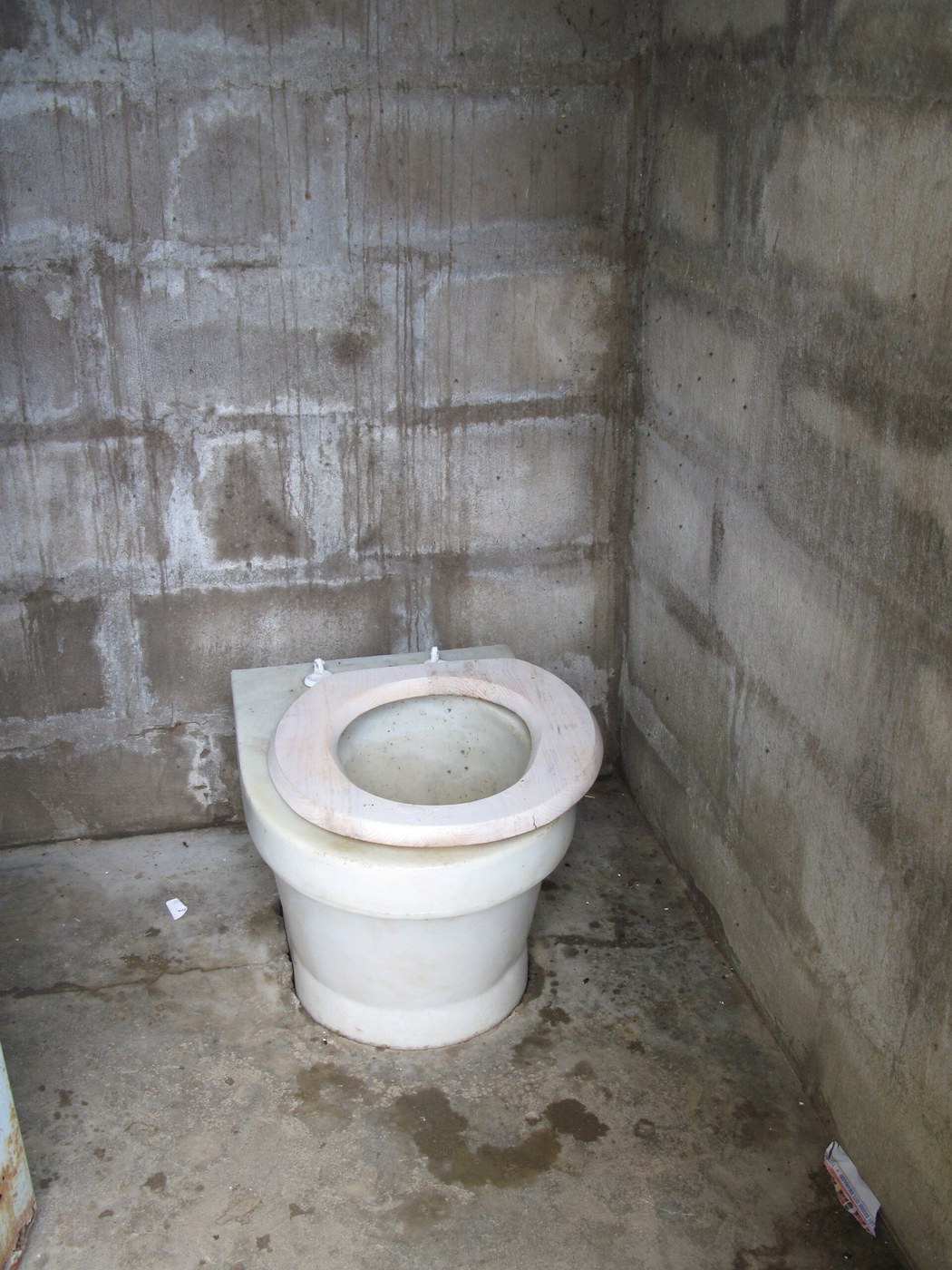


The Ventilated Pit Latrine
A simple pit latrine costs almost nothing and works. It also smells, and it breeds flies that walk on faeces and then on food — which is a disease route as direct as contaminated water.
You cannot solve either problem by sealing it, because people have to use it. The ventilated improved pit latrine solves both with a black pipe and a piece of gauze, and no moving parts.
The smell. Fit a vertical vent pipe from the pit to above the roof and paint it dark so the sun heats it. The air inside warms, rises, and draws a continuous updraught out of the pit. That has to be replaced, and the easiest path is down the squat hole. So air flows inward past the user and out through the vent — the odour never reaches the person, because the airflow is going the wrong way for it. The superstructure is kept deliberately dark inside so the vent is the brighter opening and the draught is not disturbed.
The flies. Flies find the pit by smell, but the smell now comes out of the vent, so they gather at the vent top — where a fly screen stops them. Any that get in through the squat hole and breed will, on emerging, fly toward the light. In a dark superstructure the brightest thing is the vent, so they fly up it and die against the screen from the inside.
The screen is the trap because insects navigate by light, and the building was arranged so the only light is where you want them to go.
التعليمات
Make a dark pipe pull air by itself
Make a dark pipe pull air by itself
Stand two identical tubes vertically in the sun, one painted matt black and one left light or shiny. Hold a smoking taper at the base of each and watch.
Expect a visible updraught in the black one and little in the other.
Measure the air temperature inside both. The difference is the whole engine: warm air is less dense, so it rises, and something must come in behind it.
Note that nothing was powered. The sun is the pump, and the only design decision was the colour.
المواد لهذه الخطوة:
 أنبوب فولاذي مجلفن2 m
الأدوات المطلوبة:
 ميزان حرارة
Prove the airflow direction is the odour control
Prove the airflow direction is the odour control
Build a box with two openings — a wide one at the front and a tall dark chimney at the back — and place a smoke source inside.
Hold a tissue at the front opening and observe which way it moves.
Expect air to flow inward at the front and out of the chimney.
Now put your nose at the front opening. The smoke is leaving elsewhere.
This is the entire odour solution: the smell is not removed or masked, it is routed. Air is made to travel from the user toward the waste, never the other way.
Use light to steer the flies
Use light to steer the flies
Make the same box light-tight except for one bright opening at the top, and release a few flies inside. Observe where they gather.
Expect them to go to the light.
Now brighten the front opening and repeat. They will divide, and some will leave past you.
That comparison is the reason a VIP latrine's superstructure is dark inside and often has no window. The darkness is not neglect or cost-saving — it is a functional requirement, and a latrine built with a cheerful window stops working as a fly trap.
Screen the vent and check the mesh
Screen the vent and check the mesh
Fit corrosion-resistant mesh over the vent top and inspect it against a light. Measure the aperture: it must stop flies while barely restricting airflow — around 1.2 to 1.5 mm is the usual compromise.
Test the draught with and without the screen and confirm the loss is small.
Then consider the material. This screen sits in sunlight, in corrosive humid air, for years, and it is the single component the whole fly control depends on. Steel rusts through and fails silently; the standard recommendation is stainless or plastic-coated glass fibre for exactly this reason.
المواد لهذه الخطوة:
 شبك سلكي مجلفن1 قطعة
Find how the design fails in practice
Find how the design fails in practice
Work through what happens to your test rig if: the vent is shaded by a tree; the vent is fitted on the shaded side of the building; a window is added for comfort; the screen corrodes; or the vent is made short to save pipe.
Test the shading and the short-vent cases directly and measure the draught.
Expect each to reduce or reverse the effect.
Every one of these is a common real-world failure, and none of them looks like a fault. The latrine still appears complete, and simply smells. A design whose failure is invisible needs its reasoning taught alongside it — which is what this blueprint is for.
History & Context
History & Context
Developed where it was needed, not exported to there. The ventilated improved pit design was worked out largely in southern Africa — the Blair Research Laboratory in Zimbabwe is closely associated with it — and refined through field trials rather than laboratories. That origin matters: it was designed around materials, budgets and building practice actually available, which is why it spread and why many better-funded imported designs did not.
It is an engineering solution to a biology problem, using physics. No chemicals, no water, no power, no consumables beyond an occasional screen. The disease route is broken by controlling where air goes and where light is. For a technology that has to work in a village with no supply chain, having nothing to run out of is worth more than any amount of performance.
Water is not always the better answer. A flush toilet needs a piped supply, a sewer or septic system, and enough water to spare — around 6 litres per flush, which is drinking water spent on transport. Where water is scarce or infrastructure absent, a well-built VIP latrine is not a poor substitute for a flush toilet; for that setting it is the correct technology. Assuming otherwise has wasted a great deal of aid money.
Where it leads. The same reasoning produced the twin-pit design, where one pit rests and composts while the other fills so the contents can be safely dug out and used, and the urine-diverting dry toilet, which separates the two streams because it is the mixture that smells and it is the liquid that makes the solids hard to handle. Each is the same instinct: understand the mechanism causing the problem, then arrange the geometry so it cannot happen.
Honest limits. A pit fills and must eventually be emptied or replaced, and emptying is dangerous, unpleasant work that is frequently left undone. It needs suitable ground — not rock, not a high water table — and a pit near a well contaminates it, so siting is a public health decision, not a convenience one. And the vent must catch sun and wind, which constrains where the building can face.
المواد
2- عنصر نائب
- 1 قطعةعنصر نائب
الأدوات المطلوبة
1- عنصر نائب
مواد المخططات المرتبطة

المخططات ذات الصلة
هذه المخططات تشارك المعرفة مع هذا — التقنيات والمواد والمبادئ
CC0 ملكية عامة
هذا المخطط مُصدر بموجب CC0. يحق لك نسخه وتعديله وتوزيعه واستخدامه لأي غرض، دون طلب إذن.
ادعم الصانع بشراء منتجات عبر مخططه حيث يكسب عمولة الصانع يحددها البائعون، أو أنشئ نسخة جديدة من هذا المخطط وضمّنه كرابط في مخططك لمشاركة الإيرادات.