ศิลปะ
ความงามและสุขภาพ
งานฝีมือ
วัฒนธรรมและประวัติศาสตร์
ความบันเทิง
สิ่งแวดล้อม
อาหารและเครื่องดื่ม
วิศวกรรมย้อนรอย
วิทยาศาสตร์
กีฬา
เทคโนโลยี
อุปกรณ์สวมใส่


Craft Knife: Doniger's Hinged Handle and Reversible Blade
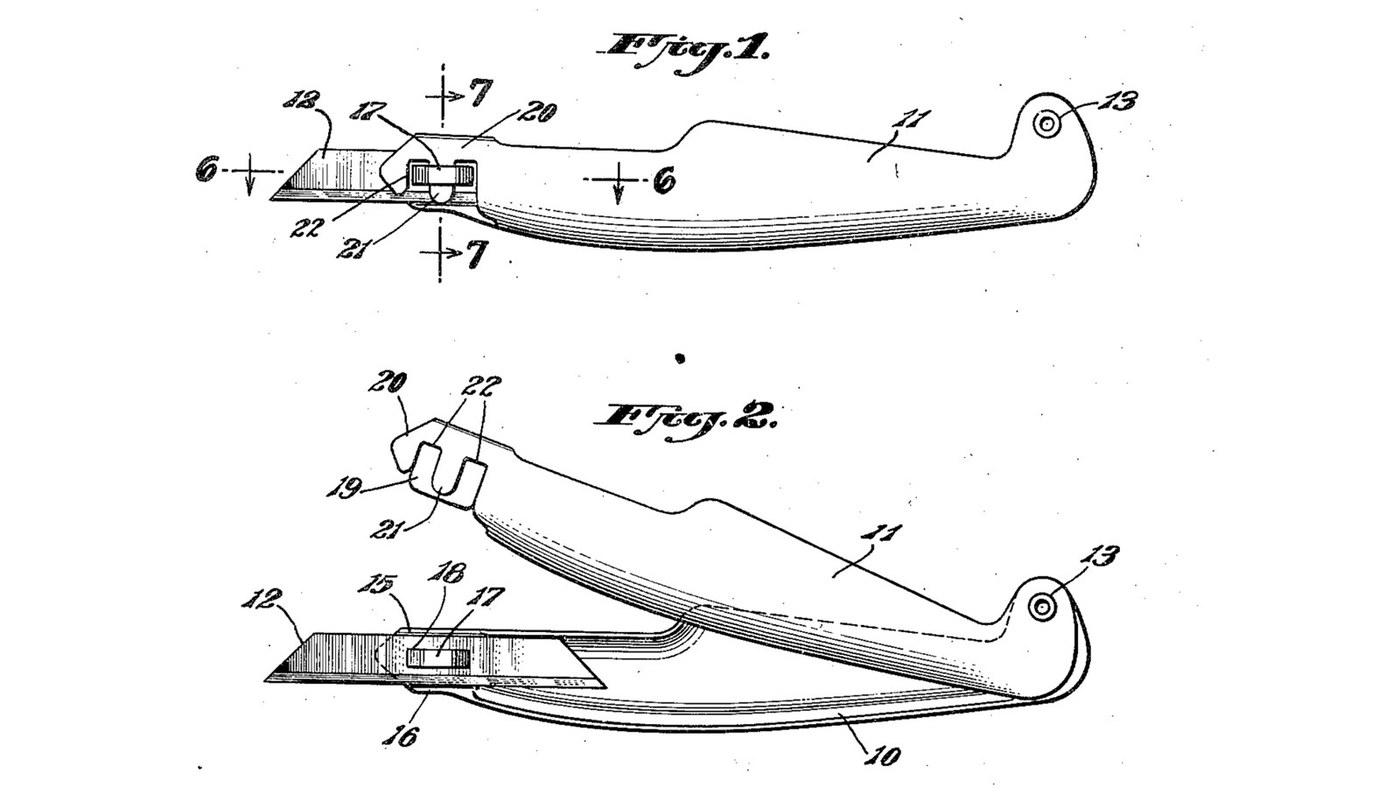
A knife for model carving and fine cutting, by Sundel Doniger of New York, founder of X-Acto (US 2,463,682, filed 1945, granted 1949). The handle is two shell-like metal halves pivoted at the rear. A thin blade with a slot in its middle drops over a small 'staple' pressed out of one half; closing the other half pushes a tongue into the staple and locks the blade solid. Swing it open to change the blade or turn it end for end: the spare end rests inside the handle.
The patent gives no sizes or metals. Mild steel sheet, the rivet, the spring steel blade and the sizes are ours. The picture: Figs. 1 and 2 of the patent.
ระดับกลาง
1 day
คำแนะนำ
1
1
Mark out the two handle halves
Mark out the two handle halves
Scribe two mirror-image halves, about 130 mm long, on mild steel sheet about 0.8 mm thick (ours). Give each a flat rear ear for the pivot and a nose at the blade end.
วัสดุสำหรับขั้นตอนนี้:
 แผ่นเหล็กกล้าละมุน1 ชิ้น
เครื่องมือที่ต้องใช้:
 เหล็กขีด
 ไม้บรรทัด
2
2
Cut and file the halves
Cut and file the halves
Cut both halves out with tin snips and file the edges smooth.
เครื่องมือที่ต้องใช้:
 กรรไกรตัดแผ่นโลหะ
 ตะไบโลหะ
 ปากกาจับชิ้นงานหน้าโต๊ะ
3
3
Dome the grip, keep the ends flat
Dome the grip, keep the ends flat
Hammer the middle of each half into a shallow bulge over a hollow in a hardwood block. Leave the pivot ends flat, so the pivot cannot wobble, and leave the noses flat.
เครื่องมือที่ต้องใช้:
 ค้อนหัวกลม
 ท่อนไม้เนื้อแข็ง
4
4
Form the blade wall and its shoulders
Form the blade wall and its shoulders
On the mounting half (10), the nose is a flat wall (14) in the plane where the halves meet. Turn its top and bottom edges inward into shoulders (15, 16) just as far apart as the blade is wide.
เครื่องมือที่ต้องใช้:
 คีมปากแบนค้อนหัวกลมปากกาจับชิ้นงานหน้าโต๊ะ
5
5
Press out the staple
Press out the staple
Slit the middle of the wall along two short parallel lines, lengthwise. Press the strip between the slits outward to form the staple (17).
เครื่องมือที่ต้องใช้:
 สกัดเย็น
 เหล็กตอกนำศูนย์ค้อนหัวกลม
 ทั่ง
6
6
Bend the locking channel
Bend the locking channel
Bend the nose of the locking half (11) into a springy channel: a broad rear flange (19) about the size of the wall, and a front flange (20) with a tongue (21) and a cut-out (22) each side of it to clear the staple's legs.
เครื่องมือที่ต้องใช้:
กรรไกรตัดแผ่นโลหะ ชุดตะไบเข็มคีมปากแบน
7
7
Drill the pivot
Drill the pivot
Clamp the halves together, punch the centre of the rear ear and drill through both.
เครื่องมือที่ต้องใช้:
เหล็กตอกนำศูนย์ สว่านมือปากกาจับชิ้นงานหน้าโต๊ะ
8
8
Rivet the pivot
Rivet the pivot
Rivet the flat ends together (Doniger used an eyelet; ours: a steel rivet). Close it firmly: the friction of the flat ends must hold the halves wherever you swing them.
วัสดุสำหรับขั้นตอนนี้:
 หมุดย้ำเหล็กกล้า1 ชิ้น
เครื่องมือที่ต้องใช้:
 ค้อนย้ำหมุดทั่ง
9
9
Anneal and cut the blade blank
Anneal and cut the blade blank
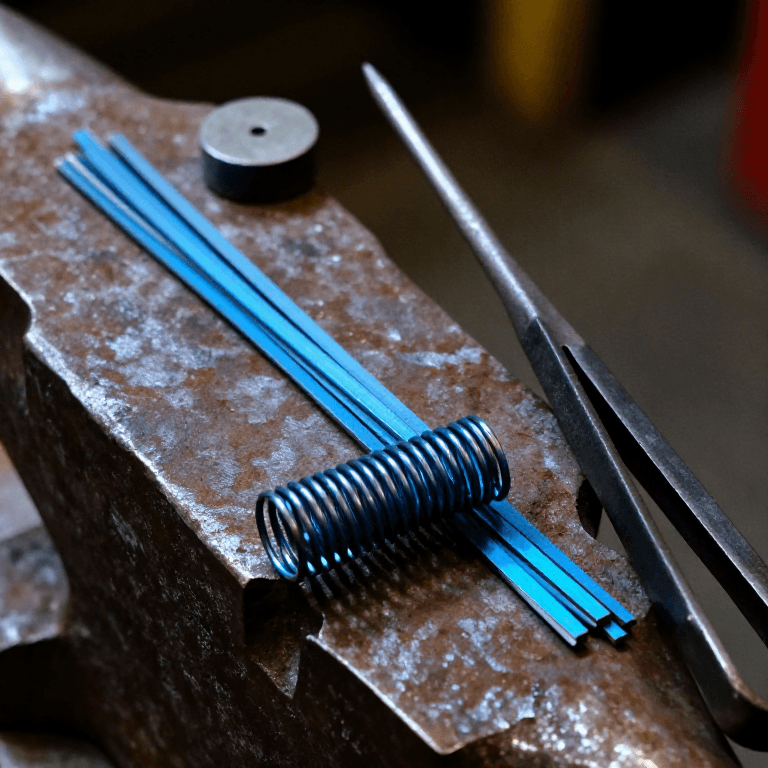
Soften a piece of spring steel strip about 0.4 mm thick (ours), as in the connected spring-steel blueprint. Cut a blank as wide as the gap between the shoulders.
วัสดุสำหรับขั้นตอนนี้:
 แถบเหล็กสปริง1 ชิ้น
เครื่องมือที่ต้องใช้:
 เตาตีเหล็ก
 คีมช่างตีเหล็ก
 ขี้เถ้าไม้เนื้อแข็งกรรไกรตัดแผ่นโลหะ
 ถุงมืองานเชื่อม
10
10
Cut the centre slot
Cut the centre slot
Cut a slot (18) in the exact middle of the blank that fits closely over the staple. Drill its ends and file out between them.
เครื่องมือที่ต้องใช้:
เหล็กตอกนำศูนย์สว่านมือชุดตะไบเข็มปากกาจับชิ้นงานหน้าโต๊ะ11
11
Shape both points
Shape both points
Cut each end of the blank to a slanting point, as in Fig. 1, and grind a cutting bevel at both ends.
เครื่องมือที่ต้องใช้:
กรรไกรตัดแผ่นโลหะ หินลับแบบหมุนตะไบโลหะ
12
12
Harden and temper the blade
Harden and temper the blade
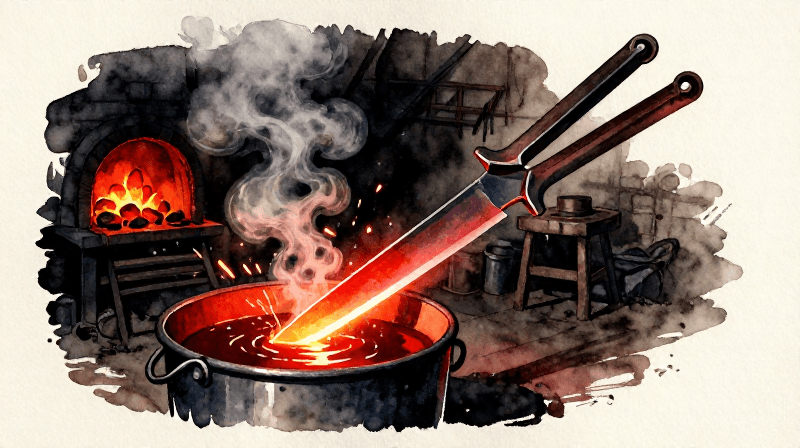
Harden the blade in oil as in the connected spring-steel blueprint. Temper it to the knife colour given in the connected heat-treatment blueprint, not to spring blue.
เครื่องมือที่ต้องใช้:
เตาตีเหล็กคีมช่างตีเหล็ก น้ำมันคาโนลาถุงมืองานเชื่อม
13
13
Hone both edges
Hone both edges
Hone both ends keen on the sharpening stone.
เครื่องมือที่ต้องใช้:
 หินลับมีด
14
14
Fit and lock the blade
Fit and lock the blade
Swing the halves open. Lay the blade flat on the wall, its slot over the staple and its edges between the shoulders. Swing the locking half shut: the tongue enters the staple and the channel grips the blade. No tools needed.
15
15
Reverse or change the blade
Reverse or change the blade
Swing the locking half up, lift the blade off the staple and turn it end for end, or fit a new one. The spare end sits protected inside the handle.
16
16
What the patent says, and what is ours
What the patent says, and what is ours
The patent fixes the parts and how they lock: hinged shell halves, flat riveted pivot ends that hold by friction, a wall with shoulders and a pressed-out staple, a slotted double-ended blade, a springy channel with tongue and cut-outs. It gives no sizes, no metals and no blade making. All sizes, the mild steel, the rivet and the spring steel blade are our choices. Doniger's better-known X-Acto knives hold the blade in a round collet instead.
วัสดุ
3- 1 ชิ้นตัวยึดตำแหน่ง
- 1 ชิ้นตัวยึดตำแหน่ง
- 1 ชิ้นตัวยึดตำแหน่ง
เครื่องมือที่จำเป็น
21- ตัวยึดตำแหน่ง
- ตัวยึดตำแหน่ง
- ตัวยึดตำแหน่ง
- ตัวยึดตำแหน่ง
- ตัวยึดตำแหน่ง
- ตัวยึดตำแหน่ง
- ตัวยึดตำแหน่ง
- ตัวยึดตำแหน่ง
- ตัวยึดตำแหน่ง
- ตัวยึดตำแหน่ง
- ตัวยึดตำแหน่ง
- ตัวยึดตำแหน่ง
- ตัวยึดตำแหน่ง
- ตัวยึดตำแหน่ง
- ตัวยึดตำแหน่ง
- ตัวยึดตำแหน่ง
- ตัวยึดตำแหน่ง
- ตัวยึดตำแหน่ง
- ตัวยึดตำแหน่ง
- ตัวยึดตำแหน่ง
- ตัวยึดตำแหน่ง
พิมพ์เขียวนี้สร้าง

บลูพริ้นท์ที่เกี่ยวข้อง
บลูพริ้นท์เหล่านี้แบ่งปันความรู้ — เทคนิค วัสดุ หรือหลักการ

CC0 สาธารณสมบัติ
พิมพ์เขียวนี้เผยแพร่ภายใต้ CC0 คุณสามารถคัดลอก แก้ไข แจกจ่าย และใช้งานผลงานนี้เพื่อวัตถุประสงค์ใดก็ได้ โดยไม่ต้องขออนุญาต
สนับสนุนเมกเกอร์โดยซื้อสินค้าผ่านพิมพ์เขียวของพวกเขา ซึ่งพวกเขาจะได้รับ ค่าคอมมิชชันเมกเกอร์ ที่ผู้ขายกำหนด หรือสร้างเวอร์ชันใหม่ของพิมพ์เขียวนี้และรวมเป็นการเชื่อมต่อในพิมพ์เขียวของคุณเพื่อแบ่งรายได้